Andrey Kudievskiy had already built a business before he decided to learn, formally, how to run one. By 2021, he described Distillery as an eight-figure professional services company. That same year he enrolled in UCLA Anderson’s Executive MBA program. Success had supplied a rather inconvenient piece of information: the job kept changing, and its occupant needed to change with it.
He had a compact description of the predicament: “an engineer by trade and a manager by accident.” Software engineer became senior engineer. Senior engineer became manager. Eventually there was a company, and the person who could once solve a problem by writing code had to solve problems through other people. Every promotion came with a new syllabus. None offered the comfort of a finished education.
This is the interesting tension in Kudievskiy’s career. He makes his living assembling technical talent for other businesses, yet his own development has depended on admitting where his technical talent stops being enough. Distillery sells the ability to bring the right people into a room. Its founder has had to practice the same thing on himself.
A prince, a programmer, a departure
The early attraction was technology itself. Growing up in the USSR, Kudievskiy became fascinated by computers through Prince of Persia. In the story he later told, a game helped open the door to a working life. A child’s interest in what a computer could do eventually became an adult’s interest in what people could build with one.
He started working in tech at 19 while studying computer science. His early professional experience included software engineering, database development and administration. Within five years of starting, he had helped create a cloud synchronization startup that was subsequently sold to a Fortune 500 company. The experience put him close to both the construction of software and the commercial life surrounding it.
After university, he saw a business opportunity in a geographical mismatch: technical talent in developing countries and customers with opportunities in the United States. Connecting the two became the premise of Distillery. The company traces its beginnings to 2008; Kudievskiy relocated the business to the US in 2012. Those dates describe different steps in the same enterprise, rather than a single immaculate founding moment.
He had studied in Taganrog and called it his hometown. Los Angeles brought a different set of working customs. Looking back in 2017, he described face-to-face meetings, office visits and coffee as meaningful advantages in winning clients. Remote delivery still benefited from someone turning up in person. Software could cross an ocean without much ceremony. Trust generally preferred an introduction.
- 2008The business begins
- 2012Relocates to the US
- 2016Advisory board formed
- 2023UCLA EMBA class
The company with a misleading name
Distillery makes software, a fact Kudievskiy has found useful to establish early in conversation. The name supplies a ready-made opening joke about the absence of alcohol. It is an economical introduction for someone who advises entrepreneurs against turning their first encounter into a prolonged sales presentation. Give people a reason to remember you, then leave room for them to speak.
The work behind that introduction was concrete. In 2016, the company announced launches for SoapBox, Circle and CIZO. Its services covered design and development rather than a single product of its own. Working for other founders meant entering their particular problems, making decisions with them and then accepting that the resulting app would carry somebody else’s ambition into the world.
The Netvest project illustrates that relationship. Kudievskiy described working with founder Mark Rochelli on an investment platform that let members examine investors’ actual portfolios and understand the reasoning behind their decisions. Distillery’s work on the app won a Gold Stevie in the fintech software category. Here, the founder’s achievement was bound up with helping another founder ship.
By 2017, Distillery had reached number 1,365 on the Inc. 5000. Its 2023 announcement marked a seventh consecutive appearance on the list. Rankings give this sort of business a public scoreboard. The less photogenic work happens between appearances: staffing a project, keeping a client, clarifying a requirement and making sure a growing organization can repeat what it has promised.
On the Inc. 5000, as announced in 2023.
Hire the missing pieces
Kudievskiy’s answer to the expanding job began with other people. Distillery formed an advisory board in 2016, bringing outside experience into decisions about finance, technology, venture capital and sales. In 2021 he credited advisers Eric Lee, Gadiel Morantes, Joel Milne and Randy Churchill, alongside mentor Safir Adeni. He wanted access to people who had already managed at a scale he was trying to reach.
By his 2024 conversation with Ethan Cole, the advice had become explicit: “Look at your weaknesses.” Choosing advisers, in his account, starts with understanding the capabilities a founder lacks. Sales, operations and finance cannot all depend on the same person being equally accomplished at everything. A board assembled this way has a practical purpose: supply judgment the founder cannot manufacture alone.
His networking stories also resist the usual fixation on collecting customers. One casual conversation in St. Petersburg led to the hire he described as his best: the first chief operating officer for the delivery team. A useful connection could alter the machinery inside the business before it added anything to the sales pipeline. The value of a conversation might only become apparent much later.
There was also the occasion on which he forgot a new acquaintance’s name, guessed Brian and discovered it was John. The conversation ended promptly. Even a founder who recommends authenticity can demonstrate the hazards of an improvised introduction. The lesson is refreshingly small beside the grand language of business networking: pay attention to the person in front of you.
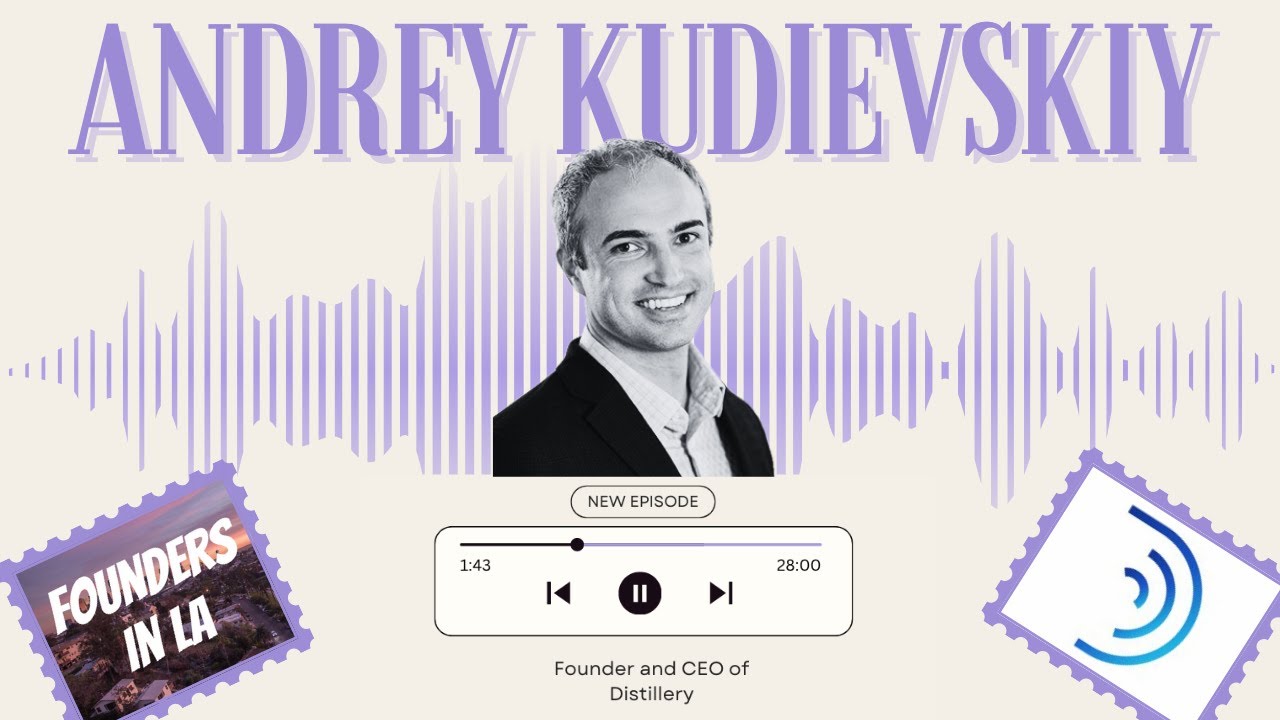
“Look at your weaknesses.”Andrey Kudievskiy · Founders In LA, 2024
Back to class, across borders
Formal study became another way to address the gaps. Kudievskiy pursued business education at Stanford and then the UCLA Anderson Executive MBA, joining the class of 2023. UCLA’s ambassador profile places him in Redondo Beach during the program, travelling for work at least twice a month while also being a parent. The classroom had to fit around an already operating life.
He described a long-term ambition there: building a publicly traded professional services company. It is a specific destination, and one that demands more than the founder’s ability to sell or recruit. Public-company ambitions imply an organization able to explain its performance, distribute responsibility and keep operating as individuals change. The ambition gives his continuing education a practical context.
Geography was changing the management problem too. Distillery expanded its delivery presence into Mexico and Argentina. By 2023, the company said it had shifted to operating solely as a nearshore software development business. For Kudievskiy, international expansion involved the work of bringing different cultures into one team experience. An office map could show the locations; it could not do the integrating.
His first impression of Córdoba offers a more human view of that map. He noticed the number of young people walking through the city center and wondered whether he had arrived in the middle of a college campus. He later understood it as a student city. For an executive looking for technical talent, a walk through town had supplied a memorable introduction to the place.
Another syllabus arrives: artificial intelligence
In July 2024, Distillery announced an AI training program that extended beyond its engineers. Recruitment, marketing, finance, sales and operations were included in foundational training, while technical staff had additional learning appropriate to their roles. The stated target was full AI literacy across the US and Latin American workforce by the end of that year. That was the goal announced, rather than a completion figure.
The design of the program fits Kudievskiy’s recurring concern with learning the next job. A salesperson needs enough understanding to discuss a project sensibly. A developer needs more detailed capabilities. The company was attempting to make a new technology part of ordinary work across departments, rather than confining it to a specialist corner of the organization.
A Databricks consulting partnership followed in September 2024. In an April 2025 podcast conversation, Kudievskiy discussed the effect of AI on engineering work and reported productivity gains at Distillery. His argument centered on how tasks change and how engineers develop useful skills. He also emphasized communication across languages as a practical advantage when serving multinational clients.
Then software entered a setting where decisions receive unusually immediate reviews: a baseball dugout. For the Oakland Ballers’ September 6, 2025 game, Distillery built an AI decision system that used live data, player statistics and historical performance to inform game strategy. The application ran across web and tablet devices. It brought the company’s engineering work into a public experiment with an audience watching each decision.
In August 2026, Distillery announced that it had become an OpenAI Select Partner. The sequence shows where Kudievskiy has been directing the company: training people, developing partnerships and putting new capabilities into client projects. Each announcement adds a new obligation to the old professional services bargain. Someone else has a problem; the team must be able to help solve it.
A program structure, not a chart of completed training.
Leave room for the next person
Kudievskiy also appears on UNest’s board and has served as a mentor in the Preccelerator program. Those roles extend the same pattern beyond Distillery: working around other entrepreneurs, offering experience and participating in businesses whose daily choices belong to a wider group. Having needed advisers himself, he also occupies the other side of the conversation.
Away from the organizational chart, there is room for California. When imagining a day with a visiting friend, he put surfing first and Griffith Observatory on the itinerary. His Code Story introduction describes a long-distance runner who had completed five official marathons. These details belong to a life outside the title, something easily squeezed out by an enterprise that always has another stage to reach.
The business ambition remains considerable. The method is more ordinary and more revealing: study, find experienced people, listen and let responsibilities move. Kudievskiy began with an interest in what computers could do. The continuing question of his career is what a company can do when its founder learns to give other people the work.