A bus is a useful antidote to grand thinking. It has a route, a timetable, and passengers who would quite like to know where it is. Before Carlos Vela Canul was discussing artificial intelligence or the expansion of a software business across borders, he and his future partners worked on an app that tracked their university’s buses. The problem was small enough to describe in a sentence. Solving it opened a much larger question: who else needed something like this?
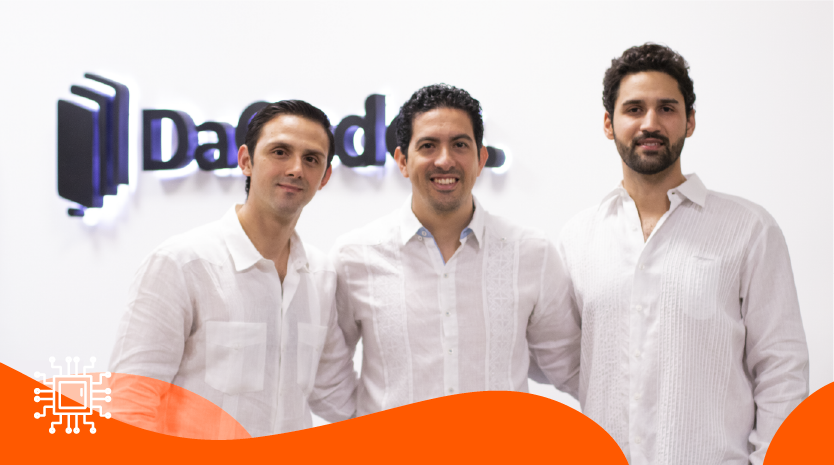
The project was Mayabús, the transport service at Universidad Anáhuac Mayab in Mérida. Vela had studied mechatronics. His fellow founders, Jorge Campos Berny and Mauricio Moreno Jure-Cejin, came from industrial engineering. They were friends before they were business partners. In August 2014, they founded DaCodes. Their route from university to entrepreneurship began with a piece of everyday infrastructure, rather than a prediction about the next fashionable market.
That origin gives Vela’s subsequent career an appealing scale. A passenger looking for a bus and a company trying to make sense of AI have something in common: both need technology to make an uncertain situation easier to navigate. The distance between those assignments is considerable. The practical test is still whether the thing helps somebody.
The first customer cannot read your intentions
There was an awkward detail in the founders’ early enthusiasm. Engineering qualifications did not mean they already knew everything necessary to run a software company. Vela recalled having the motivation to learn and approaching people who knew more. Learning subjects outside their own areas was difficult. It is a more useful origin story than effortless brilliance: the founders had to become capable of delivering what they wanted to sell.
A good intention also makes a rather poor reference. Campos Berny described the difficulty of finding early clients when nobody knew the company and nobody could recommend its work. Employment arrangements and the legal details of paying staff brought another education. The customer sees an application. The founder also sees the obligations accumulating behind it.
DaCodes developed with support from tecniA, the university’s technology and innovation park. Branding, consulting, office access, and student interns were among the forms of help. That puts institutions and other people back into the picture. A company may begin with three names on its founding story; getting it into working order can require a considerably longer guest list.
A restaurant guide, then a bigger room
By 2017, the company was working on problems beyond campus transport. In Mérida, DaCodes and tecniA presented Degusta Yucatán, a restaurant guide built around local discovery. The product included restaurant photographs, user profiles, and comments. A restaurant app and a bus tracker belong to different corners of daily life, but each has a wonderfully unforgiving audience. People want the information while they are trying to go somewhere.
The launch also shows the business taking shape around clients with their own ideas. DaCodes supplied software expertise to help another venture reach its users. It was a services relationship, with all the translation that entails: an entrepreneur describes an experience, and a technical team must decide how it will actually work on a phone.
Vela was soon discussing entrepreneurship outside the office too. In May 2017, he appeared on Ingeniería XXI, a radio programme associated with Yucatán’s civil engineers and Radio UADY, to talk about businesses and new companies. In March 2018, he joined a university panel on entrepreneurship and business models alongside founders from other industries. The developer was also becoming someone who could explain the work.
That distinction matters in his story. Software services require the ability to listen to people whose expertise lies elsewhere, then give them a clear account of what can be built. A conversation about a business model belongs in that job just as naturally as a conversation about a programming language.
The founder returns to the classroom
One revealing detail about Vela is how often education reappears after the founding date. In December 2024, on Discovering Tech Stories, he described DaCodes as the business he had worked in since leaving university. He also described himself as the technical member of the three-founder group, the one who had immersed himself in programming and kept learning new languages and trends.
In the same conversation, he laid out his three Ps: patience, passion, and perseverance. These are familiar words in entrepreneurial advice. They become more concrete beside a decade spent in the same business. Patience concerns the time required for results; perseverance concerns returning to the work; passion concerns his continuing interest in software. None removes the need to learn the next thing.
“You can’t stop learning.”
Carlos Vela Canul, reflecting on his 2025 business-scaling programme
In 2025, Vela joined Cohort 19 of the Latino Business Action Network’s Business Scaling Program at Stanford Graduate School of Business. The nine-week programme brought together business owners who were already operating companies. His account of the opening weekend described meeting 120 Latino entrepreneurs working across technology, e-commerce, AI, and industrial businesses.
By June, he had completed it. He thanked professors, fellow participants, and mentor Ben Weeda, and wrote about improving how he executed his plans for DaCodes. The distinction between founding and scaling had become a subject of study. Having an operating business supplied the questions; returning to a classroom supplied other people who could challenge the answers.
The scene has a pleasing reversal. Years earlier, university friends had needed help becoming business owners. Now an experienced founder was deliberately becoming a student again. A successful examination has a limited shelf life in software. Curiosity, provided it is exercised regularly, is rather more portable.
The next hire has to explain the work
In April 2025, Vela described a company with roughly 250 people, including about 200 developers. He set out a goal of reaching 500 developers over approximately five years. The target was an ambition, with recruitment and new capabilities among the work required to pursue it. A round number can be written down in seconds. Making room for the people represented by it is a longer assignment.
His description of hiring went beyond technical fluency. Senior people needed communication and leadership skills, including the ability to explain ideas to a client. That emphasis suits a founder whose own work has crossed between engineering and business. The person who understands a system has to help other people understand the decisions surrounding it.
There is a practical reason to take that seriously. A client does not experience a development team as a collection of isolated programming talents. The relationship includes questions, disagreements, explanations, and decisions about priorities. Vela’s hiring priorities put those exchanges inside the definition of good engineering work.
At TechNights during Mexico Tech Week 2024, he joined a discussion of scaling SaaS in Latin America. The programme placed him alongside Pulpo’s Evaristo Babé, Chiper’s Carolina García, and Nazca’s Erin Winslow. In a related conversation, he encouraged people to seek mentors and build relationships with those who had already reached a goal they were pursuing. It was a social answer to a business question.
AI still needs someone responsible
Vela’s approach to AI combines enthusiasm with a fairly ordinary management obligation: make sure the team knows how to use it. He described training developers and project managers, holding regular discussions of new tools, and treating learning as a company investment even when a client was not directly paying for it. The ambition involved improving the capabilities of people already inside DaCodes.
He also raised a question that survives every product demonstration: who takes responsibility when software reaches production and fails? His discussion kept experienced engineers, architecture, and oversight in the picture. Automation can change how work is performed. The customer still needs someone able to stand behind the result.
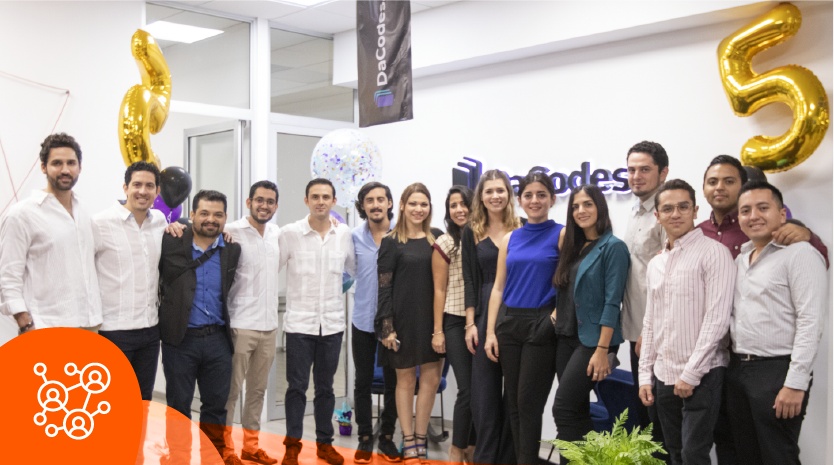
By May 2026, Vela was describing a team of more than 300 people across Latin America, serving clients in Mexico, the United States, and other countries. In a conversation with Rodrigo López for Sin Manual, he returned to the beginnings in a café, the experience of building with two friends, and becoming a father while growing the business. His public account retained the people around the company as well as the technology inside it.
In July 2026, he announced that DaCodes had reached AWS Advanced Tier Services Partner status, citing more than 30 AWS certifications across the practice and Amazon RDS Service Delivery validation. He connected the milestone to helping clients put AI into production. Certifications are a visible marker; the less photogenic part is the repeated study behind them.
The bus-tracking project remains a useful place to finish. It asked for something specific: show people where their transport is. More than a decade later, Vela’s assignments involve larger teams, new tools, and clients across borders. The questions have multiplied. His recurring response has been to learn, find people who know more, and bring that knowledge into the work. A timetable, at least, would make the next part easier.