The first problem was finding a bus. At Anáhuac Mayab, in Mérida, the university transport service offered an appealing student project: an app that could tell passengers where their ride was. For three engineering students who would become DaCodes’ founders, the distance between a useful idea and a functioning business turned out to be considerably longer than a bus route.
- DaCodes builds software and supplies Latin American engineers to client teams.
- Its work ranges from property portals to insurance analytics and testing.
- The buying decision: a defined project, a dedicated team, or extra specialists.
First, find the bus
Carlos Vela, Jorge Campos and Mauricio Moreno met at university. The bus project gave them something specific to make: routes, schedules and location information on a phone. A 2017 account in Milenio reported that their first idea had little success. They noticed a different demand nearby. Startups wanted applications but needed someone to build them.
The founders learned through courses and videos, then began taking on that work. “Todo lo hicimos por nuestra propia cuenta,” Vela said: they had done it themselves. By the time of that report, DaCodes had fifteen people. The interesting change was the customer. Instead of persuading students to use an application, they could help businesses turn their own ideas into one.
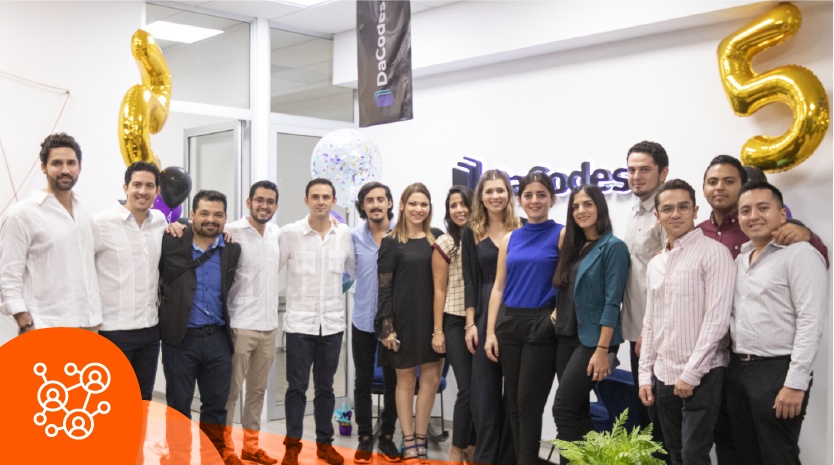
The university’s tecniA technology park helped with branding, advice, office space and access to interns. In January 2020, Anáhuac Mayab described a fifty-person company with more than 200 clients. It also recorded the less photogenic parts of getting started: learning employment rules, finding customers without recommendations, and acquiring skills outside the founders’ original disciplines.
The customer changed the brief
Then the brief changed again. In an April 2025 interview, Vela said pandemic-era customers wanted developers they could not hire themselves. DaCodes began selling staffing alongside project delivery. He estimated staffing represented roughly 75% of income at that point. An agency could now become part of someone else’s engineering department.
Share of income Vela attributed to staffing in April 2025. A dated founder estimate.
That explains where DaCodes fits. It occupies the space between hiring employees directly and commissioning a supplier to deliver a finished application. A client can keep control of its roadmap while adding specialists. Or it can ask DaCodes to handle the work from product definition through engineering.
Nearshore delivery makes its strongest practical case when working hours overlap and questions get answered during the same day. But proximity only helps if people communicate. Vela identified English proficiency as a challenge in serving U.S. clients and described a stronger recruitment focus on communication and leadership. For a buyer, that makes the interview almost as important as the résumé.
Ordinary parts, specific problems
Consider Dvelopers.mx. The real estate business needed a portal that could present developments in Yucatán and let visitors filter their searches. DaCodes describes using a headless content management system, a React interface and AWS infrastructure, including S3, RDS and EC2. Terraform supported the infrastructure work.
This is a useful example precisely because the ingredients are familiar. The work was combining content, search and hosting around a particular business. Reusing established components can leave more effort for the parts customers actually touch. Custom development does not require a new invention behind every button.
content
CMS
interface
AWS infrastructure underneath · Terraform for infrastructure management
Healthcare.com needed a different kind of help. The insurance marketplace’s published engagement brought in business analysts and quality assurance specialists. DaCodes describes analytics work using Excel and Sigma Computing, with testing processes involving TestRail and automation using Python and Selenium. The engagement is listed as talent augmentation and lasted a year.
The two projects clarify what a long services menu can obscure. One customer needs a product assembled. Another already has a product and needs particular disciplines strengthened. Developers, designers, analysts and testers solve different constraints. Asking for “more tech talent” skips the useful part of the diagnosis.
Buy the right kind of help
DaCodes advertises fixed-scope work, dedicated teams and talent augmentation. For fixed-scope engagements, its homepage makes discovery a prerequisite. That is a sensible point to pause: agreeing on the problem, workflows and acceptance criteria gives a price and deadline something solid to attach to.
For an indicative budget, its Clutch profile lists $25-$49 an hour and a project minimum of $50,000. Those are directory figures, rather than a proposal for a particular job. Historical reviews cover different budgets. A buyer still needs to establish which roles, management, testing and infrastructure costs are included.
Before buying more engineering, decide which decisions you want to keep.The buyer’s question
A dedicated team suits sustained development. Augmentation suits an existing team with a specific gap. Fixed scope suits work whose boundaries can be defined. If priorities change weekly, a rigid specification will need renegotiation. If nobody owns priorities internally, adding engineers leaves that vacancy untouched. The engagement model is part of the design.
The next brief is already changing
DaCodes now promotes AI and data work alongside software engineering, cloud operations and product design. Its site also markets branded business applications, including CRM, inventory and ERP offerings. These move the conversation toward recurring operational workflows: following up sales opportunities, tracking stock, or connecting finance processes.
For a prospective customer, these offerings suggest a practical shortlist. Define the workflow that needs attention, identify the systems it must connect to, and decide who will review its output. A sales follow-up tool and an insurance analytics pipeline carry different consequences when they make mistakes. The useful demonstration follows your own task from input to result, with the handoffs visible. That gives engineering skill something concrete to prove.
The company has also announced ISO/IEC 27001:2022 certification, naming Insight Assurance as its certification body. It describes months of preparation, process reviews and audits. Buyers handling sensitive information can make that concrete by asking how the certified scope relates to their proposed engagement and who will have access to their systems.
The lesson to copy is modest and useful. Start with a problem someone recognizes. Watch what customers request after the first delivery. Change the offer when their constraint changes. DaCodes’ story begins with passengers looking for a bus. Its commercial thread is the repeated discovery that another customer needs help getting somewhere.