Before Mauricio Moreno Jure-Cejin was helping businesses make sense of artificial intelligence, there was a bus to find. The Mayabús, Universidad Anáhuac Mayab’s transport service in Mérida, needed an app that could tell students about its routes, whereabouts and schedules. A university project took up the problem. From that modest assignment came the beginning of DaCodes, the software company Moreno would establish with Carlos Vela Canul and Jorge Campos Berny in 2014.
A bus app is a pleasantly specific place to begin a technology career. Nobody has to explain the addressable market to a student waiting for a ride. The problem is already standing at the curb. The founders’ first idea did not enjoy much success, but the experience pointed them toward other people with ideas, deadlines and a need for software. Their route would turn out to have considerably more stops than the original brief suggested.
A useful place to begin
The three friends met at Anáhuac Mayab, sharing part of their engineering education. Moreno studied industrial engineering; Vela’s background was mechatronics. This was a company taking shape around a practical assignment, with the founders learning unfamiliar parts of software development as they went. Courses and videos helped fill the gaps. The business emerged from that willingness to learn, then from the discovery that startups needed mobile applications to put their own plans into motion.
The distinction matters to Moreno’s story. His professional life has involved much more than programming a particular product. It has included administration, relationships, organizational culture and teaching. The university project offered an early version of the same puzzle: a useful technology still needs people who understand the problem, organize the work and help somebody use the result. Engineering gave him a starting vocabulary. Building the company kept adding new subjects.
First, find somebody who will pay
By July 2017, DaCodes had a team of 15 and ambitions to work in the United States and Europe. Getting to that point had required the first customer and the first payment. The founders had begun with little money, teaching themselves while looking for a market. It is a less ornamental account of entrepreneurship than the usual tale of a brilliant idea arriving fully dressed. Here, the wardrobe was assembled during the journey.
One early product was particularly easy to explain over lunch. On May 5, 2017, DaCodes and the university’s tecniA technology park presented Degusta Yucatán, a restaurant guide intended to give local restaurants more interaction with customers. Moreno appeared as a partner and administrative director. He described a business developing software for iPhones and Android devices, responding to the way applications had become part of everyday life.
The restaurant guide placed the company’s work in a recognizable setting: a city, its restaurants and the people deciding where to eat. DaCodes’ broader work also included automating processes and improving customer experiences. These were assignments in which the interesting question was what the software let a business do. The app icon was only the visible end of a much longer conversation.
The meeting behind the milestone
Growth brought another kind of engineering problem. In 2019, industrial-engineering students Pol Sotos Cano and Nazario Medina Gámez examined processes at DaCodes for Business. Their project described a business that had gone from three employees to 29 in four and a half years. It looked at how work moved through the organization, drawing on interviews with employees as well as the founders’ perspective.
Moreno and project manager Eric Segovia took part in a brainstorming session lasting about two hours. Among the proposals examined was a clearer arrangement for assigning project tasks, with the founders stepping away from distributing work directly. The detail is revealing precisely because it is ordinary. Somebody has to decide who does what. Add enough people, and the informal answer becomes an increasingly crowded conversation.
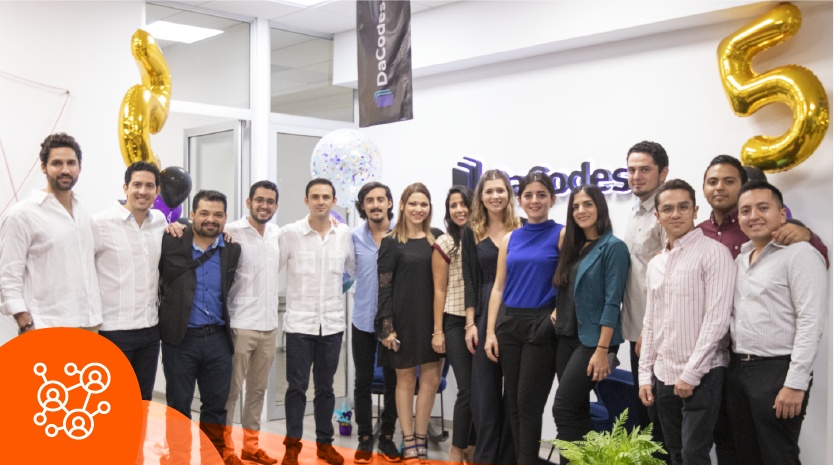
Later that year came the more photogenic milestone. On November 22, DaCodes celebrated its fifth anniversary and opened new offices at tecniA, with family, friends and guests attending. By its fifth birthday, the company had served more than 200 clients, including Discovery Channel, Decathlon and Bepensa. Moreno and his partners thanked the people who had helped them through those first years. The ribbon-cutting had an organizational story behind it.
- 2014DaCodes begins
- 2017A restaurant guide
- 2019The fifth birthday
- 2026AI skills & standards
Planting leadership
Moreno has a phrase for what needs to happen as an organization grows: “sembrar el liderazgo”, or plant leadership. Speaking about the company’s development in 2020, he argued that a founder who tries to remain the only leader will eventually run out of capacity. Colleagues should be able to encourage one another and become mentors, with leadership developing in different parts of the business.
“por eso es importante sembrar el liderazgo”
Mauricio Moreno, 2020
“That is why it is important to plant leadership.”
His current role gives that view a practical setting. DaCodes lists Moreno as a co-founder and Co-CEO, with responsibilities spanning innovation, people and culture, marketing and brand. Vela and Campos also hold the Co-CEO title, with different areas of responsibility. The company’s leadership is visibly plural. There are three names at the top of the founding story, and the job descriptions carry that arrangement into the present.
For Moreno, culture has also become a public subject. At an Anáhuac Mayab employment panel in March 2025, he discussed retaining talent through a strong organizational culture and offering professionals more than an attractive salary. The remark belongs alongside his earlier argument about mentorship. In both cases, attention turns to the experience of working inside the business, beyond the moment someone signs an offer.
A company with more than one address
By 2023, DaCodes’ team extended across Latin America. A profile that May described more than 200 collaborators in 115 cities. Moreno spoke about growing up alongside the internet in the 1990s and treating Yucatán’s geography as a starting condition rather than a barrier. He called himself a creative engineer, connecting his personal outlook to an ambition for the region.
He wanted more opportunities for graduates of technology and software programs in Yucatán’s municipalities. He also saw the arrival of remote workers and people from elsewhere as a way to bring different ideas into Mérida. His view of a technology center included the people already there and those choosing to arrive. The map could get larger while the regional connection remained intact.
The footprint described for DaCodes’ collaborators in May 2023. A dated snapshot of a distributed team.
Working across borders was already part of the business. In 2023, DaCodes served clients primarily in Mexico and the United States, including through staff augmentation: finding and managing technical teams that complement a client’s own workforce. The early ambition to reach customers abroad had become a question of organizing people, projects and relationships across locations.
When the customer says wait
That same year, Moreno described a complication in the arrival of generative AI. Business leaders were pausing to see what the technology would do, slowing activity while they reconsidered their decisions. For a software company, that uncertainty matters. A client needs to decide which problem to solve before a team can begin building the answer.
The observation gives his later AI work an interesting context. He had seen enthusiasm for a new tool coexist with hesitation about buying technology services. The useful next step would involve understanding applications well enough to make decisions. A demonstration can make people curious. Turning that curiosity into a project requires a more precise conversation about the task, the information available and the result somebody expects.
In the 2025 university panel, Moreno said generative AI would change work from universities to companies. His comments placed the technology beside questions about organizational culture and talent. The people doing the work were still central to the discussion, even as the tools available to them were changing.
Back to the classroom
Explaining technology has its own place in Moreno’s career. He hosts DaCodes’ Hola Mundo podcast, whose first episode in April 2021 featured him and Vela discussing the beginning. In November 2022, he appeared on Fernando Trueba’s True Growth to discuss product development and the company’s history. The conversation was later shared through Hola Mundo, bringing the story back into the company’s own audio catalogue.
His university also lists him as a teacher of The E-Business Class for MBA students. His own education includes an MBA and further training in digital transformation through MIT Professional Education, entrepreneurship at Babson College and cluster management. The industrial engineer has kept returning to the business of learning, both as a participant and as someone explaining the material.
At the Centro de Inteligencia Artificial de Yucatán, or CIAY, he is listed as director and an instructor for an introductory AI-at-work course. Its agenda runs through writing instructions, working with documents, trying assistants and checking results. The exercises put the technology next to ordinary work. A spreadsheet, apparently, is quite capable of securing a place in the future.
The next route runs through Yucatán
CIAY connects businesses, government, academia and startups around training, research, applications and events. Moreno’s stated ambition is to prepare more people in Yucatán for specialized technology work. His case for Mérida includes its ability to attract talent and offer a place people want to live. The regional ambition depends on skills people can actually acquire.
In June 2026, he was also listed among members of a new committee concerned with competencies in AI and the transformation of intellectual capital. Its work includes developing a competency standard at the intersection of organizational management and technology. That adds a different assignment to the founder’s working life: helping define how people demonstrate what they know.
The bus project remains a useful point of return. It began with a local need that students could understand immediately. Moreno’s current work reaches a wider group, but the question still fits on the same route map: how does a new capability become something people can use? Between an app for getting to university and a classroom for learning AI lies a company, two co-founders, many colleagues and years of practical work.
Follow the route
More from Mauricio and the organizations around his work.
- DaCodes Company and leadership
- CIAY AI training and regional projects
- Mauricio on LinkedIn Professional profile
- Mauricio on Instagram @mau_mjc
- The True Growth conversation Listen to the product-development interview
- Hola Mundo The DaCodes podcast
- The university years The founders on getting started
- The Yucatán AI ambition A 2026 interview