Joe Ross kept calling. The teenager on the other end was not especially interested. Geoffery Bacon was a football recruit with letters arriving from West Point, a place he barely understood. Some of the letters went in the trash. Ross tried texts, calls and emails, then visited Bacon’s high school in Milwaukee. A military academy was a difficult proposition to explain to someone who had never pictured himself attending one.
What Bacon remembered years later was the absence of a sales pitch. Ross told him there would be miserable days alongside the good ones. “Some days are going to suck. You’re going to have good times, bad times. But you can get through it,” Bacon recalled him saying. The assurance came with work attached. When admission looked uncertain, Ross and fellow mentor Adisa King kept pushing. Bacon graduated from West Point in 2015.
There is a recognizable business philosophy in that recruiting story: tell people the truth about the difficulty, then stay around to help. Ross now leads HigherEchelon, the Huntsville company he co-founded in 2009. Its work spans leadership development, engineering and technology. The titles on his biography are CEO and president. The older title, coach, still explains quite a lot.
A captain’s education in losing
In 1994, Ross shared the Army football captaincy with Pat Work. The team finished 4-7. Leadership, in that setting, meant showing up to the next practice with a losing record and persuading other people that the next assignment deserved their attention. There were no stock options to sweeten the argument.
Yet the season ended with a result Army supporters could take home: a 22-20 victory over Navy in Philadelphia. A season’s arithmetic and its emotional verdict can be quite different things. Ross’s final year as a player contained both the weekly work of a difficult campaign and the satisfaction of beating the opponent everyone remembered.
He graduated in 1995, a three-year letter winner. His connection with football would survive the move into the infantry, graduate education and business. He returned to the Army coaching staff in 2009 to work with fullbacks and special teams, joining Rich Ellerson’s staff. The team’s 2010 Armed Forces Bowl victory came during that coaching chapter.
The work had a useful specificity. Fullbacks have assignments. Special teams have assignments. A play can fail because somebody misunderstood a detail that looked perfectly clear on the board. Ross’s later interest in training, rehearsal and communication has an obvious home on a football sideline, where an elegant explanation gets only a few seconds to prove itself.
From giving orders to studying performance
Ross’s Army service took him to Kosovo in 2001, leading 144 soldiers from the 101st Airborne Division. The assignment put him in charge of people doing consequential work far from a stadium. In the years that followed, his career turned toward the question of how people prepare to perform.
Between 2003 and 2008, he directed the Military Enhancement Program. He worked with Pentagon leadership on the Army’s Warrior Ethos and helped write the Soldier’s Creed. That combination is revealing: one part training framework, one part language people could carry with them. Institutions need both instructions and a shared account of what those instructions are for.
His formal education followed the same territory. A master’s at Springfield College brought athletic counseling into the picture. A doctorate at Walden University added organizational psychology. The progression connected the individual athlete’s experience with the much larger problem of a team or institution trying to work together.
Those credentials also meant returning to the position of a student. A former captain and infantry officer could spend years teaching others and still have more to learn about leadership. That is a useful detail in a career now devoted partly to people with very senior titles. Experience provides material to examine; the examination still has to happen.
The startup that waited for payday
HigherEchelon began in 2009. Its early financial rule was refreshingly uncinematic. Ross and his founding colleagues started with a $1,000 investment and agreed they would join the business full time when it could support competitive salaries. Reaching that point took three or four years.
The temptation is to edit those years out. A founder’s biography usually moves briskly from idea to achievement, skipping the awkward interval when the idea must coexist with the rest of life. Ross’s version keeps the interval. The business had to earn the right to become the founders’ full-time work.
The company’s first full-time employee arrived in 2012. By 2019, the workforce exceeded 140, including more than 70 veterans. In September 2020, HigherEchelon received the Northern Virginia Chamber of Commerce’s Distinguished Service Award in its established veteran-owned business category. The milestone came eleven years after the founding, ample time for patience to become less glamorous and more useful.
There is a pleasing consistency between the financial decision and the work Ross sells. Preparation matters. Constraints deserve attention. A team needs enough room to improve. Leaving a job can make a stirring announcement; making payroll offers a more recurring test. HigherEchelon’s early history gives that test its proper place in the story.
- 2009HigherEchelon founded
- 2012First full-time employee
- 2019140+ employees; 70+ veterans
- 2020Distinguished Service Award
A coach needs a different kind of teammate
Co-founder Paul Maggiano brought experience that complemented Ross’s. Before joining HigherEchelon full time, Maggiano led customer relationship management programs at the Carlyle Group and Oldcastle. His background included Salesforce implementation, business operations and procurement. He had also served as an Army Blackhawk pilot.
The partnership helps explain why HigherEchelon’s work extends beyond leadership workshops. A team can understand its purpose and still struggle with the tools and processes required to do the job. Maggiano’s corporate experience put those problems within reach of the same business.
Ross’s own work with Army Game Studio offers a particularly concrete meeting of coaching and software. Beginning in 2012, he served as lead consultant on GoArmy Edge, a free application that lets football players rehearse assignments, learn playbooks and practice reads in a virtual environment. The old problem of explaining a play acquired another way to solve it.
A player could work through an assignment before taking the field. The connection to Ross’s coaching career is direct, and it gives substance to the company’s broad interest in people, processes and technology. Here was a coach helping develop a tool for the part of football that happens before anyone moves. Even a fullback sometimes benefits from sitting still.
The instructor still takes lessons
In June 2009, Ross attended a three-hour coaching clinic with former NFL special teams coordinator Gary Zauner. Ellerson had responded to an invitation for clinics tailored to coaches’ needs. It is a small incident, easily lost among the larger appointments, and perhaps more illuminating for being small: an Army assistant coach showing up to learn how to coach his specialists.
The same appetite appears on his reading lists. Ross has recommended Jim Collins’s Good to Great and Collins and Jerry Porras’s Built to Last, alongside books about golf, tennis, hockey and baseball. Business and sport occupy neighboring shelves. His later recommendations include The Outward Mindset, The Agile Leader and Remote Leadership.
That is a rather busy bedside table. It also suggests the breadth of the problem he keeps returning to: helping someone perform well involves attention, judgment, practice and the other people in the room. No single sport, or management discipline, gets exclusive rights to those questions.
At HigherEchelon, Ross developed the Resilient and Adaptable Leader methodology. The program combines leadership instruction with assessment, coaching and repeated practice. Its design asks people to work on behavior over time. A course may introduce an idea; the calendar supplies many opportunities to discover whether the idea has become a habit.
Another first day, even for generals
Ross is also the lead instructor for executive transition courses serving flag and general officers. It is an unusual classroom: people who have spent careers carrying responsibility preparing to become newcomers in another professional setting. Seniority does not cancel the need to learn a new environment.
His public posts with colleague Burt Thompson frequently celebrate those classes and their spouses. The recurring hashtag is #BESTCLASSEVER. Ross appears willing to award that distinction repeatedly. A coach can be forgiven a certain generosity toward the latest team.
The wider circle around the classes includes the Army War College, the Military Officers Association of America, American Corporate Partners and other transition partners. The work is visibly collaborative. It takes instruction, professional connections and people willing to help translate years of service into a different workplace.
In 2022, HigherEchelon reported that 94 percent of its surveyed employees considered it a great place to work, as it received certification for a second consecutive year. Ross directed the credit to his employees. The distribution of credit is familiar to anyone who has coached a team.
“This award belongs to the HigherEchelon team for their attitude, dedication, and effort to optimize organizational performance!”
Joe Ross / March 2022
Back in front of a team
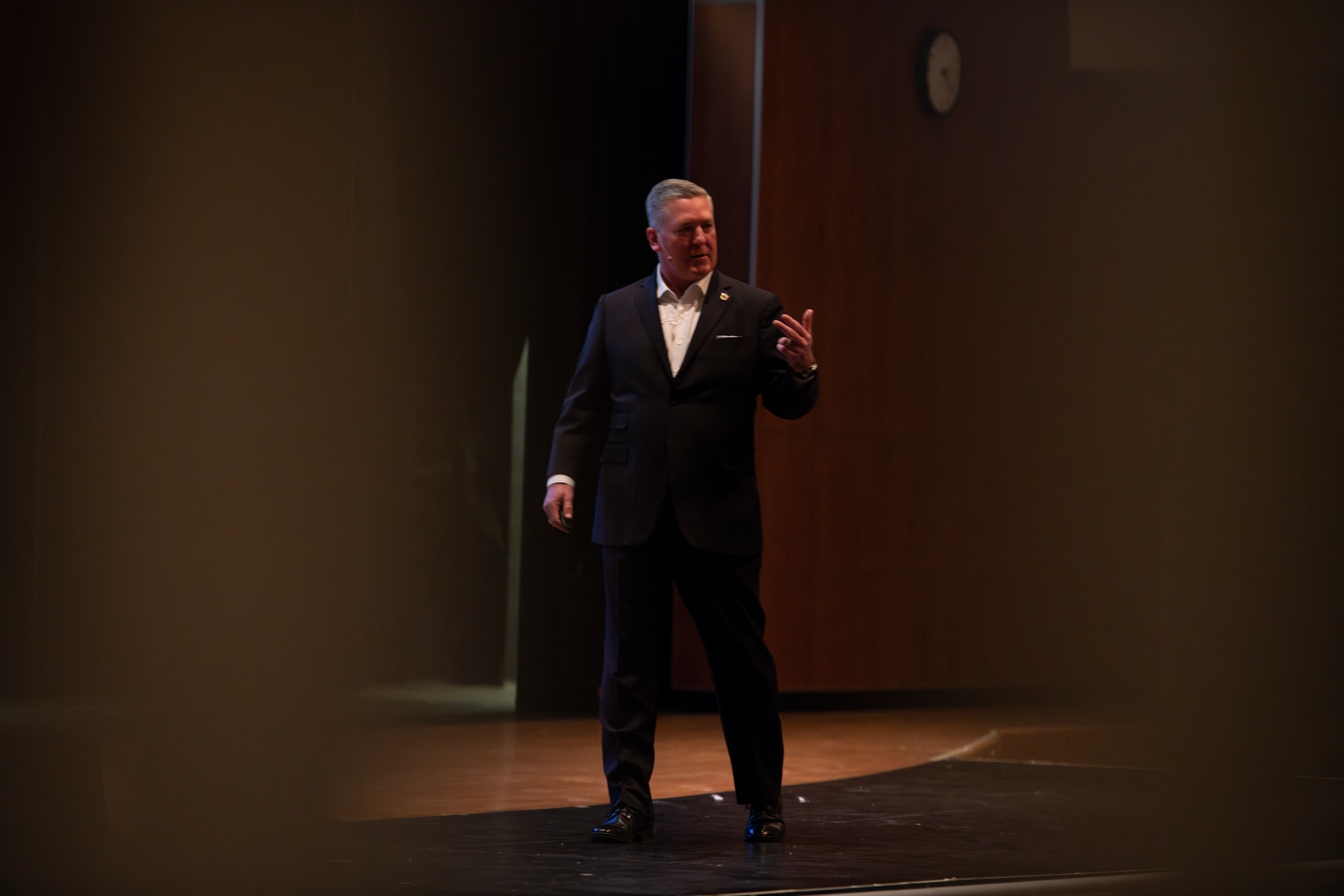
On February 1, 2025, Ross addressed the Wyoming National Guard’s Joint Leadership Conference in Cheyenne. More than 600 senior-ranking soldiers and airmen attended the conference, along with a Tunisian delegation. The agenda concerned preparation for a changing military environment. Ross’s session addressed resiliency.
In the photograph, he stands onstage in a dark suit, one hand raised as he speaks. The football uniform is long gone. The task remains recognizable: take an idea people need, explain it, and help them prepare for what comes next.
For Bacon, that work once began with messages he did not particularly want to answer. It became a relationship he remembered after graduation. A company has more ways to count progress: employees, programs, contracts, awards. The recruiting story supplies another measure. Years after the first conversation, did the person still believe you had told him the truth?