Wande Adams began with a number: $100,000. In 2015, living in the Washington, DC area, he was thinking about young African migrants trying to establish themselves. A six-figure annual income was the goal he had in mind for a couple starting a family. The question was how to get within reach of it. His answer involved teaching tech skills, including lessons in his church and a training school he ran on the side.
There is something pleasantly unromantic about that beginning. Entrepreneurship stories often open with a sudden revelation, preferably beside an airport window. Adams’s starting point was a household calculation. What could someone learn that would improve their earning prospects? It is a question with little patience for decorative answers. A person still has to get through the month.
As co-founder and CEO of The Bulb Africa, he would carry that concern into a larger organization. Training, work experience and business support became connected parts of the project. The journey makes more sense when followed from the learner’s end: the distance between acquiring a skill and persuading someone to pay for it.
The lesson travels to Nigeria
Adams moved to Nigeria in 2018 and continued the training work with partners through Room2Grow, helping people learn web development. The geography changed; the attention to earning capacity remained. He had seen an industry looking for workers and people looking for direction. Putting those two needs in the same sentence was straightforward. Building a useful route between them required more.
His own background had already taken him through established organizations. He held leadership roles at Verizon and Vencore, the US government contractor. He graduated from the University of Baltimore and earned a master’s degree in forensic accounting from the University of Maryland University College. Forensic accounting is an unexpected academic detail in a tech-training founder’s biography. It also gives his résumé a welcome resistance to the usual straight-line story.
The Bulb’s ambitions covered people starting careers and people starting businesses. Those groups could eventually need each other. A young company needs capable staff; a newly trained professional needs somewhere to work. Read together, the activities suggest a practical attempt to make both sides of that exchange easier.
“So, I started teaching in my church, had a training school on the side”
Wande Adams, reflecting on his early training work, 2022
Ten pitches, three places
On October 10, 2018, ten entrepreneurs gathered for an Enov8 Solutions pitch event in Lekki, Lagos. The initiative carried The Bulb name. Adams, then described as Enov8’s business development executive, led the team working with the contestants before they faced the judges. Three ventures emerged as winners: BetBridge, Tringoo and Humaai.
The setting adds a useful dimension to his story. Teaching a beginner and preparing a founder for investors both involve making knowledge usable under pressure. A person may understand an idea perfectly well and still struggle to explain why it should become a business. The pitch room makes that struggle public, with remarkably little sympathy for a beautiful slide that answers the wrong question.
The winners were expected to benefit from Enov8’s infrastructure and mentoring. At that stage, those were plans for what would follow. The important detail is the arrangement itself: the event proposed support beyond choosing a winner. Adams’s part in preparing the entrepreneurs places him close to the ordinary work behind a startup announcement, where an idea has to survive questions about customers, delivery and money.
Washington, DC area
Nigeria
fellowship cohort
West Africa Fellow
A fellowship with the bills in view
By March 2022, The Bulb Africa was inviting applications for its fourth fellowship cohort. The four-month opportunity included data analysis, quality assurance, product design and product management. Fellows would be paid while learning, with an option to enter the attached internship program. The announcement said the fellowship had received more than 5,500 applications since its first cohort in 2020.
Those terms put an economic detail inside the educational design. Learning takes time that might otherwise be spent earning. A stipend acknowledges that cost. An internship gives the next stage a shape. Neither detail, on its own, settles every question about access or employment, but both address something a list of course modules leaves untouched.
The program also introduced tracks that did not require coding skills. Program director Modupe Durosinmi-Etti explained the expansion in terms of people interested in other roles in the ecosystem. It widened the picture of who could belong in a technology business. Software still needs people who can understand users, organize products and evaluate whether the thing actually works. The invitation was broader than the familiar image of a lone person typing into the night.
The stopwatch test
One participant’s account makes the classroom less abstract. A University of Ilorin industrial chemistry graduate had been teaching chemistry, mathematics and computer studies while looking for other work. His learning journey eventually brought him to The Bulb fellowship. An early assignment involved building a JavaScript stopwatch. He thought he had done well until he saw what his peers had produced.
Anyone who has learned in a group will recognize that small recalibration. You bring in something you are proud of, then discover that the room contains standards you had not yet imagined. It can be an uncomfortable afternoon. It can also give the next week’s practice a purpose.
The participant went on to learn C# and credited instructors David Adele and David Igbigbi, as well as Habeeb Olakitan’s teaching of professional skills. He remembered encouragement from Adams and chairman Tosin Osunkoya, and later secured a software-engineering job at The Bulb. His account gives several people their due. That is useful: an institution’s work reaches a learner through the people who explain, correct, encourage and show up again.
A photograph needs a business
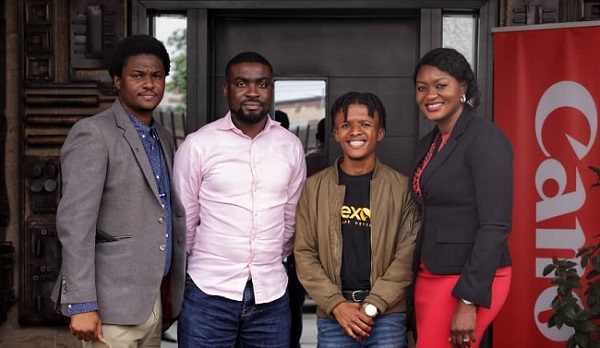
Adams’s other ventures bring the same interest in earning into a different profession. At Peexoo’s 2021 unveiling in Lagos, he was identified as co-founder and head of strategy. The platform aimed to help photographers and content creators showcase their work and connect with clients. Partnerships were intended to help creators obtain equipment as well.
A photographer can possess an excellent eye and still have a difficult business. There is equipment to acquire, work to display and a customer to find. The creative act occupies only part of the working day. The rest can be devoted to less photogenic matters, such as persuading someone that the invoice deserves the same attention as the pictures.
Peexoo’s Canon partnership added another part of the proposition. Adams described plans for masterclasses with international facilitators and access to opportunities beyond the local market. The language connected professional learning with commercial access. His role at The Bulb and his role at Peexoo meet at that point: capability becomes more useful when a person has places to practise it and customers who can recognize it.
Start before the first job application
The work also reached children. In 2022, The Bulb Africa served as technical partner on Wema Bank’s innovation challenge for children. Adams described its purpose as teaching participants to solve everyday problems. The company’s NextGen activities introduced children to different areas of technology.
At the Future Z event that year, Adams and Tosin Osunkoya launched the NextGen Club, extending the learning program’s activities in schools. There is a different timescale here from helping a graduate find work. A child trying an idea has years before a recruitment interview becomes relevant. The immediate opportunity is to discover that a problem can be approached, tested and worked through.
That widens the story without changing its practical subject. Learning can begin with curiosity and eventually become useful work. It needs room to develop along the way. The adults arranging the program have to translate a large ambition into something a child can actually attempt. Technology becomes less distant when it is attached to an everyday question and someone is there to help with the first answer.
The employer has homework, too
Adams has argued that increasing the supply of trained people also requires better conditions for them to work. In his 2022 writing, he called for collaboration with universities and the National Youth Service Corps, updated curricula and recognition of suitable technology-training institutions. He also urged employers to consider competitive pay, remote work, professional development and equity.
That argument gives responsibility to the hiring organization. Training people takes effort. Keeping their interest takes effort too. It is a useful complication for any company that speaks of a talent shortage as though workers were a natural resource waiting to be collected. People make choices about where their skills will take them.
A July 2024 account from Abigail, a media and marketing intern at The Bulb, brings the subject back to an ordinary working day. She described improving her writing and communication, receiving help from colleagues and hearing Adams talk about consistency and a growth mindset. The remembered advice sits beside actual tasks and feedback. It belongs to the working environment rather than a poster on its wall.
A founder who keeps teaching
Adams was selected as an Acumen West Africa Fellow in 2023. By 2025, he was listed as a panelist for Acumen’s West Africa Selection Conference. His public LinkedIn writing has covered career opportunities for graduates, hiring, remote teams and founders’ use of time. The subjects are the practical concerns of people trying to make work function.
The thread running back to those early lessons is easy to follow. A skill needs practice. A beginner needs a chance. A business needs people who can do the work. Adams has approached those needs through several settings, from a church-based class to a fellowship, a pitch event and a platform for photographers.
The distance between a skill and a salary can contain a surprising amount of life. It holds the application, the first assignment, the person who answers a question and the employer willing to take a newcomer seriously. Adams’s story is interesting because he keeps working in that distance. It is crowded, practical territory. There is always another lesson to prepare.