A fish pond is an unlikely recruiting office. For FutureMap Foundation, it supplied a useful audition. Two students at Sule Lamido University in Jigawa State, identified by the foundation as Ibrahim and Nasir, built an Internet of Things system to monitor pond conditions and alert fish farmers about feeding and water replacement. FutureMap encountered them at an innovation competition and invited them to Abuja to work alongside other young technology professionals.
By July 2026, the foundation reported that Nasir was working in a Nigerian commercial bank’s IT division and Ibrahim was pursuing a funded master’s degree in Britain. Both had become fellowship facilitators. The appeal of this account is its specificity: a local agricultural problem, a working project, an introduction, and further opportunities. The pond gave the students something more persuasive than a statement about their potential.
That sequence helps explain this Abuja-based nonprofit, whose work reaches into Hadejia, Jigawa State. FutureMap runs technology education, supports emerging innovators, and brings public agencies, businesses, and investors into conversation. Its central proposition is that learning a skill becomes more valuable when someone creates a place to use it. The challenge is making that connection repeatable.
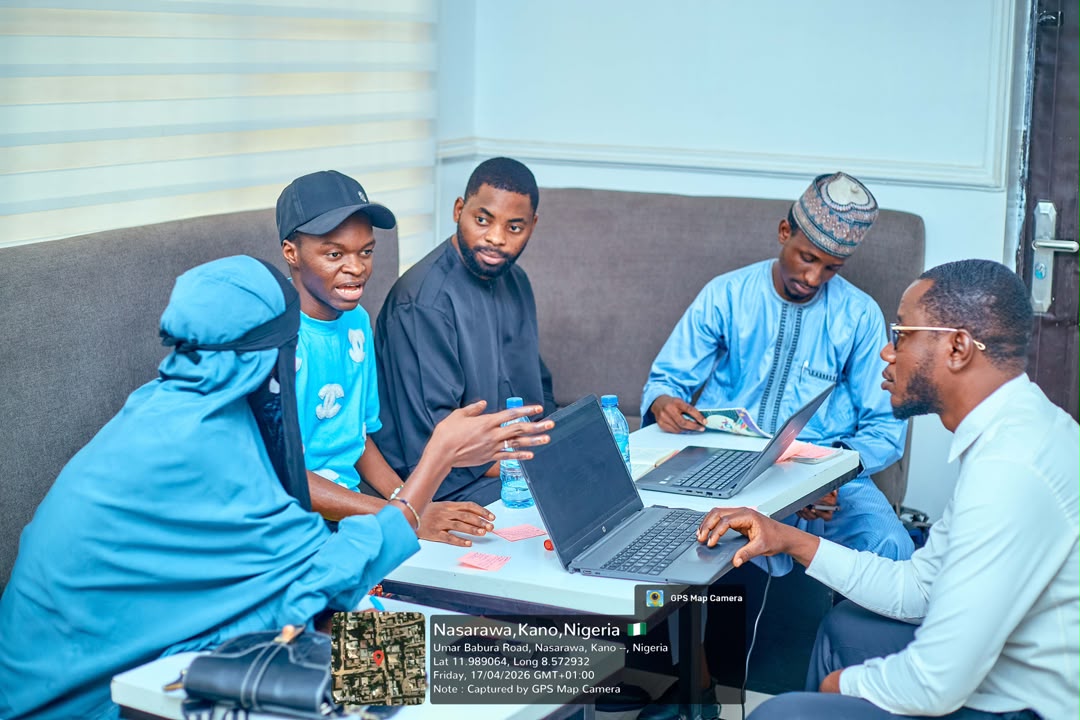
01The road to Hadejia runs through a classroom
FutureMap Academy gives that proposition a physical address. Its Hadejia institute has hosted a STEM bootcamp for children, capacity development for artisans and IT technicians, and activities involving women and community development with the National Information Technology Development Agency, or NITDA. The intended audience extends beyond university graduates already comfortable with a laptop.
The academy’s own student spotlight describes a girl learning to assemble and fly drones at a bootcamp. FutureMap connects that exercise to possible agricultural uses, including spotting crop disease. The distinction matters: learning to operate a drone is an activity; building a viable agricultural service would be a later achievement. Still, putting the equipment into a child’s hands makes the subject considerably less abstract.
In December 2024, its Workshop of the Future drew at least 317 participants, according to a subsequent Tech Digest account. Sessions explored AI applications in office work, agriculture, health, education, energy, and climate, with practical problem-solving exercises. Collaborators included NITDA, Jigawa State, Huawei, Cosmopolitan University, and Open School Initiative. The workshop placed technology instruction inside a wider discussion of the region’s economy.
For someone deciding whether FutureMap is relevant, this breadth is useful. A schoolchild, an artisan, a would-be developer, and a public official do not need the same course. They may, however, benefit from the same institution bringing equipment, instructors, and working relationships closer to them. Hadejia is an operating choice with consequences for who can participate.
02A fellowship with somewhere to go afterward
The Future Tech Fellowship adds a more structured route into professional work. In May 2025, FutureMap announced an agreement involving Thermolinks Concepts Limited and Arewa Data Science Academy. The launch targeted young professionals aged 18 to 30, particularly women and people from underserved communities, across product design, front-end development, back-end development, and data science.
The original plan allowed about 20 participants per track. It specified three months of virtual instruction for most tracks, six for data science, followed by three-month internships. Recorded lessons, live teaching, weekly projects, mentoring, final presentations, and an alumni network formed the support structure. These are the launch specifications; the academy also advertises longer courses separately, so applicants should use the terms of their particular intake.
By July 2026, FutureMap reported more than 3,000 applications, an approximately 3% selection rate, and participation spanning Nigeria’s 36 states, Ghana, and Cameroon. It said about 40% of fellows had progressed into internships and employment. That combined category deserves to stay intact: an internship is a useful step, but it is not the same outcome as a permanent job.
The fellowship’s practical attraction is the work around the lessons. Team assignments require people to explain decisions, respond to feedback, and finish something other people can inspect. Partner placements introduce the demands of an actual workplace. For a prospective employer, a project and a supervised placement can provide more useful evidence than a list of courses completed.
Foundation-reported figures. Selection and career progression use different denominators; internships and employment are combined.
03The expensive word is “access”
FutureMap’s published ambitions are substantial. Its brochure sets a target of training 3,000 Nigerians in deep technology by 2030, alongside goals for teacher training, mentoring, and technology hubs. Those are intended future outputs. They should not be confused with the separately reported 3,000-plus applications to the fellowship.
In its May 2025 advisory-board announcement, the foundation described a proposed Future Innovation Hub valued at ₦1 billion. That figure belongs to a named project proposal, rather than serving as a price tag for every academy activity or an audited total of money spent. The distinction is essential when buildings, programs, and long-range employment projections appear in the same announcement.
The operating model is partnership-led nonprofit delivery: FutureMap assembles training institutions, public bodies, mentors, and other collaborators around programs. Learners are beneficiaries; employers can supply placements; institutions contribute expertise and access. These relationships explain more about how the organization works than the language of software subscriptions or venture rounds would.
There are costs beyond a construction budget. Virtual study takes time, a usable device, and reliable connectivity. Internships require employers willing to supervise beginners. Physical facilities need maintenance and people who can teach. Anyone borrowing this approach should budget for those recurring commitments. A room full of computers is an asset; making it consistently useful is an operating responsibility.
- 01Learn3 months of virtual training; 6 for data science
- 02Apply3-month partner internship
- 03Stay connectedProjects, presentations, mentoring and alumni support
04When the people with ideas met the people with keys
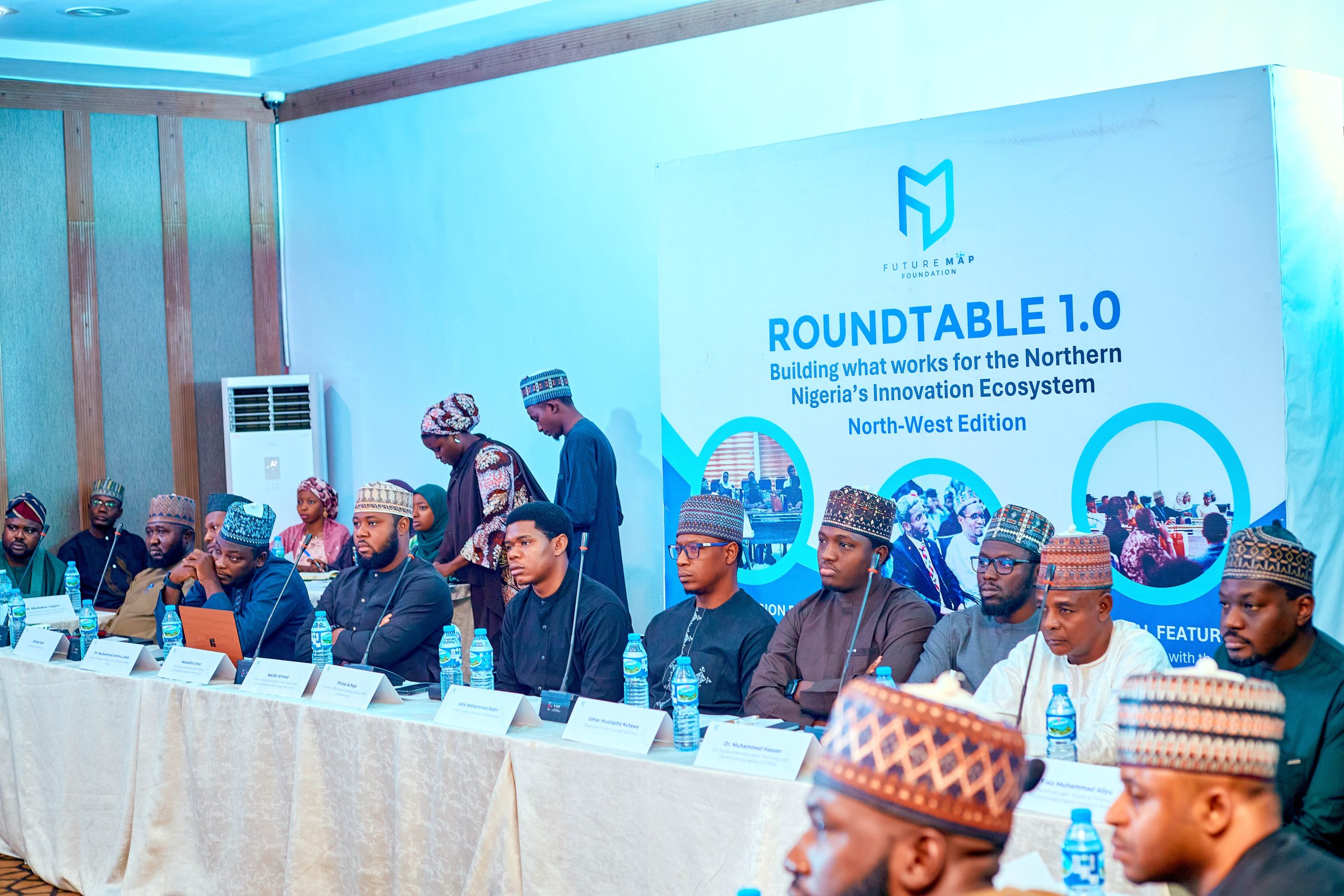
On January 3, 2026, FutureMap convened roughly 50 founders, policymakers, investors, hub managers, development partners, and researchers in Kano. Its account of the roundtable describes an awkward finding: the region already had facilities and programs, yet innovators still struggled to reach customers, public infrastructure, data, and procurement systems.
The meeting’s diagnosis shifted attention toward access and coordination. Participants described underused ICT centers, obstacles to selling to government, and products without a credible route to paying users. The foundation’s account records the phrase “beautiful nonsense” for innovation without market fit. It is a pointed description of what happens when a polished demonstration never acquires a customer.
The resulting proposals included opening existing facilities, clearer procurement routes, and shared funding arrangements. These were proposed remedies to problems voiced in the room. The reusable lesson is straightforward: invite people who buy and operate services into the discussion while products and training programs are still being designed. Their constraints belong in the brief, alongside the inventor’s idea.
“beautiful nonsense”
The phrase recorded in FutureMap’s Kano roundtable account for innovation without market fit.
05A clinic puts the question next door
By July 2026, the Hadejia project had expanded into a more unusual pairing: an academy and a community clinic. Reporting on their commissioning identified the facilities as the Bola Ahmed Tinubu Future Academy and the Senator Oluremi Tinubu Clinic. Nigeria’s First Lady, Oluremi Tinubu, inaugurated them. FutureMap had described community consultations and needs assessments as inputs into their design.
One foundation survey found that 75% of respondents had never taken digital or technology training. That is a finding about its surveyed community, not a national participation rate. The accompanying healthcare work emphasized kidney disease, prevention, earlier detection, and referral. Bringing these concerns together gives the academy a concrete set of local problems to investigate.
A July account published on FutureMap’s site describes fabrication and innovation laboratories, a health-wearables research unit, prosthetics facilities, and startup support at the academy. It describes the clinic as a place where locally developed health technologies can be tested and refined, and credits collaboration with eHealth Africa. The proposed relationship is more interesting than either building viewed alone.
In practical terms, proximity can shorten the conversation between someone making a tool and someone expected to use it. A clinician can explain why an interface slows work; a developer can revise it. That is the logic of the pairing, rather than evidence that a particular prototype has already improved health outcomes. Clinical use still depends on appropriate evaluation, professional oversight, and dependable service.
06One organization, several different rooms
FutureMap also operates at conference scale through Global Tech Africa, an initiative implemented with Ascend Studios Foundation. Coverage of its 2023 collaboration identified partners including NITDA, the U.S. Consulate, Venture Garden Group, Business Sweden, and the HOW Foundation. The conference gives investors, policymakers, and technology businesses a meeting place; the academy addresses a different part of the same employment problem.
On its conference page, FutureMap reports more than 2,000 attendees and more than 30 strategic partnership agreements for GTA 2024. It also labels $120 million as handshake investment commitments. The wording matters: expressions of investment intent are not equivalent to cash disbursed, foundation revenue, or completed funding rounds.
The organization’s expertise combines program delivery with institutional relationships. Its team page lists executive director Dr. Shuaib Sani Shuaib alongside project management, procurement, accounting, human resources, and monitoring roles. Its 2025 advisory appointments added experience in public health, government technology policy, enterprise innovation, and financial-sector IT. Those are useful capabilities for work that crosses several institutions.
FutureMap’s stated values include empowerment, collaboration, innovation, and sustainability. Its emphasis on connecting younger people with older generations also runs through its current mission. These are declared commitments. The more tangible cultural clue is its use of former participants as facilitators: people who have navigated an opportunity can help the next group understand the route.
07The next useful introduction
In the training market, FutureMap sits between a coding program, a local innovation hub, and an organization that convenes institutions. A learner could pursue university study, an independent bootcamp, or an online course instead. FutureMap’s distinctive offer is the combination of place, applied projects, mentoring, and relationships with organizations that might use the resulting skills.
The model is most useful when those relationships lead to real work. A virtual course needs students who can stay connected; an internship needs supervision; a startup needs buyers; a clinic needs staff and operating resources. Where those conditions are weak, adding more enrollment places alone will not solve the underlying problem. The January roundtable made that tension unusually explicit.
Prospective fellows can follow intake announcements and examine the relevant track, schedule, and placement arrangements. Employers can explore hosting interns or supplying project briefs. Educators and community organizations can discuss training partnerships. For other nonprofits, the part worth copying is the sequence: start with a specific local problem, bring capable people into it, and arrange the next useful introduction. Sometimes the first brief comes from a fish pond.
Follow the work
Explore programs, intake announcements, and the conversations around them.