The second meeting was the warning. LakeHub’s organizers had invited people for 2 p.m. By 3:30, nobody else had arrived. Eight eventually turned up, staying past dark. In Kisumu in 2013, enthusiasm for a technology community existed. Getting it into the same room took more work.
Early organizer Evan Green-Lowe described the fix: a cafe reserved a room each Saturday in exchange for promotion and business. Tea and mandazi came at half price. Attendance became a habit. When the founders’ other commitments later slowed progress, they began recruiting a full-time employee. The useful lesson was wonderfully ordinary: a community needed somewhere reliable to go, and somebody with time to run it.
That modest beginning has grown into an organization spanning software education, entrepreneurship and agricultural innovation. LakeHub’s central wager remains geographic: young people in western Kenya should be able to develop technical careers without first relocating to Nairobi. A classroom, an employer connection and a business mentor can change what staying in Kisumu makes possible.
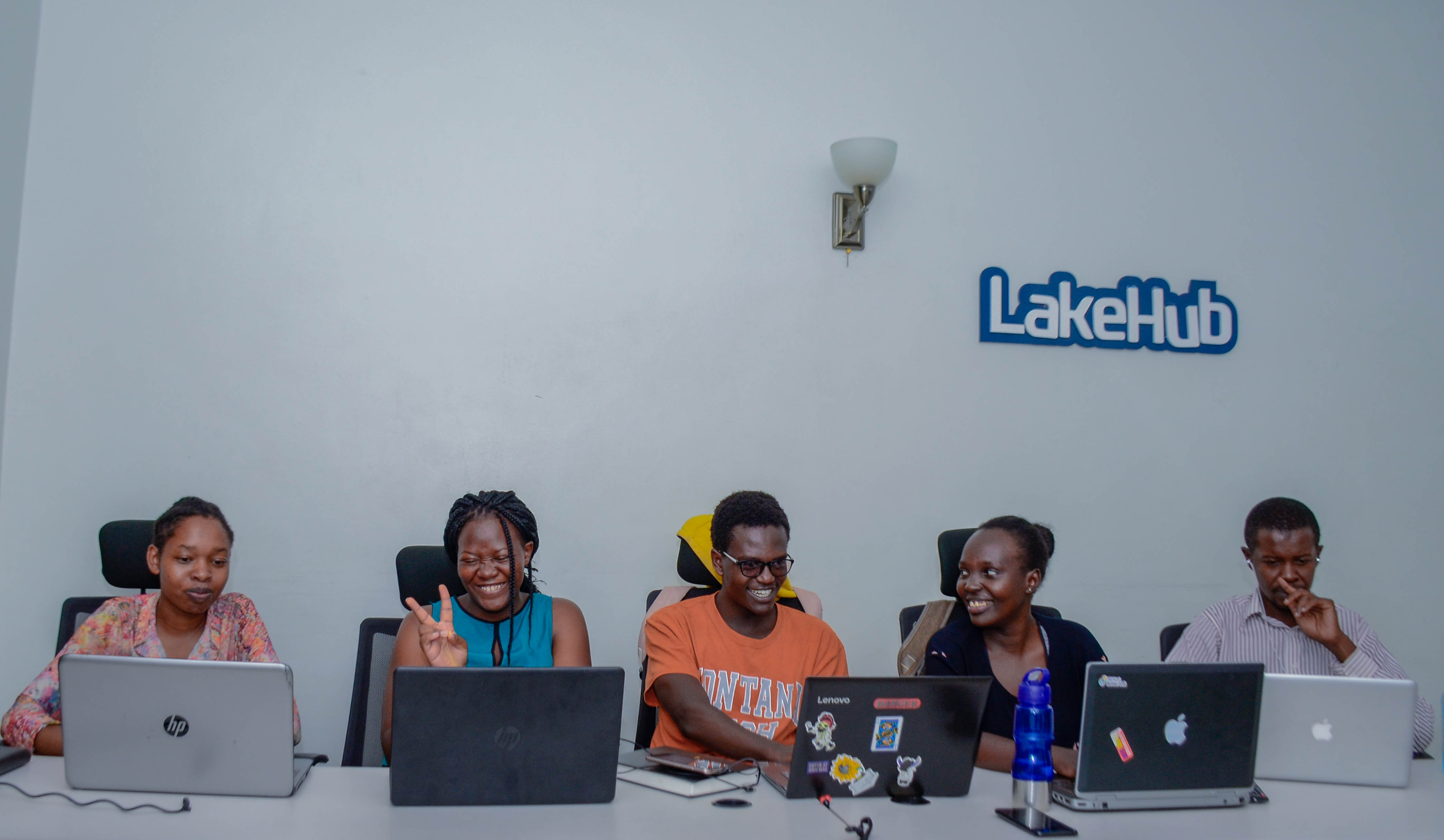
A tech map with more than one pin
The imbalance LakeHub tackles is measurable. In a 2022 mapping exercise covering 200 innovation centers across Kenya’s 47 counties, 46 percent were in Nairobi. The report called for wider access to spaces where young people could develop and test ideas. A country can have a lively technology sector while leaving much of its talent a long journey from the action.
Financial Sector Deepening Kenya had described the local problem in 2015: western Kenyan technologists faced gaps in reliable internet, investment networks, mentorship and practical business support. James Odede, a Maseno University computer science graduate and LakeHub co-founder, helped build a response rooted in the region he knew. Local knowledge was part of the proposition, especially for businesses serving nearby industries.
LakeHub now describes itself as a nonprofit. Its history dates the foundation’s registration to 2017 and the launch of its Academy and incubation programs to 2019. Current co-executive directors are Caleb Nyoiro and Dorcas Owinoh; Odede appears among its advisors. What unites the programs is a focus on helping young people turn technical ability or a business idea into a livelihood.
“We have a permanent home!”
James Odede, announcing LakeHub’s new community space, September 2014
Two years, zero tuition, plenty of work
Zone01 Kisumu is LakeHub’s clearest offer to an aspiring software developer. It advertises a two-year, full-time course with no tuition charge and no requirement for previous coding experience. Adults over 18 can enter the selection process. The education relies on collaborative, self-paced projects and peer learning, with students working through problems together rather than following a conventional sequence of lectures.
The public launch in October 2023 brought together LakeHub, 01Talent Africa, Kisumu County Government and United Cities and Local Governments of Africa. At launch, Odede described sustenance stipends during training and a minimum three-year employment contract afterward through a global talent agency. Those were the program’s stated terms and commitments, an unusually substantial proposition for someone weighing a career change.
The curriculum connects general software development to possible specialisms including cybersecurity, data engineering, artificial intelligence and web applications. For students, the attraction is a structured route through a field that can otherwise feel like an endless pile of online tutorials. For employers, the proposition is access to developers who have spent sustained time building and troubleshooting software.
There is evidence beyond the launch announcement. In April 2026, Kenya News Agency reported the first cohort’s graduation and said at least 70 young people had secured jobs through the program. That is a useful employment result. It should be read as a reported count, rather than converted into a placement percentage without a matching cohort denominator.
A free place still has a price
One former participant makes the personal arithmetic clear. Rose Adhiambo Oginga taught mathematics and physical education before joining LakeHub’s FemiDevs program. In a published 2022 interview, she said: “I had to quit my job to complete this course at the Academy.” A supported place can still require giving up earnings. That cost belongs in any honest account of access.
FemiDevs was designed around barriers facing young women entering technology. UNDP’s 2022 annual report records 200 women enrolled across Kisumu, Busia and Migori. The work combined web development, practical design tools, mentorship and preparation for employment or internships. Its audience was specific, and so was its geography: women outside the capital who could benefit from an organized route into digital work.
Contemporary reporting on the program also described laptops, internet access and funded scholarships. These are consequential details. Someone cannot participate in a digital course on motivation alone. Equipment, connectivity and the ability to attend determine who can actually take up an offer. Rose’s account adds a further requirement: enough room in one’s life to change direction.
For prospective learners, the choice is therefore bigger than whether coding sounds interesting. A full-time apprenticeship suits someone able to commit substantial time and work independently with peers. Someone needing an evening course alongside an inflexible job faces a different calculation. The learning model asks participants to contribute to the group as well as draw support from it.
The employer connection is part of the offer
LakeHub’s institutional customers and partners extend beyond the people sitting at computers. Development organizations support inclusion and employment programs; businesses need talent; early-stage founders need help reaching customers. Its economic structure is built around these relationships. Segal Family Foundation lists LakeHub as a partner since 2019, while UNDP, GIZ and international project collaborations support identifiable pieces of its work.
That arrangement helps explain the tuition-free offer. The learner is a beneficiary within a wider funded program, with the talent agency linking training to employment. The organization combines education and convening with enterprise development. For someone evaluating LakeHub, the relevant unit is often the individual program: its sponsor, selection criteria, time commitment and intended outcome.
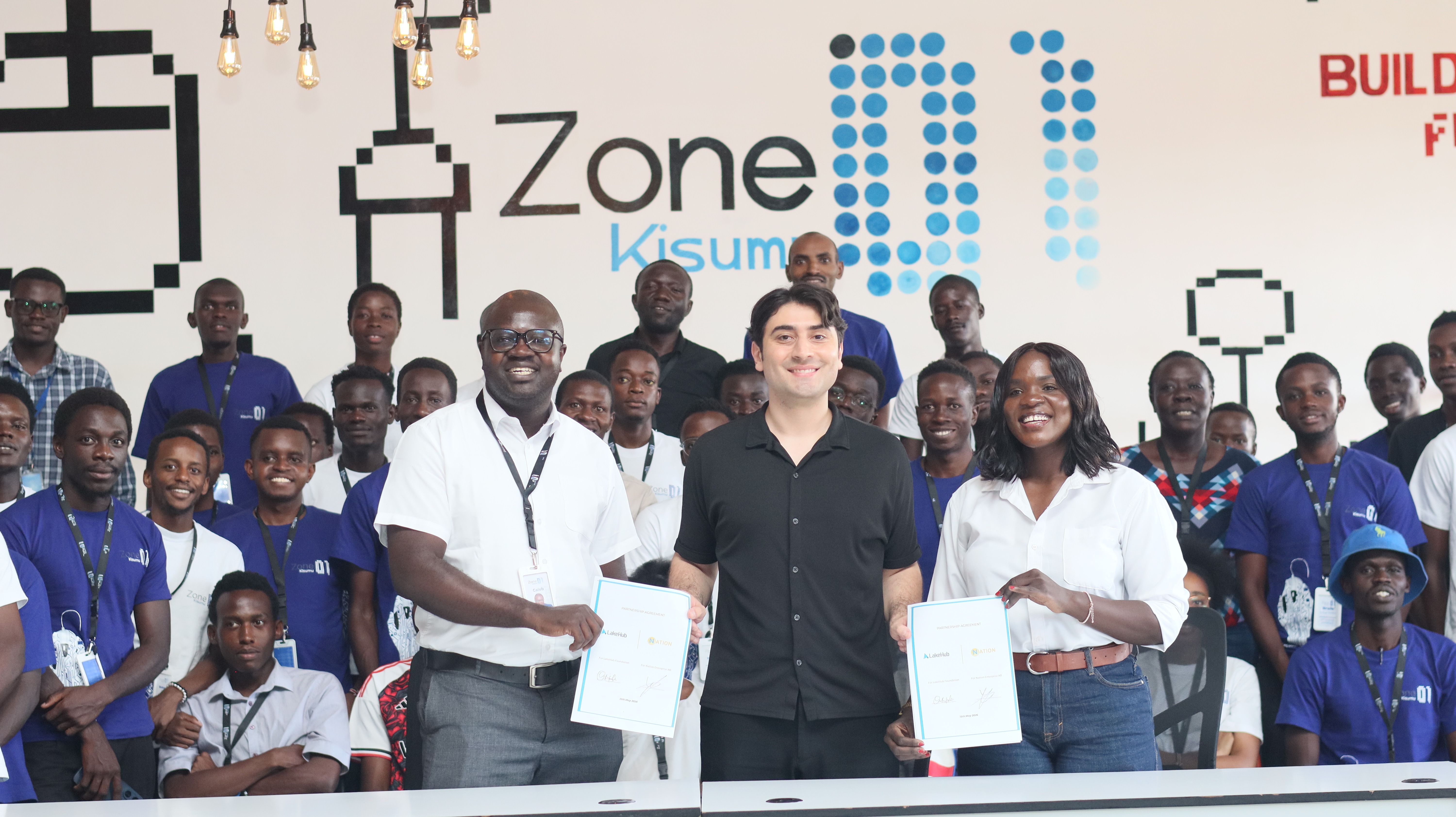
In May 2026, Zone01 Kisumu announced an agreement with Nation.dev aimed at international opportunities and industry exposure. The visit included a discussion about software engineering in the age of AI. For a training organization, that is a practical concern: students need skills that employers will value when they finish, and relationships through which their work can be seen.
Compared with a university course, a standalone coding bootcamp or an ordinary coworking space, LakeHub bundles several kinds of support around a local community. Hubs such as iHub and NaiLab belong to the broader Kenyan innovation landscape. LakeHub’s distinguishing choice is to do this work from Kisumu, close to the young people and enterprises it wants to serve.
Before the pitch, find a customer
Its incubation work applies a similar logic to entrepreneurship. A 2020 circular and shared-economy program offered six months of support covering customer needs, validation, prototypes, acquisition, bookkeeping and team building. Three selected entrepreneurs per cohort could receive up to €5,000 each, depending on need, to develop a minimum viable product and take it to market.
The sequence is worth copying: establish whose problem matters, test an idea, then use limited capital to build something those people can try. A modest grant forces choices. A founder needs to decide what the first version must demonstrate, which customer to approach and what evidence would justify spending more. Training in bookkeeping belongs alongside the prototype because a functioning business needs both.
LakeHub’s GIZ-linked agribusiness programs make that support more specific. Its published incubation offer targets 120 young agripreneurs across five western counties. A separate acceleration program targets 100 enterprises and advertises selective seed grants of up to KES 300,000. Poultry, groundnuts, passion fruit and beekeeping appear among its value chains. These are program targets and grant ceilings, with everyday businesses at their center.
Satellite data meets the farm
KijaniSpace extends that agricultural interest into Earth observation and connected sensors. LakeHub is one of 13 African and European partners in the project, which began in October 2024. It connects climate-smart agriculture and aquaculture with technical capabilities spread across the consortium. LakeHub contributes local relationships, convening and talent development to a collaboration reaching Kenya, Tanzania and Uganda.
The technologies discussed at its regional dialogue included Copernicus data, meteoblue weather information and AquaRech water-temperature sensors. Those are distinct contributions from a wider network. For a developer, the attraction is learning how data and software might support a concrete farming decision. For a farmer, the test is whether the resulting information is useful enough to change an action.
- 01Learn the tools
- 02Build a prototype
- 03Test with users
- 04Earn adoption
The first demo opens the door. Field testing decides what deserves to stay.
At LakeHub’s July 24-25, 2026 hackathon, nine teams produced nine functional minimum viable products. Each presented a prototype, a business or sustainability model, a pitch and a live demonstration. Feed Sync placed first, followed by Nemo and Jonam. The project’s follow-up identified continued mentoring, incubation and testing with farming and aquaculture communities as the next steps.
The training offer also exposed practical limits. Its archived 2026 terms made participation free and provided hackathon catering, while asking participants to pay for travel and accommodation. The planned weekly workload was three to six hours. Even a remote-first program has physical costs when people must assemble to build together.
LakeHub’s approach depends on those connections holding: students able to attend, partners able to support them, employers prepared to hire and users willing to test a product. Remove any one and the journey becomes harder. The durable idea is simple enough for another town to borrow: create a dependable place to learn, then keep building the relationships that make the learning useful.