Dorothea Koh was worrying about what success might do to her company. In 2024, with Bot MD’s team growing, she considered a future in which she might employ a hundred people and no longer know everyone. For a founder who had begun with a co-founder and a coffee-shop table, that prospect had a personal edge. More people could help her build. They could also make the company harder to recognise.
Koh had already worked inside large organisations. She had held regional responsibilities at Baxter and worked in business development at Medtronic. She understood something of the distance between a decision at headquarters and its consequences elsewhere. Starting Bot MD gave her the opportunity to make those decisions herself. It also made her responsible for what the organisation would become.
That is the thread running through her career: a persistent interest in how an idea survives contact with the place, the people and the working day it is supposed to improve. A good diagram helps. Eventually, someone has to use the thing.
Cold brew, then California
Bot MD began as a hobby project. Koh and her co-founder, Yan Chuan Sim, known as YC, worked on it over nights and weekends at Coffee Bean in Singapore’s Forum Galleria. There was a considerable amount of cold brew involved. In June 2018, the project became the company they were building together.
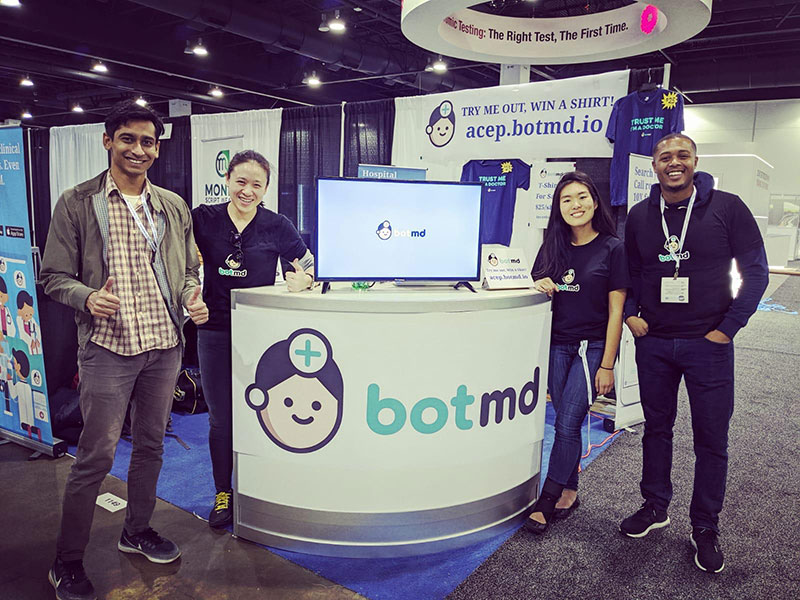
By that summer, the founders were in Silicon Valley as part of Y Combinator’s Summer 2018 batch. They lived and worked out of a garage in Palo Alto, returning to Singapore later that year. The first version of their app launched in July.
The locations make a pleasingly compact origin story: shopping centre, garage, company. They also describe a practical change in Koh’s working life. She had moved from operating within businesses with established structures to helping create one whose product and customers were still taking shape. Experience could guide her decisions; it could hardly make those decisions on her behalf.
There were now two founders with a shared undertaking. An accelerator could provide advice and an intensive period of work. The task of turning that beginning into a useful business would continue long after the flight home.
An education in looking closely
Koh graduated from Northwestern University in 2006, studying biomedical engineering and economics. She later earned a master’s in bioengineering at Stanford and completed its Biodesign Innovation Fellowship in 2008. Engineering and economics make an apt pairing for someone whose later work would require both building products and finding a way for a business to sustain them.
She has traced an early entrepreneurial impulse to a Northwestern capstone design project. Working with biomaterials gave her an idea she subsequently explored as a startup. The classroom project acquired a life beyond the assignment, becoming one of the experiences she credits with setting her career in motion.
Stanford supplied a method she would keep using: identify a need, consider possible responses, make prototypes and revise them. Asked about its influence on Bot MD, she described applying that process almost subconsciously. Her advice to other innovators was direct.
“Obsess about building products that users love.”Dorothea Koh
The verb matters. It makes usefulness something to return to repeatedly. A team can finish a specification, commission an attractive interface and still have plenty to learn about whether its product earns a place in somebody’s routine.
A habit of going to see
Her corporate career began at the Singapore Economic Development Board before taking her to Medtronic. In 2012 she joined Baxter as chief of staff to the president of Baxter International. Later assignments included leading an innovation team in China and running country operations in Indonesia, Singapore and the Philippines.
In Shanghai, her team’s work involved developing business models for the Chinese market. Her explanation of that work stressed the setting: people’s habits, available infrastructure, economics and the circumstances in which a product would be used. The process required time in the market before a proposed answer could be treated as ready.
That is a less portable kind of experience than a standard presentation suggests. A presentation travels very well. The local conditions that make an idea workable demand another visit, another conversation, another look at what people actually do.
For Koh, working across countries offered repeated opportunities to examine that gap. China, India, Indonesia and the Philippines figure in her accounts of the years before Bot MD. Those experiences gave her a reason to question whether a solution that looked sensible in one setting would work equally well somewhere else.
The cost of getting it wrong
Koh’s advice about starting a company includes a fairly substantial commitment: consider whether the idea is worth years of your life. In discussing entrepreneurship, she has encouraged testing assumptions with prototypes that require little code before becoming absorbed in building a more elaborate product.
That puts a useful limit on enthusiasm. Early work needs to answer whether people want something enough, why this particular team should build it, and whether there is a market worth pursuing. Writing more software can be a way to postpone those questions. A small experiment may bring them forward.
Her view of funding is similarly practical. She has compared raising money to drawing on a credit card, with obligations arriving after the initial freedom to spend. She advocates stretching resources and thinking seriously about whether an unsuccessful business should continue.
These are sober ideas from someone who chose to start a company. They leave room for ambition while acknowledging its bill. A founder can believe in the work and still ask what further spending will establish. The answer ought to be more specific than buying another few months in which to keep believing.
A little personality in the machine
Bot MD’s early product had jokes and animated GIFs alongside its working features. Koh has spoken about wanting software that evokes a feeling as well as completing a task. The friendly character was part of the design, a way of making the interaction approachable.
This interest in the experience of using a product sits alongside her technical training. It requires attention to small choices: how a response sounds, whether an interface feels welcoming, whether someone knows what to do next. Those details become especially consequential when a product needs to fit into a busy day.
A burst of early downloads did not, however, guarantee continued use. Koh has described the frustration of seeing people try the app and then fail to return. The team had to reconsider its approach, concentrating on information users could not obtain through ordinary web search.
The distinction between trial and habit is easy to blur when the download count is going up. Koh’s account makes the uncomfortable interval visible. Interest had opened a door. There was still work to do before the product would give people a reason to keep opening it.
The company becomes the next design problem
By 2024, Koh was asking how to scale thoughtfully and avoid becoming bureaucratic. Her question was about the experience of running a larger team, including the possibility of eventually not knowing everybody. Growth was changing the founder’s job.
Here the company itself starts to resemble a product under revision. People need to find information, understand responsibilities and get decisions made. Adding colleagues can provide skills and capacity while creating new demands on communication. A founder cannot personally carry every conversation indefinitely.
Her earlier regional roles give this concern an interesting context. She had seen organisations with country operations and layers of responsibility before beginning a company at a coffee-shop table. Building her own offered a chance to decide which working habits deserved to survive as the team grew.
The question remains practical. What can someone decide without waiting? Where does a concern go? How does a customer’s experience reach the people designing the next version? Those are questions any growing team can ask. In Koh’s case, her stated concern about bureaucracy gives them a place in the story alongside the more familiar milestones of founding and fundraising.
Dot, off the clock
Koh’s nickname is Dot. Users sometimes call her Bot, she has said, which gives the company name an unusually efficient route into conversation. In a June 2024 interview, she also named Ocean’s 11 as a favourite film and dark chocolate with hazelnut as her ice cream choice. Wine is a subject she can discuss for hours.
Her personal website adds the Father Brown stories by G. K. Chesterton to the picture. Asked what she would do if money were no object, she proposed travelling and starting a gin bar. It is a pleasantly concrete answer to a question that often produces a declaration about changing everything.
These details need no elaborate theory of leadership attached to them. They are enough to suggest a life outside the role, with books, tastes and an alternative business involving a rather different inventory. The person answering questions about company building also has an opinion about what should be in the glass.
Her advice to newcomers is equally plain: “Be hungry and humble, and keep an open mind.” It leaves room to want something and to learn that the first way of pursuing it needs work.
More seats at the table
Her public responsibilities now extend beyond Bot MD. GovTech Singapore’s board directory, updated in October 2026, lists Koh among its directors. Northwestern’s biomedical engineering department also lists her on its advisory board. She remains identified as Bot MD’s founder and CEO.
Those roles connect the company builder to institutions concerned with technology and education. They also place her alongside people whose work involves different kinds of organisations and different responsibilities. Her career has continued to cross those boundaries rather than settling into a single professional setting.
The arc from Northwestern and Stanford to regional corporate work, a weekend project and her own company contains several changes of scale. Each required attention to the circumstances of the work. A good idea had to become a workable product; a workable product required a company able to support it.
Now the coffee-shop founder has more colleagues to consider. Her question about staying responsive as that number grows is a fitting one to carry forward. The company has acquired more moving parts. Koh wants to keep people able to move them.
Keep company with Dot
Her own pages, conversations and current work.
- Dorothea Koh’s personal website
- LinkedIn: Dorothea Koh · X: @dotkoh5
- Bot MD
- Watch: Biodesign Innovation video linked by Koh
- Listen: Alternative CV, testing early ideas
- Listen: Alternative CV, large companies and startups
- Read: Koh on rebuilding and growing Bot MD
- Read: Ice Breakers with Dorothea Koh
- GovTech Singapore’s board directory