Somewhere in the history of Razer, a perfectly reasonable business making equipment for gamers acquired a constituency demanding toast. Min-Liang Tan had mentioned a toaster. An engineer had made a prototype. The audience, demonstrating the persistence usually reserved for a difficult level, declined to let the matter rest. By 2015, Tan was describing a movement trying to make the company build it.
The joke grew into Project Breadwinner, an April Fools’ concept in 2016. In a 2019 conversation, Tan laughed about a toaster market that had gone a long time without much attention. He also acknowledged an inconvenient detail: a company full of designers and engineers would still need people who understood appliances. He said it was receiving little of his time. Bread, unlike a social-media post, needs someone to manage the heating element.
It is an unusually useful introduction to Razer’s co-founder, CEO and creative director. Tan invites people into the conversation, takes pleasure in an unlikely object, and can end up negotiating with the audience he has assembled. The distance between a private enthusiasm and a public expectation is sometimes no wider than a slice of bread.
The lawyer brought his attention to detail
Tan was born in Singapore in 1977 and graduated from the National University of Singapore with a law degree in 2002. His professional life began in law before he co-founded Razer with Robert Krakoff in 2005. The career change has the ingredients of a familiar escape story. Tan has repeatedly complicated that reading.
He enjoyed being a lawyer. He has described legal training as preparation for running the company, particularly its insistence on attention to detail. That same habit, he says, informs his creative direction and product design. Later, as Razer moved into payments, his experience in technology regulation became useful again. An old profession can remain in the room long after the job title changes.
His account of Razer’s beginnings is smaller and more personal than a plan to conquer consumer electronics: he and his co-founder wanted to make something enjoyable for themselves. The distinction matters when trying to understand the product choices that followed. A player’s irritation with an object can be a starting point. Whether enough other people share the irritation is a question a business eventually has to answer.
A laptop for someone who lived on planes
The mouse was a sensible place to begin. A gamer feels the quality of an input device through the hand, repeatedly, in situations where small differences can matter. Razer’s early catalogue grew around that relationship between player and machine. The company’s history records the Diamondback at its founding and the DeathAdder’s arrival in 2006. A peripheral could become an object someone chose carefully, rather than accepted with a computer.
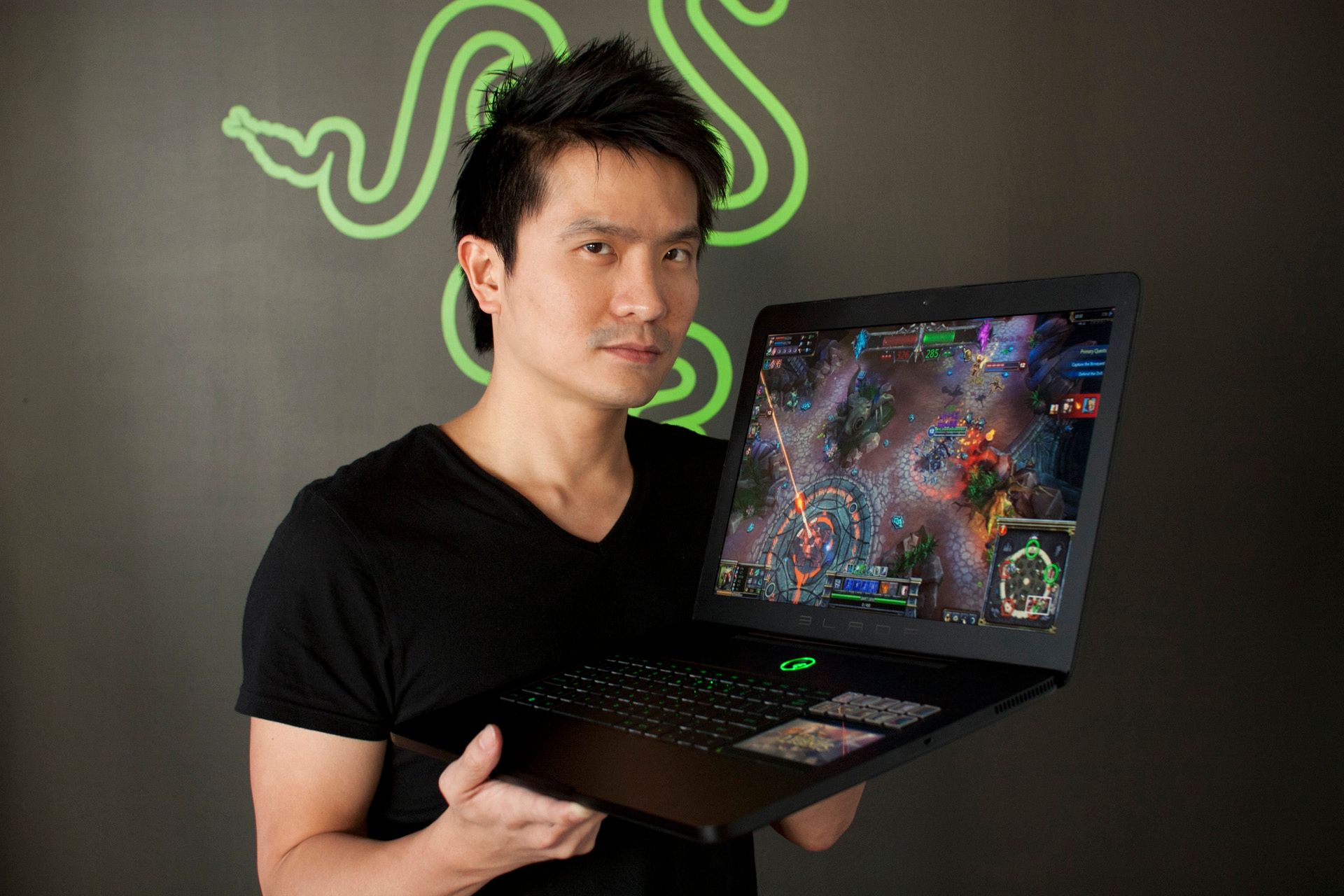
A laptop required a larger leap. When the original Razer Blade appeared in August 2011, it carried a $2,800 price and an unusual second touchscreen beside the keyboard. That display could work as a trackpad or show game information. Ten small adaptive keys sat above it. It looked like a company accustomed to studying the space under a player’s fingers had decided to take responsibility for the rest of the machine.
Tan’s explanation for wanting a gaming laptop was practical. He travelled constantly and wanted to play on the move. In 2013, describing a monthly circuit through San Francisco, Taipei and Singapore, he joked, “I’m based on a plane.” Razer’s geographically scattered design operation was also producing a particularly demanding customer: its own boss, with another flight to catch.
He talked about starting with the features he wanted, rather than selecting a price bracket first. That helps explain both the appeal and the expense of the approach. The wishlist belongs to someone deeply interested in the product. It is not automatically the wishlist of someone shopping on a budget. Tan was candid about that limitation.
Two computers the customers never met
The surviving products can make this process look tidier than it was. Tan disclosed in 2015 that two laptops preceded the Blade internally. Both were fully built and ready for manufacturing. Neither was released. He had used them; very few other people had. The machines disappeared from the commercial story before a customer could form an opinion.
He described ideas arriving from across the company, followed by prototypes and repeated testing with esports players. Feedback meant another revision. A product could spend months or years in that loop. The detail worth keeping is the willingness to stop after the object was already real. An unreleased computer is an expensive way of admitting that a first answer did not satisfy the question.
There is a less charming side to such control. Tan has called himself “a bit of a control freak.” He has described reviewing work as small as a poster or a retail fixture. Early investor Koh Boon Hwee characterised him as impatient and exacting. Intensity can protect a design from compromise; it also sets the conditions in which other people must work. Both belong in the portrait.
“I’m a bit of a control freak.”
Min-Liang Tan, 2014
The audience has a permanent marker
Razer’s customers have occasionally taken their attachment further than a purchase. Some tattoo its three-headed snake on their bodies. That creates an almost absurd imbalance: a product can be replaced at the next upgrade, while its logo remains on the customer. Tan has spoken about that loyalty as a responsibility. The audience has made a rather longer commitment than the warranty.
His public presence helps sustain the relationship. He talks directly with fans through social platforms instead of appearing only when there is a product announcement. Facebook, X, Instagram, LinkedIn and Weibo provide several doors into the same conversation. That accessibility can produce useful feedback. It can also produce a toaster campaign with an unexpectedly long memory.
At a 2017 event, he explained Razer’s expansion through a simple observation: gamers also listen to music and watch films. His imagined store was a place for tournaments, visiting creators and playing, with less interference from salespeople. Retail became another way of letting customers experience the company’s tastes. The product category could change while the intended customer stayed recognisable.
That is a coherent way to expand, although coherence does not guarantee that every expansion will work. It asks customers to trust a judgement beyond the object that first earned their attention. A mouse buyer might consider a laptop; a laptop owner might try a headset. Each step spends some of the trust accumulated by the previous one.
A niche with a stock-market chapter
There are conventional business milestones alongside all the talk of play. Razer listed in Hong Kong in 2017, raising $529 million. In 2022, Tan and founding investor Lim Kaling took it private in a transaction valuing the company at about $3.2 billion. Public ownership was a chapter, rather than the destination at which the story stopped.
The acquisitions show how widely the definition of serving a gamer could stretch. Razer bought THX, the audio business founded by George Lucas, in 2016, and smartphone maker Nextbit in 2017. Its reach also extended into virtual currency through MOL Global. These were different businesses with different demands, held together by Tan’s ambition to build around a player’s wider life.
His own vocabulary for allocating resources has often come from strategy games. In a 2016 conversation, he compared business choices to deciding which units to build in a real-time strategy game. The analogy sounds playful until one remembers that a company cannot reload a saved position. Money committed to one project is unavailable for another. Enthusiasm still has a balance sheet.
- 2005Co-founds Razer with Robert Krakoff
- 2011The first Blade laptop is unveiled
- 2017Hong Kong IPO raises $529 million
- 2022Razer returns to private ownership
- 2025Singapore AI centre announced
The next player may be an assistant
AI is the current test of how far Tan’s instinct can travel. In August 2025, Razer announced an AI Center of Excellence in Singapore and plans to hire 150 local specialists. It outlined a network extending to Europe and the United States, with work ranging from player coaching to tools for testing games. The ambition involves the machinery behind a game as well as the hardware on a desk.
Project AVA makes the consumer side visible. Introduced in 2025 as a virtual esports coach, it appeared at CES 2026 as a holographic desk companion. Razer described a system able to interpret on-screen activity and respond to its user. In February, it clarified that the refundable $20 reservation offered in the United States was an expression of interest, rather than a preorder. A demonstration and a delivered product occupy different places in this story.
Tan has argued for AI that assists developers and supports human creativity. He has also expressed dislike for poorly made generated game content. His proposed dividing line is usefulness to the player and the people building the game. It is an appealing principle, and one whose value depends on what the eventual tools actually do.
During a live interview in January 2026, he faced questions about whether gamers wanted the direction Razer was taking. That is a sharper version of the question behind every self-directed product: how reliably does the founder’s enthusiasm stand in for the customer’s? Direct contact with an audience provides an opportunity to hear the answer. It does not promise agreement.
AI specialist roles Razer announced for Singapore in August 2025. A hiring commitment, not a reported headcount.
Back to school, still answering for the toaster
On 16 April 2026, Tan returned to NUS Law for a conversation about AI, gaming and the law. Professor Tan Cheng Han joined him; Professor David Tan hosted. The discussion placed the former lawyer’s two working worlds together again. In the audience were Razer fans wearing black and green. One attendee had a mousepad signed and was still interested in Project Breadwinner.
The scene supplies a better ending than a list of valuations. More than two decades after graduation, Tan could discuss new technology with lawyers while someone waited for an update about toast. His audience had followed him across professional worlds without surrendering its sense of humour. Neither, evidently, had he.
“At heart, I’m a gamer. In mind, I’m a product designer,” he said in 2016. The order is revealing. Playing supplies the wants; design tries to give them form. The challenge for Tan now is the same one enlarged: to turn a personal appetite into something other people choose to keep on their desks. The toaster constituency, meanwhile, remains an attentive part of the room.