The car had to go. Nina Alag Suri needed an office, and the garage was available once its usual occupant had been evicted. Her starting capital was $1,000. In her recollection, $800 bought a mobile phone and $200 bought a locally assembled desktop. It was a rather thorough equipment budget: the telephone received four times the investment of the computer, and the premises received nothing.
That was the beginning of Nastrac Group, her executive search business. Years later, she would return to the same industry with a different proposition. Having built a company around finding people for jobs, she wanted to build software that could question how those people were being found. A recruiter was preparing to automate parts of her own profession. There is a certain economy in becoming your own competition.
A move that became a market
Suri trained in electronics engineering and attended the College of Engineering, Pravaranagar. Her early working life included ICIM-Fujitsu, where she met Rajeev Suri, whom she married. She went into business in Delhi, establishing Nastrac in 1997 and recruiting for the IT and telecom industries. Banking and finance would later join the firm's areas of work.
Then came Finland. Her husband's promotion required an international move, just as her own company was getting established. She initially resisted. Rajeev suggested treating the relocation as an opportunity to expand her business. For a founder whose enterprise had begun in a garage, the proposed next office was an ambitious commute.
She built European clients and operations, then opened in the UK in 2000 and Singapore in 2005. New Jersey followed in 2012, when her son began college in Boston. Family geography and business geography became intertwined. She described leaving strong leadership teams in the offices she moved away from. The business could travel because responsibility could be handed over.
- 1997Nastrac begins in Delhi
- 2000UK operations established
- 2005Singapore office opens
- 2012New Jersey joins the map
- 2017X0PA AI is founded
- 2025Dubai becomes a regional base
The candidate who disappears
Years in recruitment gave Suri a close view of what a hiring process throws away. In describing the origins of X0PA, she returned to the discomfort of seeing deserving candidates excluded. Gender, ethnicity and economic background could affect who progressed. A decision might look routine from the employer's side while closing a door for the person on the other side.
This concern was rooted in the work she had already done. Executive search depends on judgment: understanding an employer, assessing a candidate, deciding whom to introduce. Suri had seen how that judgment could carry assumptions along with it. The difficult question was how to preserve useful experience while reducing the exclusions that experience could also produce.
Her engineering background offered another way into the problem. She had long been interested in automation and productivity, and began considering a product that could unsettle her existing search business. X0PA AI was founded in Singapore in 2017, with Jussi Keppo involved as a co-founding adviser. The recruiter had returned to engineering, carrying a collection of human problems with her.
“a compulsive geek at heart”Nina Alag Suri, on her engineering instincts
A shortlist with a wider door
Suri's recurring phrase is “screen in”. It changes the emphasis of a familiar recruitment task. Screening usually suggests making a pile smaller. Her ambition is to find reasons a person might belong in the next stage, including reasons a conventional filter might miss.
Her 2024 writing on candidate screening examines the limits of eliminating applicants through rigid criteria. A required degree, an exact number of years or a particular keyword can make a process manageable while overlooking potential. The neatness of the shortlist offers little comfort to someone whose ability sits outside its rules. A tidy filing cabinet is a poor judge of character.
For Suri, skills are the more useful starting point. In her public explanations of the platform, she describes assessing what candidates can do while leaving out personal characteristics and educational pedigree. The aim is to make room for a person's capabilities to register before familiar labels have settled the argument.
Her discussions of hiring also extend to people already inside a company. Internal mobility asks whether an existing employee could fit another role. It is an appealing extension of the same idea: a business may already employ someone whose next opportunity is hidden by the title on their current desk.
In a conversation with Jeff Mains, she discussed natural language processing, skills-based screening and recruitment interactions that need not begin with a conventional résumé. These are practical questions about access. Someone has to decide which information counts before a hiring system can decide whom to put forward. Suri's work keeps returning to that first decision.
The practical appeal is easy to understand. An employer looking at a candidate for a different role has to translate previous experience into possible future work. That translation leaves room for questions a fixed checklist cannot settle. Suri’s emphasis on matching skills asks the system to help make those connections visible, giving the recruiter more to consider before closing an application.
The machine needs explaining
There is an awkward responsibility attached to Suri's ambition. If software helps choose which candidates receive attention, its reasoning matters. Faster processing alone cannot tell an employer whether a recommendation deserves confidence. The person whose application has been assessed has a stake in that explanation, too.
In her 2023 discussion with Microsoft's Masako Kodama, Suri described X0PA's AI Verify status as an achievement she especially valued. She also described adoption by Singapore polytechnics for internships and graduate hiring, and selection by Workforce Singapore for its national job portal. These settings take the problem beyond one company's vacant desk and into pathways through which people enter work.
Her stated goal is an objective, skills-based process. That remains a goal to be tested, rather than a reason to assume an algorithm has become impartial. Suri herself has emphasised the need to validate algorithms. A system designed to reduce bias still needs people who ask what it is doing and why.
Two businesses, two ways to pay
Nastrac grew without external funding, Suri has said. X0PA brought a different set of demands. Software development and international distribution required her to think again about capital and ownership. The garage founder's experience could travel into the new venture; its financing model did not have to follow.
In January 2022, X0PA announced a $4.2 million Series A led by ICCP SBI Venture Partners, with SEEDS Capital, AI8 Ventures, XCEL NEXT VENTURES and SASV Investments also participating. The money was intended to support international expansion and product development. Suri had moved from personally funding a phone and desktop to assembling investors across several markets.
When she later discussed the round with Sriram Iyer, she described choosing investors for their geographic reach and agreement with the company's direction. She said roughly 60 percent of investment was going toward sales, marketing and market expansion, with 40 percent toward innovation and research and development. The business of building software also involved the business of getting it into somebody else's organisation.
Her approach to expansion had a deliberately practical limit: enter markets in portions the company could handle. It was a familiar concern for someone who had previously built overseas offices while leaving managers responsible for those already operating. Ambition still needed a timetable, a team and a budget.
Singapore behind her, Dubai on the calendar
Singapore remained the headquarters of X0PA. Suri's connection to it was personal as well as commercial: she wrote in 2025 about the country being a home where her family had flourished and the natural place to establish the new venture. In 2024, the Singapore Computer Society recognised her in the Digital Achievers individual category of its Tech Leader Awards.
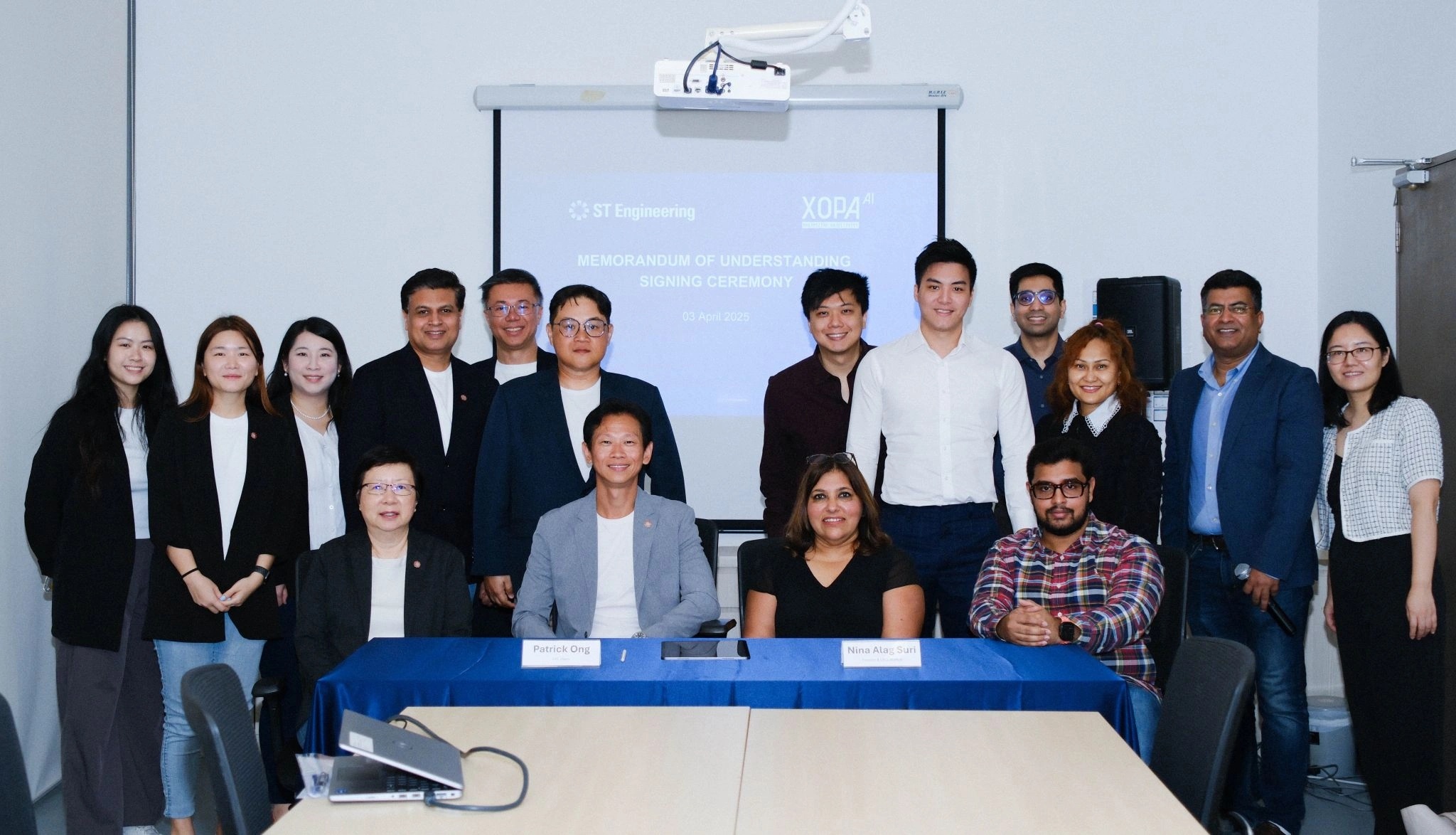
The Middle East offered another chapter. A 2020 partnership with Seed Group had already established a route into the UAE. By August 2025, Suri was describing life in Dubai and the work of establishing a regional headquarters there. She chose to learn the market herself before building a local team.
Her day began around six with her dogs, followed by work with Singapore, four hours ahead. UAE client and investor meetings occupied the afternoon. She planned the next day's work before finishing the current one. Away from meetings, she enjoyed the cinema and listened to startup and AI podcasts, describing her own listening choices as boring. Her entertainment had developed a suspicious resemblance to her business.
Her professional circle also includes Chief, the network for women executive leaders, where she has been described as a founding member. The connection sits comfortably alongside a career built through international offices, advisers and investors. A company selling automation still depends on people who introduce it, question it and help it reach a new market.
Another hand on the controls
By May 2026, Suri was appearing at Plug and Play's Silicon Valley Summit in Sunnyvale, in an event connecting Singapore-based AI founders with investors and the wider technology community. International expansion had brought her back to the work of explaining a new business to a new room.
In August, X0PA appointed Sri Harsha Allamraju president, giving him responsibility for product and commercial functions across four operating regions. Suri remained founder and CEO, leading corporate strategy, capital, acquisitions and global market development. Delegation had again become part of making the next move possible.
On 1 October 2026, she put a sharper boundary around that ambition in an essay about the agentic workforce in Singapore and the Middle East. AI could prepare a decision; people should remain responsible for closing the door. She urged employers to define fairness, examine outcomes and have systems tested independently. Her position makes supervision a task that requires actual attention, rather than a name attached to an automated process.
“let AI rank, never let AI reject”Nina Alag Suri · October 2026
The line running through her career is unusually consistent. Each business asks how a person reaches an opportunity; each expansion asks who can carry responsibility forward. Her first office required moving a car. The later venture asks employers to move some of the assumptions that occupy the entrance to a job. Suri has spent a working life finding people a place. She is still revising the rules of admission.
Continue the conversation
- Read: The Agentic Workforce in Middle East and Singapore ↗
- Nina's LinkedIn articles and updates ↗
- Nina on Twitter/X ↗
- Explore X0PA AI ↗
- Read: The Power of Screening-In Candidates ↗
- Watch: Nina's interview with Seed Group ↗
- Listen: funding and expansion with Sriram Iyer ↗
- Read: Nina's Dubai morning routine ↗