The applicant had been busy. For more than fifteen months, according to Buddhishan Manamperi, the student had manually committed the same print statement to GitHub, again and again. The resulting contribution chart offered the reassuring spectacle of regular activity. Underneath it sat a much smaller accomplishment. It was an unusually laborious way to produce very little software.
Manamperi told the story while explaining what catches his attention in applications for internships and entry-level jobs at Fcode Labs. He wanted side projects, explanations of the learning process, and contributions to other people’s code. He also invited candidates to describe projects that had failed. “Share your failures,” he wrote. A neat chart could wait; he wanted a conversation about the work.
There is a useful introduction to him in that distinction. The co-founder and co-CEO of Fcode Labs spends much of his public writing asking how people demonstrate understanding. Across hiring, product design, and remote engineering, he keeps returning to the details that make collaboration possible. The software matters. So does what the person building it has been allowed to understand.
A house with three job descriptions
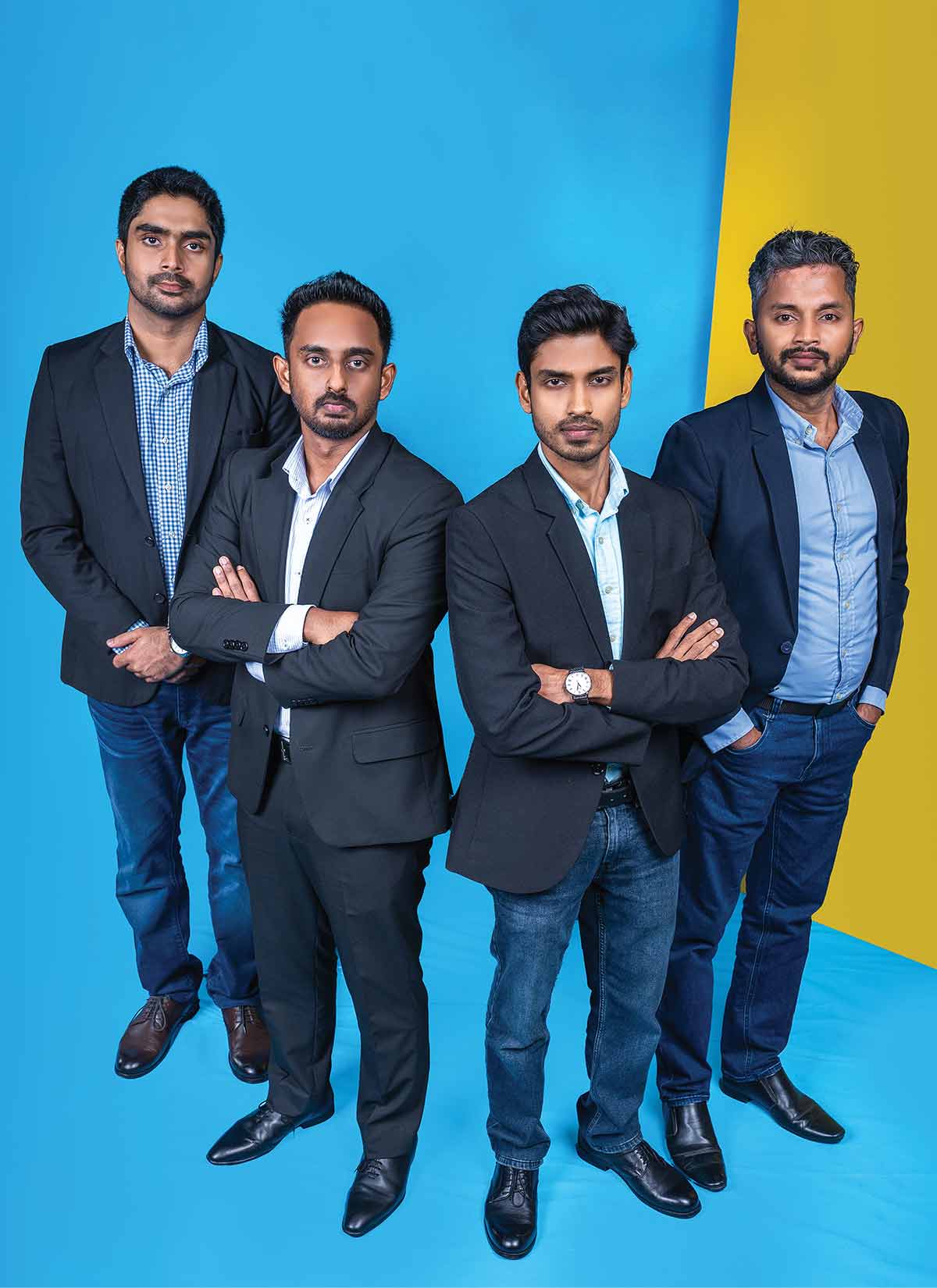
Fcode Labs began in December 2018, in a room in Manamperi’s family home. The other founders were Tharindu Malawaraarachchi and Ramesh Rathnayake, friends from the University of Moratuwa. This was a return to entrepreneurship after earlier student ventures had failed and the friends had gone into separate jobs. They were comfortable, they later recalled together, but still wanted another attempt.
By June 2019, the company had a dedicated office in a two-story house in Piliyandala. There were still only three founders to do the work. Tharindu and Ramesh lived upstairs. Setting up a company included arranging the interiors, making branding materials, and handling cleaning and maintenance. The executive team could presumably find whoever was responsible for the furniture without issuing a calendar invitation.
Those practical details make the beginning easier to picture than any polished origin slogan. A household room became a business; another house became its workplace. Responsibilities were shared because there were few people available to share them. Building the company meant attending to both the software and the place in which the software would be made.
Dated snapshots of Fcode Labs’ reported team size
An engineer with an accounting qualification
Manamperi’s qualifications straddle technical and commercial work. He studied at the University of Moratuwa, and his professional biography lists an engineering honours degree, an MSc, and a CIMA Advanced Diploma in Management Accounting. His public profile also lists a year with Battaramulla Toastmasters Club, from April 2021 to April 2022. That is a useful combination for someone whose working life now involves both what a team can build and how a company earns the opportunity to build it.
The division of work among the founders has its own logic. Manamperi and Malawaraarachchi share the chief executive role; Rathnayake is chief technology officer. Fcode Labs describes Manamperi’s contribution in terms of creative direction and market positioning, while Malawaraarachchi’s includes global partnerships and operational strategy. The shared title sits above complementary responsibilities. Their business has several people available to ask different questions about the same opportunity.
On his own website, Manamperi calls himself an “engineer at heart and a founder by purpose.” The two roles make different demands. An engineer needs to understand a problem closely enough to solve it. A founder must also make the problem understandable to colleagues, customers, and people who have yet to join. His later advice often occupies that space between doing the work and explaining why it matters.
The résumé has a skip button
He was thinking about that explanation in January 2021, when he compared a CV to a YouTube advertisement. The reader, like the viewer, can leave almost immediately. His argument was to make relevant skills and interests visible early, think about the particular employer, and earn enough attention for a fuller conversation. His examples moved easily from software to an advertisement for cheese kottu. Career guidance need not arrive wearing a tie.
The analogy gives his more recent hiring advice some continuity. Presentation gets someone to look. After that, the applicant needs something concrete to discuss. A side project allows questions about choices and mistakes. Documentation makes a line of reasoning available to another person. Even a small open-source contribution can show how someone works inside an existing project.
His advice to students also leaves the door open to people who did not take IT at school. In a 2023 conversation about entering the industry, he emphasised enthusiasm for learning, logical thinking, problem-solving, and programming fundamentals. Specific technologies come later. It is a practical invitation: begin with the habits that let you approach an unfamiliar problem, then keep adding to what you can do.
“Share your failures.”
Buddhishan Manamperi, on applications for early-career roles
Give the team the whole problem
For engineers already inside a company, the question becomes what information reaches them. In his writing about remote teams, Manamperi describes a familiar complaint from clients: engineers do the assigned work but contribute few ideas. He asks managers to consider whether those engineers have been given enough of the wider picture to offer something useful.
He recommends sharing commercial context, including customer reactions, acquisition plans, and the progress of investor conversations. He points to the openness of a founder at Berlin-based Exazyme as an example. Elsewhere, he recalls a management team going away for several weeks and returning pleased with what the engineers had delivered in their absence. In his telling, the room to take responsibility helped the work along.
His writing on feedback supplies the practical machinery around that freedom. Clear task descriptions reduce avoidable confusion. Problems should be discussed promptly. He describes Fcode Labs gathering feedback from client managers, supervisors, and engineering colleagues, rather than waiting for one person’s verdict. He also recognises that expectations about directness can differ across cultures. A team needs an accepted way to raise a concern before the concern becomes an argument.
That same attention appears in his discussion of time zones with Swedish partner Anton Lundberg. Manamperi describes almost complete working-time overlap during a project’s early stages, then about 70 percent as the team matures. Regular conversations and usable documentation make the arrangement possible. Overlap has a purpose: establish shared understanding, then give people a workable rhythm. A meeting invitation is useful only if the meeting is useful.
Shared hours change as a remote team matures
The explanation that should only be recorded once
The less photogenic parts of company building interest him too. In an interview about Fcode Labs’ use of uQualio, Manamperi described an onboarding problem: the people who could explain company procedures were not always free when newcomers needed them. Repeating live orientations consumed time, and some sessions were delayed or missed. A growing business was depending on finding the right person at the right moment.
The company recorded two series of engineering orientation videos, accompanied by supporting material. New employees could revisit the lessons, managers could track progress, and individual sections could be updated without recording everything again. In the testimonial, Manamperi said, “We’ve cut training time in half.” It is a company-reported result, and a revealing choice of subject for a chief executive to discuss.
The attraction is easy to understand. A reusable explanation makes knowledge less dependent on someone’s calendar. It also gives the newcomer a second chance to hear something without assembling the original audience. Alongside his advice about documentation and feedback, this is a consistent concern with making information available when another person can actually use it.
Try the experience before writing the code
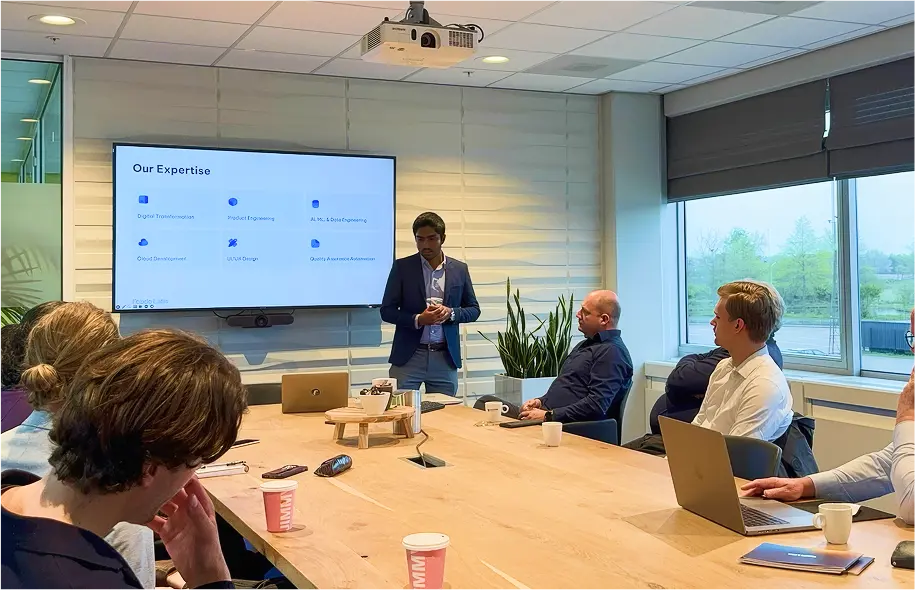
In Copenhagen, that concern took a different form. At a June 2024 event hosted with uQualio, Manamperi spoke about user experience throughout software development. He recommended trying out an experience with Figma or even PowerPoint before implementation. A simple rehearsal can give people something definite to react to while changing the plan is still comparatively straightforward.
His relationship with Europe extends beyond a speaking engagement. In April 2025, Fcode Labs announced Lundberg as its partner and country director for Sweden. The partnership connected the company’s engineering work with someone familiar with European technology businesses. For Manamperi, discussions about communication across countries have an immediate commercial setting: these are relationships through which his company works.
A shorter distance between signal and decision
By March 2026, Fcode Labs was discussing Forevate, a market intelligence service combining internal company data with outside signals such as competitor activity, pricing, and social trends. Manamperi explained the premise through the difficulty of planning far ahead when conditions can change quickly. The company was described at that point as a 100-member team serving markets in more than ten countries.
Forevate addresses a larger organisational version of a question visible throughout his work: which information helps someone decide what to do next? A hiring manager has an activity chart. An engineer has a task. A new employee has procedures to learn. A business has market signals to interpret. Each needs enough context to turn the available material into a useful choice.
For Manamperi, growth has brought more people into that conversation. The company once fitted inside a room in his family home. Now the work includes helping colleagues and clients understand things without having all the founders beside them. His advice to applicants remains a fitting place to end: bring something you have tried, explain the choices, and be ready to talk about what happened. Even an imperfect project gives everyone more to work with than another green square.
Follow the conversations
More from Manamperi, the people he works with, and the conversations behind this profile.
- Personal website
- Fcode Labs founders
- The company’s early years
- The family-home beginning
- The first dedicated office
- Company profile and qualifications
- His hiring advice
- Your CV is a YouTube Ad
- Communication and autonomy
- Feedback in remote teams
- The time-zone discussion
- Onboarding interview
- Copenhagen event recording
- Forevate interview