Before Arimac’s clients included airlines and banks, Chamira Prasad Jayasinghe and his friends repaired laptops to pay university fees. He had entered the Sri Lanka Institute of Information Technology on a scholarship. When his grades slipped below the scholarship requirements, the funding disappeared. Freelance code and broken computers became a way to continue his education. The business education arrived without a separate tuition bill.
That episode sits rather neatly beside the company he went on to build. Arimac, founded in 2011, has moved between enterprise software, video games, immersive experiences, robotics and artificial intelligence. Jayasinghe’s interests are broad. The problem behind them has been remarkably consistent: talented Sri Lankans needed somewhere to do demanding, imaginative work without having to leave the country to find it.
By October 2026, he was receiving the National AI Leadership Excellence Award. The photograph has the familiar ingredients of a business ceremony: a stage, a trophy, formal clothes, confetti. The less photogenic part of the story is more revealing. It involves university work, introductions, unsuccessful games and the patient construction of a company that could afford another experiment.
A programmer before the job title
Jayasinghe’s technical interests were established well before Arimac acquired a corporate identity. At school, he developed a Sinhala operating system and won a national young computer scientist award in 2007. The choice of language matters in this story. Years later, he would argue that English fluency should never decide who gets to work in technology.
At SLIIT, he pursued information technology and graduated with first-class honours. His student projects included interactive computing work; Kadapatha received a silver award at the 2010 National Best Quality Software Awards. A lecturer, Malitha Wijesundara, became a mentor during this period. Jayasinghe has repeatedly credited the institution’s staff with giving him people against whom to test his ideas.
There is a practical streak beneath the enthusiasm. His advice to would-be founders has been to develop expertise, find a mentor and make something people want. It is an admirably unromantic set of instructions from someone whose later ambitions included robots and animated films. Someone, eventually, has to want the thing.
Four days to make the cricket work
In 2012, musicians Bathiya and Santhush brought Arimac an opportunity connected to the Sri Lanka Premier League. The young company was already working on their website and digital activity. Could it produce a way to stream the cricket? Jayasinghe accepted before he had worked out the method.
“I didn’t even know how to do it, but I said yes.”
Chamira Prasad Jayasinghe, recalling the cricket project
The team delivered a working solution four days later. For an early business, a successful project of that kind did more than add an item to a portfolio. It gave other people a reason to make introductions. Saliya Weerasekara of Ants Work helped connect the founders to the Sri Lankan management of major consumer brands. Work for one market could become an introduction to another.
Jayasinghe still named Bathiya, Santhush and Weerasekara when discussing the people who had supported his career years later. The origin story contains plenty of nerve, but also a network. The door opened because people who knew the team were prepared to recommend it.
The client work pays for the curiosity
The public may remember a game or a robot more readily than an airline application. Jayasinghe’s business has needed both kinds of work. Arimac developed enterprise and mobile systems while pursuing projects whose value included the skills learned along the way. A game could stretch the team’s graphics, design and engineering abilities, even when its immediate economics were awkward.
Its international work also helped answer an early problem at home. When the company began offering digital interactive media, the local market was still developing. Overseas customers offered opportunities to build a portfolio; that portfolio helped win confidence in Sri Lanka. Clients including Coca-Cola, Nestlé and Unilever became part of that expansion.
In 2019, Airspace, Arimac’s platform linking airline systems, accounted for much of its sales, with Emirates and Etihad among its early users. This is a useful corrective to the temptation to tell Jayasinghe’s career entirely through its most theatrical projects. Connecting systems that previously operated separately is less likely to become a poster. It can, however, help keep the studio working.
A game can lose money and still leave something behind
Games were personal territory. As a child, Jayasinghe had enjoyed building them with Visual Basic 6. Later, he became lead engineer on Kanchayudha, a PC game released in 2016 with a Sri Lankan backdrop. An interview with SBS that December found him explaining the project as both Arimac’s leader and its project head.
The release attracted attention beyond the immediate audience for local games. It also brought the uncomfortable business of learning what a released game demands. Bugs, optimisation and commercial returns do not become less pressing because the setting is culturally meaningful. Jayasinghe acknowledged the company’s failures around Kanchayudha while arguing that the experience helped make local game development seem possible.
By the time Arimac prepared NERO for release in September 2021, the conversation included publishing, pricing and how to earn money from games. Jayasinghe described years spent building capabilities in engineering, graphics, design and sound. The next task was learning the commercial machinery around them. Creating a world and selling admission to it require different skills.
He also discussed patches and a team assigned to respond to problems. That detail is less glamorous than a launch announcement and rather more persuasive. It recognises that a game continues to become a product after it reaches players. The work does not politely stop when the trailer ends.
Who gets through the door?
The employment question was present from Arimac’s beginning. Jayasinghe wanted to give creative technical people tools, infrastructure and a reason to develop their careers locally. He has challenged the assumption that a degree and fluent English must be the entry ticket. His own first-class qualification did not make him insist that everyone else follow the same route.
The point was demonstrated in recruitment as well as explained in interviews. He found creative collaborators through work they had posted on Facebook. The ability to make something could introduce a person more effectively than the conventional application. For a company attempting to put art and engineering in the same room, portfolios had obvious advantages.
His public university testimonial also places learning within a set of relationships. Lecturers, family, early commercial supporters and employees all appear in his account of how the company grew. The founder is visible, but the list of people around him is long. His story becomes more interesting when those people remain in it.
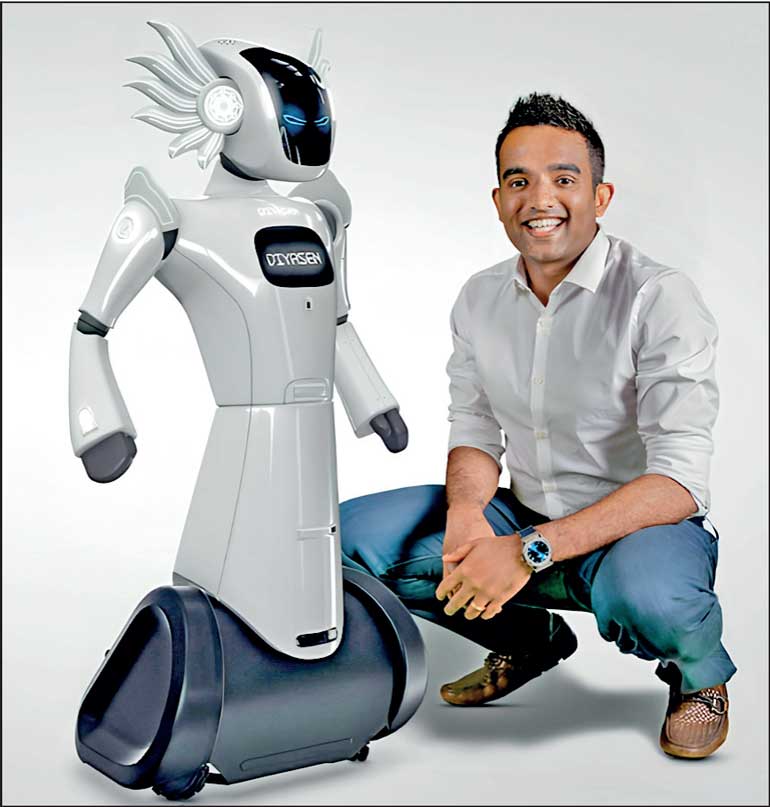
The robot is part of the same argument
Diyazen gives the company’s technical ambitions an unusually literal face. With its dark screen, white body and elaborate headpiece, the humanoid robot makes a different introduction from a software dashboard. Jayasinghe presented Arimac’s product work at Google I/O Extended Sri Lanka in 2018; the company’s experiments in robotics became one of its more visible public projects.
Underneath the different appearances, there is a shared interest in how people encounter technology. His professional profile identifies human-computer interaction as a core skill. Arimac’s work has ranged from mobile applications to immersive experiences and robotics. The interfaces change; making an interaction useful and understandable remains a recurring task.
He has taken that interest back into education, with a visiting lecturer role at SLIIT listed from 2017, and into the wider industry through SLASSCOM. In a 2017 talk published by Arimac, his appeal to young talent was explicitly tied to Sri Lanka’s place in technology. The audience he wanted to encourage extended beyond prospective customers.
Now the work speaks Sinhala and Tamil
The October 2026 award places Jayasinghe’s current work in a more specific frame. Arimac’s AI portfolio includes AgentOS for agentic operations, AIDAS for Sinhala and Tamil conversational AI, and Sherlock for fraud intelligence and electronic customer verification. The company also received national honours for financial-services AI and local-language innovation.
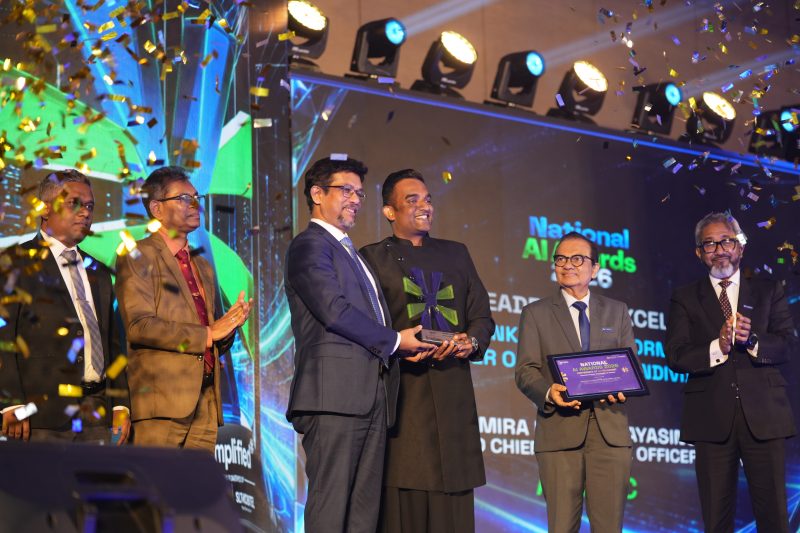
The language work gives a concrete form to an old concern. A founder who argued that English should not determine entry to a technical career now leads a business building conversational systems in Sinhala and Tamil. The two activities address different users, but both make language central to who can participate.
Arimac’s present footprint includes Sri Lanka, Dubai, Sydney and Fiji. Its website reports more than 850 digital solutions delivered across more than 11 countries. Those are company figures, describing collective work. They also show how far the range of assignments has widened since university freelancing, even as Jayasinghe continues to return to the talent available in Sri Lanka.
His current ambition is to help the country build AI technology as well as adopt it. That is a substantial task, and it suits the longer pattern of his career: learning enough to make a new kind of thing, finding people to build it with, then working out how the business can support it. Laptop repairs were a modest beginning. They already contained two enduring habits: solve the immediate problem, and keep the next possibility open.