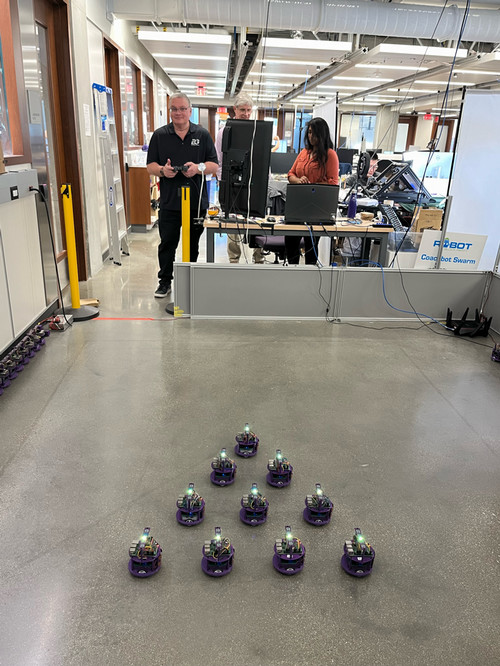
Ten small robots sit in a triangle on a laboratory floor. Behind them, Tom Wagner holds a controller. There are monitors, cables, yellow posts and the familiar university arrangement in which every available surface appears to have acquired a project. The photograph comes from his 2024 visit to Northwestern. For someone whose career includes running a robotics company, this is an appropriate place to stand: close enough to the machines to see what they actually do.
Wagner had come to discuss turning technology into a business. His talk traced a technology company’s journey from idea to impact, with the subtitle “Dogs and Cats Living Together.” The subtitle suggests an awareness that a company contains creatures with different instincts. A researcher, an investor and a customer can look at the same robotic arm and see three entirely different things. Getting them into the same room is the beginning of the work.
He had spent years moving among those rooms. A doctorate at the University of Massachusetts Amherst. University teaching. Honeywell. DARPA. The chief technology officer’s job at iRobot. Then Berkshire Grey, founded in 2013 to apply AI and robotics to fulfillment and logistics. The problem was substantial. Its everyday description could hardly be more modest: get this thing over there.
A doctorate meets the workbench
Wagner completed his UMass doctorate in 2000, in artificial intelligence and computer science. He also holds degrees from Michigan State University and the University of New Hampshire. His subsequent career crossed academic, government and corporate settings, each with its own way of deciding whether an idea deserves more time.
At the University of Maine he was a professor. At Honeywell he served as a principal lead. At DARPA, he created, managed and transitioned research programs, including work in AI, robotics, logistics and communications. The verbs matter. Creating a program gives a technical possibility a structure; transitioning it asks whether that possibility can travel beyond the people who first understood it.
From 2008 to 2012, he was iRobot’s CTO. The company made the Roomba, bringing mobile robotics into an unusually intimate testing environment: the home. A living room has furniture, thresholds and owners who have made no professional commitment to simplifying a robot’s afternoon. Consumer robotics makes the distance between technical intention and actual use rather visible.
Berkshire Grey took Wagner toward another environment full of things that refuse to be conveniently arranged. Warehouses contain items with different shapes, surfaces, packaging and destinations. Commerce gives this variety a reassuring name, inventory, then expects it to move on schedule. The underlying engineering is less reassured.
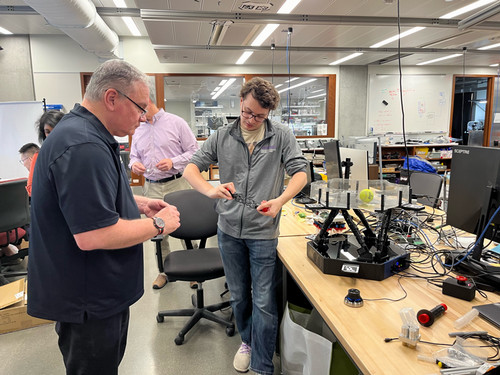
The awkward object is the assignment
It is easy to watch a robotic arm lift something and admire the arm. The more interesting part is the chain of decisions that made the lift possible. The system needs to interpret what it sees, select an object, choose where to grasp it, plan a movement and put it down somewhere useful. An object can be perfectly ordinary to a shopper while presenting several separate questions to a machine.
Berkshire Grey’s current picking system, Core, brings perception, gripping, planning and placement together. Its other systems address parcel sorting, shuttle sorting and trailer unloading. These products concern different points in the journey of physical goods. All belong to the broad territory Wagner chose when he founded the business: the operations that turn a purchase into something a customer can receive.
A warehouse provides a particular test of intelligence. Recognition alone leaves the object in the bin. Movement alone leaves open the question of whether the right thing moved. And a successful individual pick leaves a larger question about the next pick, the next order and the rest of the operation. Useful automation has to connect these answers.
- 01SeePerceive the items
- 02ChoosePlan a grasp
- 03MoveLift and transfer
- 04PlaceReach the destination
Conceptual sequence, simplified from Berkshire Grey’s description of its integrated picking capabilities.
That is why this business can be hard to explain with a single dramatic demonstration. The visible motion is brief. The work around it includes identifying goods, coordinating equipment and fitting a machine into a process that already has its own rules. A robot has arrived at work; the warehouse still has a shift to finish.
The screwdriver rule
Early investor Rich Boyle supplied a useful description of the culture Wagner’s team built: “PhD with a screwdriver.” He described technically accomplished recruits helping assemble systems, learning their physical construction along with their intellectual design. The doctorate did not excuse anyone from meeting the hardware.
There is quiet good sense in that arrangement. A research result and an assembled machine offer different kinds of feedback. A mechanism can make a disagreement unusually concrete. Something fits, moves, grips or fails to do so. The discussion then has an object on the table, which can be helpful in an organization full of people trained to argue persuasively.
The company’s 2021 investor presentation listed Matt Mason as chief scientist, alongside Wagner as CEO, Steve Johnson as COO and Mark Fidler as CFO. It also reported that 75 percent of employees had technical degrees. That historical snapshot shows the mix the business needed: scientific depth, operating leadership, financial management and commercial work. Wagner’s job put him among all of them.
“PhD with a screwdriver.”
Rich Boyle, describing Berkshire Grey’s engineering culture, 2018
A customer has to live with the machine
In his public business conversations, Wagner repeatedly returned to the customer’s operation. A 2021 investor interview described planning automation around a customer’s goods, pressures and distribution network. Some capabilities could be installed first, with others added later. The relationship extended beyond selling a piece of equipment.
One example concerned careful handling in Japan. Wagner explained that blemishes in outer packaging could matter to the customer even when the product itself was intact. That requirement became a reason to develop a careful-handling capability. The lesson is pleasantly exact: an engineer may have moved the item successfully while the customer still has a damaged package.
It is a small distinction with commercial consequences. A machine has to satisfy the definition of success used by the operation buying it. Those definitions can vary by market and application. Learning them requires a conversation, and sometimes another version of the machine.
Wagner’s own summary of the obligation was brief: “We have to execute well.” It is a sentence with little decorative value and considerable practical content. For a founder trained in AI, the customer’s verdict arrives through a collection of everyday questions. Did the goods move? Did the system fit the process? Can the business depend on it tomorrow?
The company’s present-day service offering includes monitoring, a round-the-clock help desk, on-site assistance and ongoing improvement work with customers. Those provisions put the machinery inside a continuing relationship. Installation creates obligations that survive the sales presentation. For the organization Wagner founded, being useful means attending to what happens during ordinary operations, after the visitors have left and the next batch of orders has arrived.
Public, private, still building
Berkshire Grey emerged from stealth in 2018. In July 2021, it completed a merger with Revolution Acceleration Acquisition Corp. and began trading on Nasdaq. The company that Wagner had started eight years earlier had entered a new kind of public life, with investors examining its plans alongside its technology.
In March 2023, Berkshire Grey announced an agreement for SoftBank to acquire the company in a transaction valued at approximately $375 million. The acquisition closed that July. Berkshire Grey became a wholly owned subsidiary, returning to private ownership. A listing and an acquisition are both milestones, but they describe ownership arrangements rather than a robot’s ability to handle the next object.
The sequence gives Wagner’s career a more complicated shape than a founder story that ends at the stock exchange. The business passed through venture backing, public markets and a corporate parent. Each chapter brought a different institutional setting around the same practical activity of building and deploying automation.
Another change followed in February 2025. Wagner introduced Dave Paratore as the new CEO. He signed the announcement as founder and chairman, former CEO, and described the company’s early mission in terms of customer efficiency, quality, prices and getting goods to new places. He also named integrity, honesty, hard work and service among its values. The announcement put the next phase in someone else’s executive hands.
Dogs and cats, in the same room
Return to Northwestern, where Wagner spent three days as an executive in residence. He met students and faculty, visited laboratories and talked about teams, venture capital, customers, work-life balance and uncertainty. A person expecting a lecture confined to robots would have encountered a considerable amount of human organization.
The choice of subjects fits his route through the field. A company has to make room for technical doubt while giving customers a reason to commit. It needs people who can pursue an unfamiliar problem and people who can insist on a delivery date. The title about dogs and cats allows those tensions a little comedy. A sense of humor is useful when everyone in the room has a different, defensible priority.
UMass recognized Wagner with its Outstanding Achievement in Technology Development Award in 2016, and lists him on its computing college’s advisory board. The connection to the university continues alongside the commercial biography. The scientist who left campus to build things still has reasons to come back and discuss how building works.
In the laboratory photograph, the robots are small enough to make the industrial business seem temporarily distant. Wagner stands behind them, among the equipment and the people. The scene offers a modest ending for a career built around physical intelligence. There is something to understand, something to assemble and something waiting to move. Start there.