A photograph of a crack has a peculiar limitation. It records the problem beautifully, then leaves somebody else to worry about the next step. Where exactly is it? How serious is it? Which repair should happen first? Shaun Koo’s working life has increasingly revolved around those questions. The camera gets the attention. The decision gets the budget.
Koo is the Singaporean CEO and co-founder of H3 Zoom, an inspection technology company whose tools combine images, artificial intelligence and the practical business of maintaining buildings. He began exploring drone inspections in 2016. A decade later, the story has grown beyond sending a camera up a wall. It concerns what happens when the images come back down.
That is a less cinematic problem than flight, but a more interesting one for anyone who has ever received a report and wondered what, precisely, they were supposed to do with it. Buildings are expensive possessions with an unfortunate tendency to continue ageing after the opening ceremony. Someone has to keep paying attention.
Before the camera, the room
Koo’s route into this work passed through software, analytics and acoustics. His earlier personal biography describes enterprise software work for a nonprofit in Brazil, a stint at HBO in New York City, and two years at a retail analytics firm in New Jersey. There, his responsibilities included managing, maintaining and optimising systems. Those are jobs in which keeping something working can be as important as getting it working in the first place.1
He also became a director at Aural-Aid, an acoustic solutions startup. His later speaker biographies describe co-founding an architectural acoustics business serving clients including Google, IBM and Airbnb. Before asking cameras to read buildings, he had already worked on how buildings behave for the people inside them.
The connection is suggestive rather than mystical. Software involves turning information into operations. Acoustics involves the physical consequences of a room. Inspection puts digital information and physical space in the same conversation. Koo’s career had given him experience on both sides of the table, long before an airborne camera became part of the discussion.
By January 2020, he was appearing at SGInnovate’s Robotics Revolution event as H3 Zoom’s CTO and co-founder, leading product development and solutions engineering. The title described a technical role. The work already required the judgement of somebody who could understand a customer’s building as well as a software system.2
A building makes a demanding test subject
The early idea was straightforward enough to explain: send drones around façades, capture images, and use software to help identify problems. Making that useful required somewhere to try it. In 2016, H3 Zoom participated in JTC’s Open Innovation Call under H3 Dynamics. The collaboration helped develop Facade Inspector and gave the technology actual properties on which to prove its usefulness.
One early result makes the proposition tangible. At JTC Summit, a pilot brought inspection time down from approximately four weeks to four days. That is a particular building and a particular trial, rather than a promise that every future job would follow the same schedule. Still, a facilities team can understand the difference without a lecture on machine learning.3
Reported inspection duration for this pilot. Bar lengths use 28 calendar days to illustrate four weeks; results vary by site.
In July 2018, Koo presented the system at a media showcase at PIXEL @ one-north. The demonstration followed the information through its journey: drone cameras captured building images, the images went into the AI engine, and the software produced a dashboard, a defect summary and an inspection report. The useful demonstration was the whole sequence.4
There is something clarifying about a real building. It refuses to cooperate with a slide deck. A pilot has to contend with geometry, access, operators and the needs of the people responsible for the property. Those complications are exactly what make a successful trial worth discussing.
The flight is only the first act
Drone inspection was also entering a setting with its own established practices. In 2018, a public-housing pilot in Yuhua brought drone cameras to occupied residential blocks. The arrangements included designated flying windows and masking software to blur residents if they appeared in captured images. Better inspection had to coexist with the everyday life of the building.5
The system’s capabilities were developing too. The contemporary account described detection of water marks, wall cracks and peeling paint, while noting that rust and corrosion were outside its programming at that point. It is a useful snapshot of technology at work: a specific capability, with a specific boundary.
Koo’s software strategy subsequently left room for several kinds of machines. H3 Zoom expanded beyond drone imagery to workflows involving body-worn cameras, fixed cameras and robots. A partnership with ELID connected façade assessments with robotic gondolas, which could work in tight urban environments where drones might be less suitable.6
For the person managing the property, the device is part of the route to an answer. A drone, a camera or a gondola can each gather evidence. The business becomes more useful when that evidence can enter a shared process. Koo’s willingness to leave the capture hardware open gives the software somewhere to grow.
The customer asks the awkward question
Customers supplied a consequential correction to the early product thinking. Detecting a defect was useful, but property managers and contractors wanted help choosing the next action. Koo recalled their feedback in 2026: “They told us that what they needed was help deciding what to do next.” That sentence contains an entire product brief.7
A finding becomes useful when someone can decide what to do about it.
THE QUESTION BEHIND THE PRODUCT
Developing the system also required inspection data the team could not simply acquire from a convenient downloadable collection. H3 Zoom conducted inspections itself, combining software subscriptions with services. That brought the business into contact with the conditions it was trying to interpret.
Its current platform organises defects by location and severity, with workflows that support review and maintenance priorities. The emphasis follows the customer’s question. An observation needs enough context for another person to understand why it matters, then enough structure to be used alongside other observations.
- CaptureCollect visual evidence
- LocatePut the finding in context
- AssessReview type and severity
- PrioritisePlan the next action
At H3 Zoom today, exterior inspection and room-level interior inspection sit alongside reporting and remediation workflows. The company’s description includes data from drones, 360-degree cameras and robotics. For Koo, this broadens the problem from spotting something on a façade to keeping useful records across the life of an asset.8
A founder with his feet on the ground
Koo has written about returning to site every few months. In a November 2022 post, he described spending two weekends with field operations colleagues and being reminded to stay grounded. He linked innovation with operating within performance limits and earning an industry’s confidence. It is a practical concern for a business whose technology operates around actual buildings.9
The choice of words is pleasing for somebody whose business includes flight. Staying grounded has a literal setting here. The people handling equipment and delivering inspections encounter the consequences of product choices first. A founder who visits them gives those consequences a chance to interrupt the more comfortable office version of events.
In another public reflection, Koo described entrepreneurship through accountability to customers, team, investors and the original problem. It is a demanding reading of the job. Each group can reasonably ask for something different, and the founder has to keep the promises connected.10
The attraction of that description is its absence of escape routes. A product still needs users. A team still needs direction. Funding still needs a purpose. The building, meanwhile, will continue to require attention whether the founder has had an inspiring week or an inconvenient one.
Japan keeps the paperwork
Koo’s experiences in Japan added another education. He admired the meticulous documentation he encountered there, contrasting it with situations in Singapore where older buildings might lack archival records. He also described learning to read disagreement expressed less directly than he was accustomed to. Listening became part of the technical work.11
Those observations fit a business concerned with evidence. A photograph is more useful when someone can connect it to a location, an earlier inspection and a record of what happened afterward. Japan’s attention to documentation offered Koo an example of how much context an asset can carry.
His account also contains a recognisable founder’s adjustment: having a proposed solution does not guarantee that a customer will accept the way it is presented. Technical confidence and commercial listening have to share a room. Neither is particularly good company when it insists on occupying every chair.
A railway enters the picture
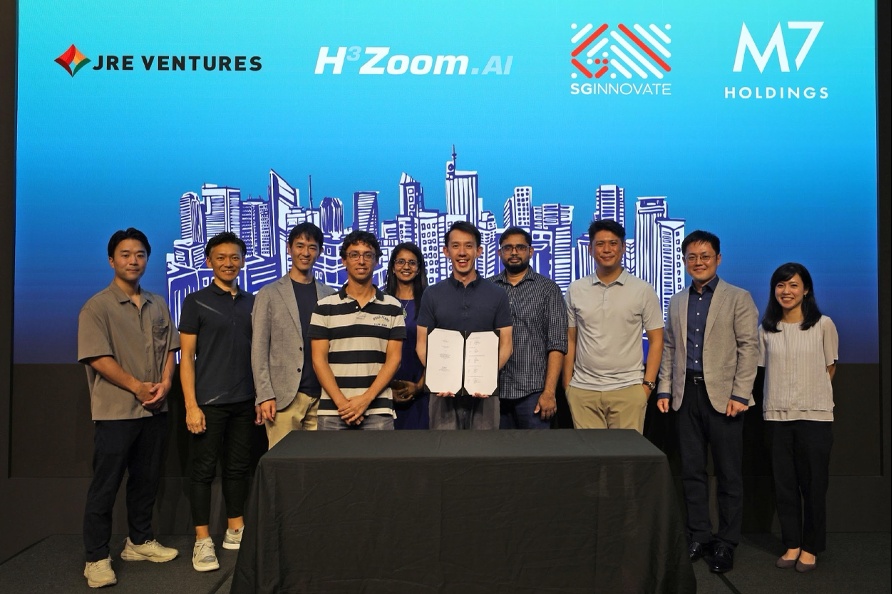
On 22 June 2026, H3 Zoom announced the final close of a US$3.6 million Series A round led by JRE Ventures, the venture capital arm of East Japan Railway Company. Other participants included SGInnovate, M7 Holdings, an AngelCentral member-led syndicate, Moringa Ventures and Lotus One Investment. The company set out expansion plans covering Japan, Hong Kong, Singapore and Southeast Asia.12
A railway investor is an apt addition to this story. Railways come with stations, commercial spaces and other assets that need looking after. The connection puts Koo’s inspection work beside an organisation familiar with the recurring obligations of physical infrastructure.
The funding announcement also described planned work on an engineering co-pilot, workflows combining 360-degree imagery and voice notes, and enterprise integrations. These remain development ambitions. Their direction is consistent with the question customers put to Koo: give us information we can use to decide.
That question offers a modest test for a considerable ambition. After the flight, after the analysis, after the report, does somebody know what to do next? Koo has spent years extending the work toward that moment. A photograph can preserve a problem indefinitely. A useful decision gives it a chance to be repaired.