Before Brontë Kolar was trying to teach robots their way around a laboratory, she wanted to build a hoverboard. It is an excellent project for discovering how little the physical world cares about a promising idea. There are propellers to choose, currents to measure and the persistent matter of getting something into the air. Enthusiasm, regrettably, provides no lift.
Her student research became a more specific investigation: how the pitch and diameter of propellers affected a propeller-powered board’s efficiency. The work appeared in the Journal of Student Science and Technology in 2017. A testing apparatus let her compare what the propellers could lift with the electrical current they drew. The dream of a flying board had acquired measurements.
Today, Kolar is co-founder and CEO of Zeon Systems in San Francisco. With co-founder and CTO Tahir D’Mello, she is building AI-powered robotics for scientific laboratories. Scientists describe the work they want done; the system turns those instructions into actions on physical equipment. Between the sentence and the result sit all the little things a person’s hands usually take care of.
The hoverboard and the laboratory are very different settings. Both make a useful demand of an engineer: show what happens when the idea meets the apparatus.
A hoverboard, before the company
There is a candid account attached to Kolar’s early research. She had entered the project intending to build the board itself, then discovered that she had underestimated the development involved. Her reflection describes learning to test the underlying science on a smaller scale. Before a new machine could be built, there were narrower questions to answer.
A propeller’s dimensions offered just such a question. Measuring maximum lift alongside current consumption makes an imagined vehicle into a set of comparisons. It also gives failure somewhere useful to go. An unsatisfactory measurement can inform the next test; an untested ambition can continue indefinitely without becoming more informative.
Personal flight remained part of her engineering work. The Silverwing team listed her as a power systems engineer while she was studying computer science and engineering at Delft. Its introduction connected her Canadian background and hoverboard research with the team’s aircraft project. Her later founder biography also describes electronics work on electric aircraft and high-density batteries.
These are concrete entries in a career that would eventually include computational biology. A power system and a research workflow have different requirements. Kolar had worked on both sides of the hardware-software boundary before asking a laboratory robot to cross it.
An education with room to turn
Kolar grew up outside Toronto. At sixteen, she learned about United World Colleges through a friend, applied and received a scholarship. She finished school on Vancouver Island, living beside the ocean among students from more than eighty countries. A Dutch fellow student introduced her to the possibility of studying at TU Delft. She had never visited the Netherlands.
By October 2020, she was starting her third year in computer science there. She described the subject as a way into several interests rather than a decision to restrict herself to one. At that point she was considering what to do after her bachelor’s, had taken up rowing and was learning Dutch.
Her education later included a master’s in bioengineering, with a computational biology focus, at UC Berkeley, and a genetics minor at Erasmus University Rotterdam. Her professional background includes computational research at UCSF and the University of Pennsylvania, followed by engineering at LatchBio. The subjects changed; programming remained useful across them.
There were smaller ventures along the route, too. In 2023, Kolar announced an MVP for Alter, a project with Ghita Houir Alami and Corrado Verhoeven. She had helped code the web application and create its branding and interface designs. The announcement invited people to try it and send feedback, while acknowledging the early version’s rough edges.
That project adds another dimension to the résumé: making something people could actually use. Code, interface and a request for feedback belong together. A product has to make sense to someone who did not build it.
Making the instructions travel
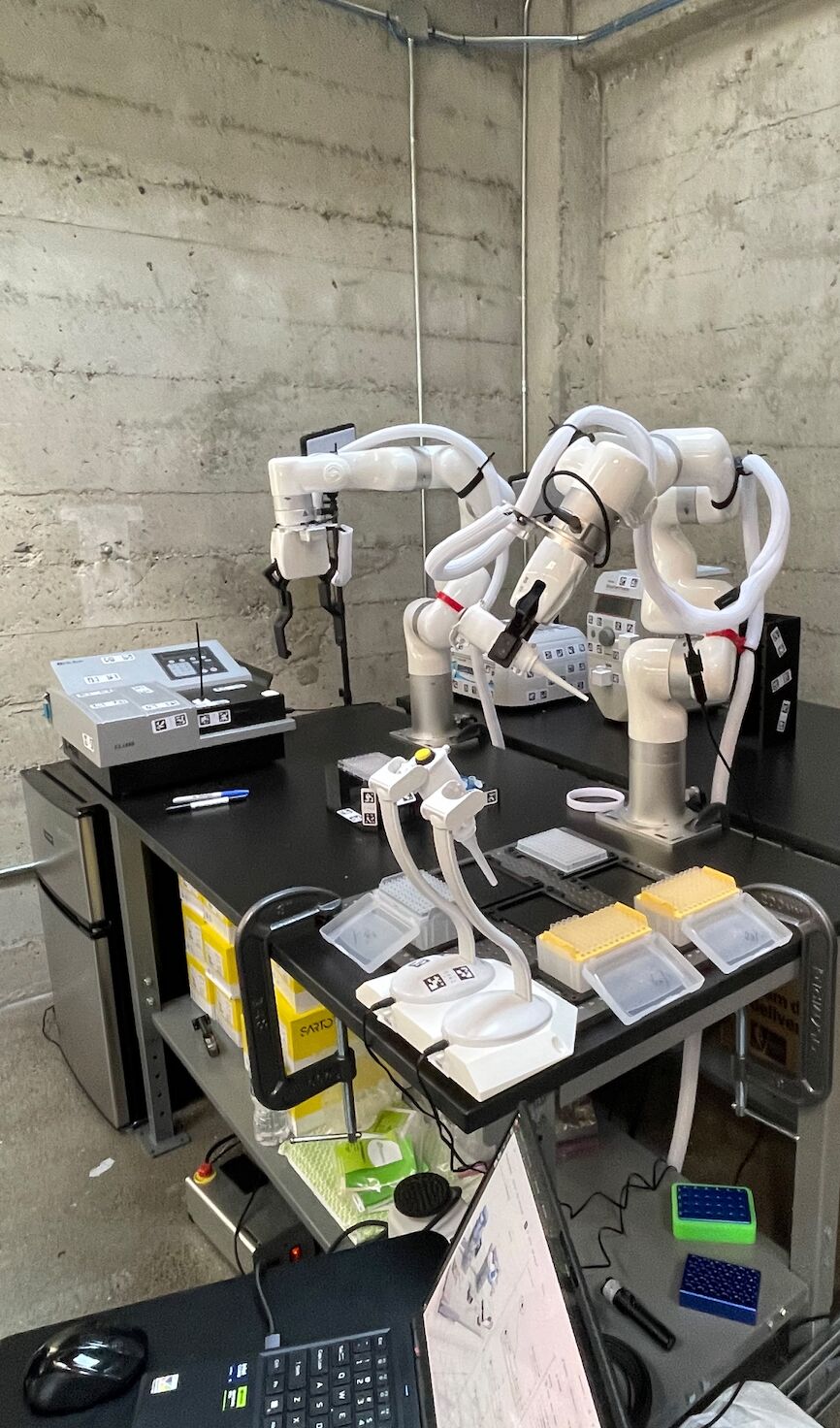
Zeon was founded in 2025 and joined Y Combinator’s Spring batch that year. Kolar and D’Mello introduced a system built around off-the-shelf robotic arms and depth cameras, with software translating plain-English protocols into robot code. Their early work included pilots with laboratories at Stanford and UCSF.
The choice of interface is central to the proposition. A scientist already has an experiment to describe. Requiring that scientist to become a robotics programmer adds another job before the experimental work can begin. Zeon’s aim is to make the description useful to the machine.
In her launch announcement, Kolar described feeling fortunate to be building the company. She connected that feeling to the technical challenges, the scientists she could support and the possibility of helping science proceed faster. The satisfaction she described was in the day’s work as well as the eventual outcome.
“On a personal note, I feel lucky to be building Zeon.”
Brontë Kolar, announcing the company
A March 2026 essay she co-wrote with D’Mello set out the problem in more detail. Existing automation handles some structured, repeatable laboratory tasks. Many other protocols involve awkward manipulations, uncertain conditions and exceptions that keep a person at the bench. Zeon is working on that less orderly territory.
The essay’s ambition is to increase how much science can be done, while giving scientists more time for thought. It also describes a practical requirement for scientific AI: a system proposing experiments needs some way to carry them out. A hypothesis on a screen still has a journey ahead of it.
The bench has opinions
In April 2026, Kolar published a technical account of Zeon’s system. Calibration comes early in the explanation. Cameras and arms need a reliable understanding of where they are relative to the workspace and one another. Small positioning errors matter when the destination is a tube rack or an instrument opening.
She also described the team’s move toward depth-based, three-dimensional models of equipment after difficulties with approaches relying on ordinary camera images. Reflective surfaces, changing light and clutter complicated that earlier work. Equipment models include the parts that move: lids, drawers and doors.
Those details make the engineering tangible. A closed lid and an open lid occupy different space. A robot carrying an object needs to account for the object as well as its own arm. The experiment’s written instructions cannot make these physical relationships disappear.
- 01DescribeWrite the experiment.
- 02PreviewReview the simulation.
- 03RunExecute on hardware.
- 04MonitorCheck each step.
Zeon’s current workflow presents four stages: describe an experiment, preview it in simulation, execute it on robots and monitor what happens. The company says its systems work with the equipment already in a laboratory and track actions and results for review. It also reports daily experimental work in laboratories across the United States.
The sequence gives the preview a real job. Before a machine moves, a person can inspect the proposed workflow. After it moves, there is something to check. For a researcher, the useful question extends beyond whether an arm reached its destination to whether the intended step actually happened.
A weekend with the doors open
In July 2026, Zeon opened its workshop for an AI and science hackathon, co-hosted with Bay Area Lab Automators and Worldwide Studios. Kolar’s invitation welcomed people without robotics experience. The hardware tracks covered complete experimental loops, connections to automated storage and new dexterity skills.
Her July 28 recap recorded more than 300 sign-ups and eight teams building over twenty-four hours. The distinction matters: sign-ups measure interest, while the eight teams describe the work produced. The event gave people outside Zeon a chance to develop workflows on its system.
One team, Tacit Teacher, addressed the problem of peeling a sealed laboratory plate. Its members used narrated videos and questions generated with AI to make human technique explicit enough to become a robotic skill. The team won the dexterity track with its ZPeel prototype.
It is an appropriately modest object to put at the centre of an automation story. A sealed plate comes with none of a flying machine’s theatrical appeal. Yet opening one asks for dexterity, judgment and an understanding of materials. Familiarity can make a difficult action look almost invisible.
Kolar’s reaction was enthusiastic and specific. She named the builders, celebrated their plate-peeling work and invited them back to the workshop. The larger ambition for automated science had found an observable, graspable piece of progress.
Back to building
Kolar and D’Mello have also received public recognition. In announcing their selection for Forbes 30 Under 30 for Zeon, she finished with four words: “Now back to building.” The brevity suited a company whose work involves a long list of small actions that have to succeed in sequence.
Her route here has crossed student research, aircraft power systems, software interfaces and computational biology. Each is a documented part of the story. Together they explain the range of work that precedes the CEO title, without requiring a tidy claim that every earlier decision was pointing toward this company.
The longer-term aspiration is for laboratories that can run themselves, including in places far from an ordinary research campus. The immediate work is closer at hand: help a scientist specify a task, review the plan and get the machine through it.
The hoverboard project began with an imagined machine and became a test of propellers. At Zeon, the objects are plates, tubes and instruments. The next useful thing may be a new workflow, a better check or a lid that finally opens. There is plenty to do before the idea leaves the bench.