BREAKING  Zeon Systems automates scientific labs with AI roboticsYC Spring 2025 batchActive pilots at Stanford & UCSFFounders named Forbes 30 Under 30Plain-English commands. Robot executes. Science accelerates.Seed round backed by YC, Salesforce Ventures, FundersClub & moreRobots that don't call in sick and never need coffee breaks BREAKING  Zeon Systems automates scientific labs with AI roboticsYC Spring 2025 batchActive pilots at Stanford & UCSFFounders named Forbes 30 Under 30Plain-English commands. Robot executes. Science accelerates.Seed round backed by YC, Salesforce Ventures, FundersClub & moreRobots that don't call in sick and never need coffee breaks
Zeon Systems - AI robotics for lab automation

YC Spring 2025  ●  San Francisco, CA  ●  Industrials / AI Robotics

Zeon Systems

The robot in the lab coat you've been waiting for.

AI-powered robotics for scientific lab automation. Tell the robot what experiment to run. It runs it - overnight, unsupervised, with full data capture. Science at the speed of thought.

AI Robotics YC X25 Forbes 30U30 Stanford Pilot UCSF Pilot
2025
Founded
2
Founders (F30U30)
$500K
Seed Raised
2
University Pilots
5
Team Members

The Origin Story

From antibiotic resistance to robotic renaissance

Brontë Kolar and Tahir D'Mello met at Latch Bio. They were studying antibiotic resistance - which, if you're keeping score, is one of the more serious problems facing humanity. Every day, they watched talented researchers spend hours on repetitive pipetting, sample handling, and protocol babysitting. Scientists with PhDs were doing work a robot could do.

The insight was obvious in hindsight: the bottleneck in scientific research isn't ideas. It's hands. America has roughly a million research scientists. Training a new one takes years of schooling. Building and deploying a robotic arm? Hours.

So they built Zeon Systems - a company whose entire thesis fits in one sentence: lower the cost of running experiments, and you get more science. More science means faster cures, better materials, and answers to questions that have stumped researchers for decades.

"We exist to push the boundary of what is possible to automate in the lab."

- Zeon Systems Mission

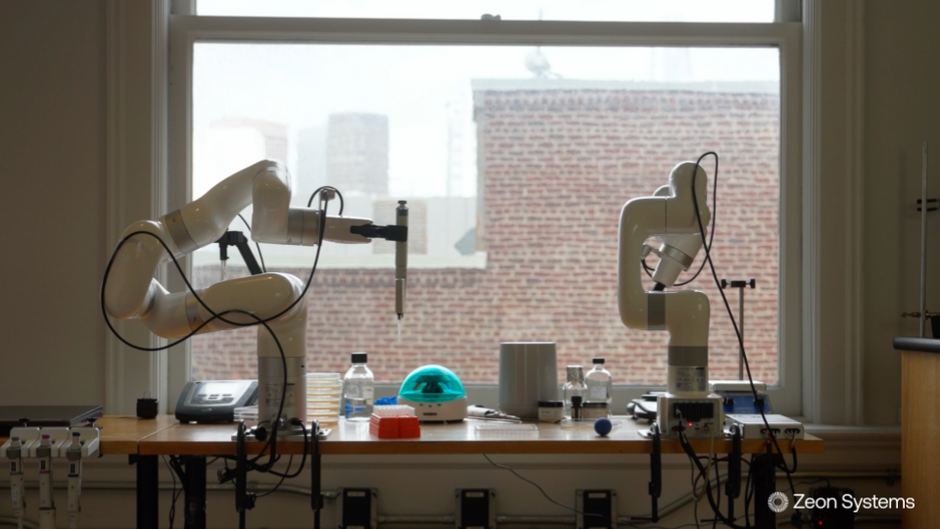
What makes Zeon interesting isn't that they invented lab robotics - that industry is decades old. What they built is the software brain that makes off-the-shelf robotic arms actually useful for flexible, evolving experimental workflows. The hardware was already there. The intelligence wasn't.

The People Behind It

Two researchers who got tired of watching the clock

Brontë Kolar

Co-Founder & CEO

Before Zeon, Brontë built electronic systems for electric aircraft and high-density battery packs - the kind of hardware that can't fail. She also did computational biology research at UCSF, UC Berkeley, and the University of Pennsylvania. The combination of physical systems engineering and biology research is exactly the background you'd design if you were trying to build robots for science labs.

Forbes 30 Under 30

Tahir D'Mello

Co-Founder & CTO

Tahir is a software and ML engineer who spent years building systems for science labs across India and the US. He studied at IIT Guwahati and Yale, and worked in biotech and pharma before landing at Latch Bio - where he met Brontë. He brings the AI and systems engineering side of the house: the world models, the orchestration engine, the closed-loop execution layer that makes the whole thing tick.

Forbes 30 Under 30

The Technology

Three layers. One working robot scientist.

Zeon's platform isn't a single product - it's a stack. Each layer handles a different part of making lab automation actually work in messy, real-world conditions.

World Model Generation
The system builds a real-time 3D model of the lab benchtop using depth cameras mounted on the robotic arms. It knows where the pipette is, where the samples are, which tube holds what. No guessing. No crashing. This is how the robot understands its environment without a human drawing it a map.
Flexible Orchestration
Scientists describe experiments in plain English. The orchestration engine translates natural language into executable robotic code - handling error cases, adapting to deviations, and chaining protocols together. New experimental workflows go from description to running robot in hours, not weeks of custom programming.
Closed-Loop Execution
The robot doesn't just run the protocol - it monitors itself. If something goes wrong at step 14, it catches it, logs it, and either self-corrects or flags for human review. Every experiment generates structured data. By morning, the scientist has results and a full audit trail instead of a messy notebook.

When you lower the cost of running experiments, you get more experiments. More experiments mean more discoveries. That's not a business pitch - it's just economics.

- The Zeon Thesis

Live Deployments

Already working at two of the world's top research institutions

For a company founded in 2025, the client list is notable. Zeon isn't doing demos in a converted warehouse - they're running active pilots at Stanford University and UCSF, handling real experiments with real data implications.

Stanford University

Running automated fluorescence screens and evolving experimental workflows. Researchers define the experiment, Zeon handles the execution - including overnight runs that would otherwise require a grad student to babysit equipment until 2am.

Fluorescence Screening
UCSF

Three distinct workflows in deployment: overnight nanoparticle fluorescence measurements, multichannel pipetting for clinical assays, and safe disposal of biohazardous waste. The biohazard disposal piece alone is notable - getting a robot to handle biohazardous materials safely is a genuinely hard problem.

Nanoparticles  ●  Clinical Assays  ●  Biohazard

Backing

Seed-funded by the people who read the science

Zeon closed a $500,000 seed round anchored by Y Combinator as part of the Spring 2025 (X25) batch. YC partner David Lieb is attached to the company.

The investor mix is telling: Y Combinator for the startup credibility, Salesforce Ventures for the enterprise distribution angle, and specialized funds like A* Capital, Pioneer Fund, FCVC, and FundersClub filling out the round. This isn't a group that backs science projects - they back scalable companies.

One investor's thesis, shared publicly: the addressable market is every research institution and pharma company on earth. If Zeon gets even a fraction of that, the return math gets interesting fast.

Y Combinator Salesforce Ventures A* Capital Pioneer Fund FCVC FundersClub
$500K
Total Seed Funding
6 institutional and strategic investors

Timeline

Moving fast, as advertised

Pre-2025

Brontë and Tahir work together at Latch Bio researching antibiotic resistance. They identify the gap: flexible lab automation that can handle evolving scientific workflows doesn't exist at the right price point.

Early 2025

Zeon Systems is founded in San Francisco. The core system - world model generation, flexible orchestration, closed-loop execution - takes shape using off-the-shelf robotic arms and custom AI software.

Spring 2025

Accepted into Y Combinator's Spring 2025 (X25) batch. Seed round of $500K closes with YC, Salesforce Ventures, A* Capital, Pioneer Fund, FundersClub, and FCVC.

April 29, 2025

Public launch via Y Combinator's launch platform. Both founders announced as Forbes 30 Under 30 honorees.

2025 (active)

Live pilot deployments at Stanford University and UCSF. Fluorescence screening, nanoparticle assays, clinical pipetting, and biohazardous waste disposal all running in production.

Context & Color

The numbers that tell the real story

~1M

Research scientists in America. Training one takes years. Zeon's pitch: build the robotic infrastructure instead, in hours.

0 hrs

Of sleep required by a robotic arm. Experiments can run overnight without a human in the room - that's the whole point.

2

Off-the-shelf robotic arms at the core of the system. The secret sauce isn't the hardware - it's the AI software running on top.

Potential scale. One investor publicly floated the idea of hundreds of millions of Zeon arms running experiments 24/7, compressing decades of drug discovery into years.

The Bigger Picture

What this is actually about

Lab automation isn't a new idea. Pharma companies have been using it for decades - but only for specific, fixed protocols at high volume. The machines that exist today can't handle the flexibility of real research, where scientists iterate constantly, adjust protocols mid-experiment, and operate in environments that change daily.

Zeon's bet is that AI finally makes flexible automation possible. The world model tells the robot what it's looking at. The orchestration engine translates intent into action. The closed-loop execution catches mistakes before they matter. Together, they add up to something that didn't exist before: a robotic system you can actually use for exploratory science, not just production pipelines.

The domains this touches - biology, chemistry, materials science, drug discovery, climate research - aren't small. If Zeon's technology matures and scales, the downstream effects could reach any area of research where repetitive physical work is currently a human's job.

The economic framing the founders use is precise: when you lower the cost of something, you get more of it. Experiments that cost $10,000 in researcher-hours to run might cost $200 with Zeon's system. At that price point, labs run experiments they currently can't justify. Hypotheses get tested that currently sit in a notebook waiting for a PhD student who never arrives.

It's worth noting what Zeon is and isn't. They're not trying to replace scientists. The robot needs to be told what to do - the intellectual work of designing experiments, interpreting results, and generating hypotheses stays with humans. Zeon handles the physical execution layer. That's a meaningful distinction, both technically and for the researchers who use it.

The team is small - five people as of 2025. But the pilots are real, the technology is deployed, and the backers are credible. For a company that didn't exist a year ago, that's a solid starting position.

Find Them Online

Links & resources