Before the chemistry lab, there were pizzas from the Red Brick Cafe and a small assembly problem. Students at Robinson College, Cambridge, were putting together robots: screws, wheels, Raspberry Pis. Sometimes a screw went into the wrong place. The remedy was to take things apart and try again. Once the machines could move, the students could start telling them where to go.
For Michal Mgeladze-Arciuch, co-president of the college’s Binson Bots society, this was a useful introduction to programming. A loop had a consequence you could watch. A conditional could change a robot’s behaviour. The machine drove or spun, and an abstract idea became something that happened in front of you. In his account of the society’s first year, the point was to help newcomers discover the pleasure of making a computer do what they wanted.
The robot had a considerable advantage over a lecture slide: it could leave the scene. Teaching someone to keep it under control gave programming a purpose, and gave the beginner a reason to care about the next line of code.
Today Mgeladze-Arciuch is co-founder and CEO of Yoneda Labs in San Francisco. His tools have become more elaborate. His responsibilities include AI development and commercial strategy. But those early robots offer a revealing way into his work: technical sophistication has to survive an encounter with somebody who wants to get a job done.
A fairly modest mountain, please
In 2020, before Cambridge, Mgeladze-Arciuch appeared among the laureates of Poland’s Matura na 100 procent programme. The profile listed Mrągowo and his school, III Liceum Ogólnokształcące in Gdynia. His next step was already written down: computer science at the University of Cambridge. Mathematics and computing were his favourite subjects.
Asked about his personal successes, he singled out getting into Canada/USA Mathcamp in 2019 and meeting the people there. Reaching subject-olympiad finals was enjoyable, he said, but the camp stood out. The detail gives his early academic story a social centre. When invited to name an accomplishment, he included the people who came with it.
His description of his interests was less ceremonious. Alongside writing code, he liked table tennis and taking a selfie at the top of a mountain of middling height. The mountain did not need to be enormous. It merely needed to be climbed. He also joked about the indentation his programming was making in his chair.
His motto was “Byleby nie było nudno.” Roughly translated: “As long as it isn’t boring.” It is a compact ambition, with room for both mathematical problems and a game of table tennis. An academic biography can become a procession of institutions. This earlier self-portrait supplies a chair, a paddle and a sensible limit on mountain size.
“Byleby nie było nudno.”
Michal’s 2020 motto · “As long as it isn’t boring.”
Four robots and an open invitation
Mgeladze-Arciuch’s Cambridge education ran from 2020 to 2023. Alongside computer science, he spent those years helping run Binson Bots. The club’s first-year approach was deliberately welcoming: newcomers could assemble a robot and write simple programs without treating unfamiliar syntax as an admission test. The pizza-and-screwdriver origin was an appropriate beginning for a society interested in getting people involved.
By the following annual report, the society had four operational, customisable robots. Its members volunteered in children’s programming classes organised by the Raspberry Pi Foundation and held sessions for college students building their first robot. Mgeladze-Arciuch’s invitation extended to undergraduates, alumni and friends of the college. Skill level was no reason to stay away.
The inventory had also acquired a lock-picking set. This is the kind of detail that makes a student society recognisable as a student society: useful equipment, snacks and an activity that requires a little explanation when someone asks what you have been doing all afternoon.
In the 2022-23 year, robot races and robot football joined the programme. Students could write their own controls; teams could compete; spaghetti towers provided another way to make an engineering idea wobble in public. New Vex sets let participants assemble and program different robots, and members continued volunteering at Coder Dojos.
It is easy to file this under extracurricular activity and hurry on. The interesting part is the design of participation. A beginner could build, test, make a mistake and try again. The club gave computing an audience beyond computing students. For someone who would later sell technical software to specialists in another discipline, that is a substantial piece of experience.
Raspberry Pi robots introduce beginners to code.
Student sessions and children’s coding classes.
Robot football, Vex builds and Coder Dojos.
Three friends, three kinds of expertise
Before Yoneda, Mgeladze-Arciuch worked on machine-learning algorithms at Jane Street and on the interpretability of large AI models at UC Berkeley. These are two distinct settings for computation: one concerned with algorithms in a trading firm, the other with understanding the behaviour of AI systems. At Yoneda, he would bring that technical background into a business organised around laboratory experiments.
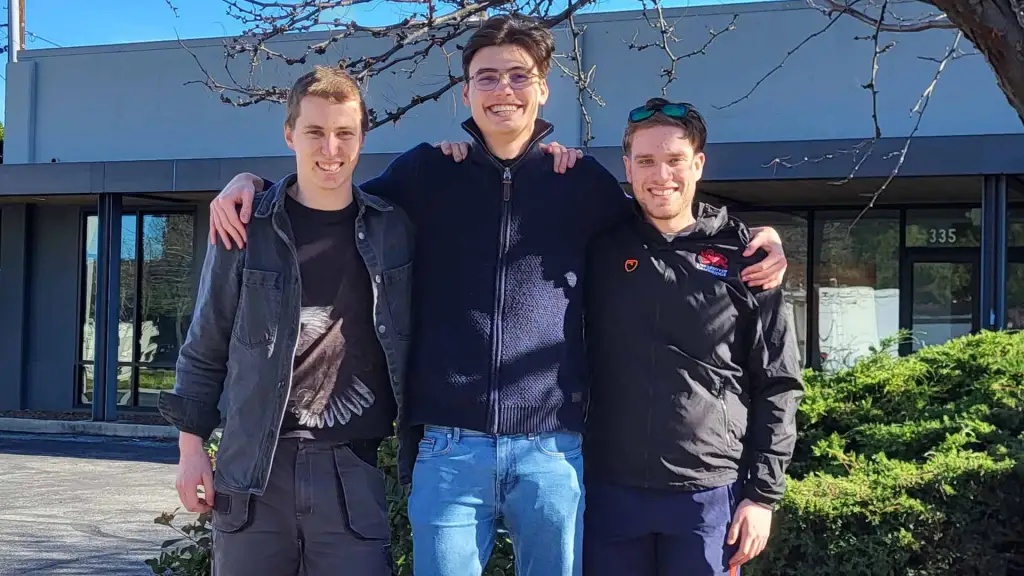
He founded the company with Jan Oboril and Daniel Vlasits, friends from Cambridge. Oboril brought chemistry experience, including work at Bayer; Vlasits brought software engineering and robotics. Their current responsibilities preserve that division. Oboril leads chemistry research and the high-throughput experimentation platform. Vlasits leads software engineering and robotics. Mgeladze-Arciuch oversees AI and machine learning as well as commercial strategy.
The initial problem came from Oboril’s experience of spending weeks trying to find reaction conditions. The ingredients alone did not settle the question. Temperature, concentration and catalyst still had to be chosen. The founders began experimenting with machine learning to help navigate those choices, combining the chemist’s problem with the programmers’ methods.
Yoneda was founded in 2023 and joined Y Combinator’s Winter 2024 batch. Its early software learned from experimental results as chemists worked. Accessibility mattered to the founders: a chemist should be able to use the models without first acquiring extensive programming experience. The launch also described an offline version, intended to accommodate sensitive experimental data.
For Mgeladze-Arciuch, the two sides of his role meet here. The AI has to make useful suggestions. The product has to fit the laboratory where those suggestions will be tested. A model can be technically interesting while its interface makes the working day longer. His remit includes both the model and the business that asks someone to use it.
The experiment has the casting vote
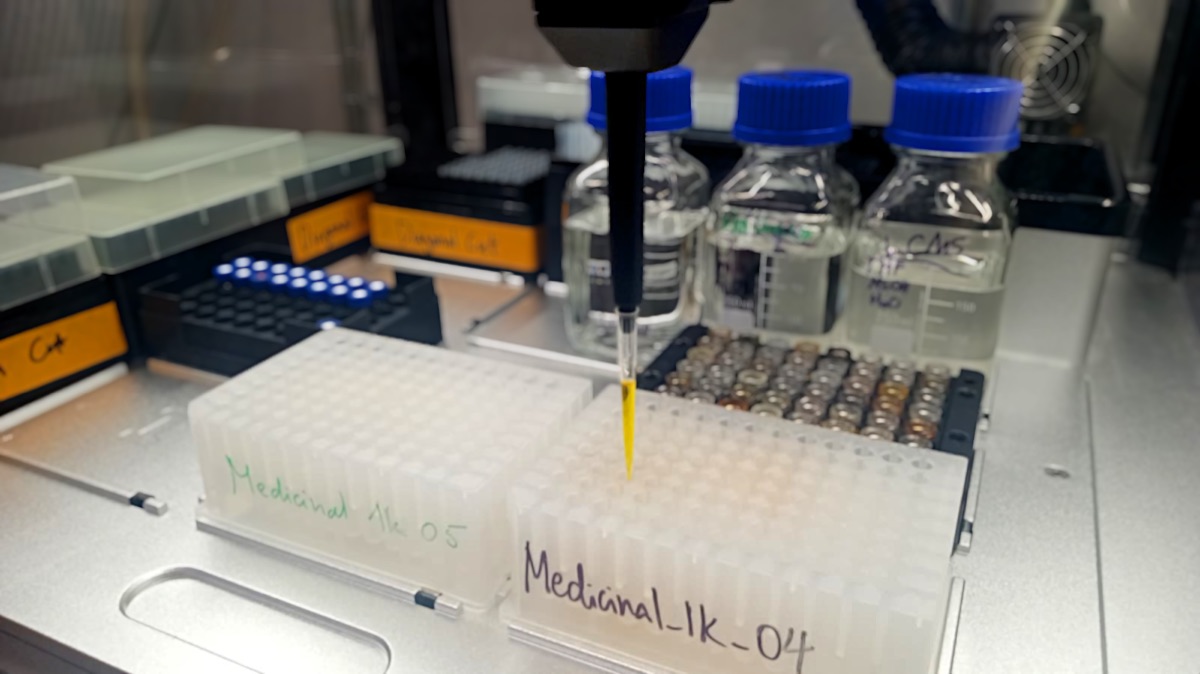
In April 2024, Yoneda announced a $4 million seed round led by Khosla Ventures. The planned spending included robotic automation for its own laboratory. This made the company’s ambition physical: equipment would run reactions and help generate the experimental data needed to train its models. The funding belonged to the company; the work ahead belonged to a team with instruments to buy and experiments to organise.
For a software founder, a wet lab adds an unusually tangible form of accountability. Predictions eventually meet material. The experiment produces an outcome that has to be measured. A good-looking screen cannot improve a reaction by itself. The lab becomes part of the product, and the product has to answer to what happens in the lab.
A reported collaboration with Symeres provided a concrete example in May 2025. The project concerned transition-metal-catalysed cross-coupling reactions. The partners reported moving from roughly 30 percent yield to more than 90 percent, identifying four different sets of conditions with in situ yields above 90 percent.
Those numbers describe the collaboration, rather than a promise for every reaction a customer might bring. They also make the problem legible to a reader who has never handled a catalyst. The task is to find conditions under which more of the intended product appears. Several successful sets of conditions offer choices, rather than a single answer to memorise.
Mgeladze-Arciuch described the result as helping customers navigate complicated reaction landscapes with greater confidence. There is a useful continuity with the robot-building sessions: the tool earns its place when somebody else can operate it and get a result. The subject has changed from introductory programming to chemistry, but the demand for usable instructions remains.
More product from the reaction
Four sets of conditions achieved in situ yields above 90%.
A laboratory with a software habit
Yoneda’s current website offers laboratory services alongside its computational approach: reaction troubleshooting, optimisation, route scouting and library work. It describes dispensing automation, in-house analysis and reactivity models trained on tens of thousands of proprietary data points. Mgeladze-Arciuch’s company now asks customers to bring it a chemistry problem and put the lab to work.
His public LinkedIn activity brings the scale back down to daily operations. Posts shared through his profile describe inventory software, experimental metadata, automated analysis and a programming language for instructing liquid-handling equipment. Another recounts making a temporary replacement belt with a 3D printer when a dispensing balance stopped moving. A broken part is quite capable of interrupting an ambitious model-training plan.
The account of feedback is especially telling: chemists use the software inside Yoneda, and complaints about unnecessary clicks can surface over lunch. This is a practical arrangement. The people building a tool are close enough to the people using it to hear which part of the day it makes awkward. A meal supplies a surprisingly effective place to discuss a button.
There is an appealing scale to Mgeladze-Arciuch’s story. Mathcamp meant meeting people. A Cambridge club meant making programming approachable. A company meant combining three friends’ expertise around a chemist’s recurring difficulty. The public record keeps returning to work that people can do together.
His stated ambition at Yoneda is to predict what will happen before a chemist runs an experiment. Getting there involves models, measurements, software, machinery and colleagues who know why a result matters. The old motto leaves plenty of room for all of it. Boredom seems unlikely when even a timing belt can acquire a speaking part.