YesPress Profile • AI · Chemistry · Deep Tech
Yoneda Labs
The recipe book for every chemical reaction on earth - written by machine learning, not grad students.
The recipe book for every chemical reaction on earth - written by machine learning, not grad students.
Every drug, pesticide, and polymer that exists had to be made by someone who ran hundreds of experiments to figure out how to make it. Temperature. Solvent. Catalyst. Reagent. Concentration. The variables multiply. The failures accumulate. Months evaporate.
Yoneda Labs thinks that's unnecessary. The San Francisco startup - founded by three Cambridge graduates who met in lecture halls and left for Silicon Valley - is building a foundation model for chemical manufacturing. Feed it a reaction you need to run. It tells you the conditions. You run the right experiment on the first try. Or close to it.
This is not speculative. Pharmaceutical CRO Symeres put Yoneda Optimize against their standard workflow on cross-coupling reactions and watched yields climb from roughly 30 percent to over 90 percent. Not eventually. In the same time frame they'd normally spend running dead-end trials.
The company's playbook draws from a simple observation: chemistry has an enormous amount of data locked in lab notebooks, journal papers, and patent filings - all describing experiments that worked, failed, or kind of worked. A model trained on that data, plus their own proprietary wet-lab experiments, can learn to predict what a chemist should try next better than most chemists' intuition alone.
Forecasts viable conditions for novel reactions before you run a single experiment. Trained on tens of thousands of experimentally generated data points. Think of it as the morning weather forecast - but for chemical reactions.
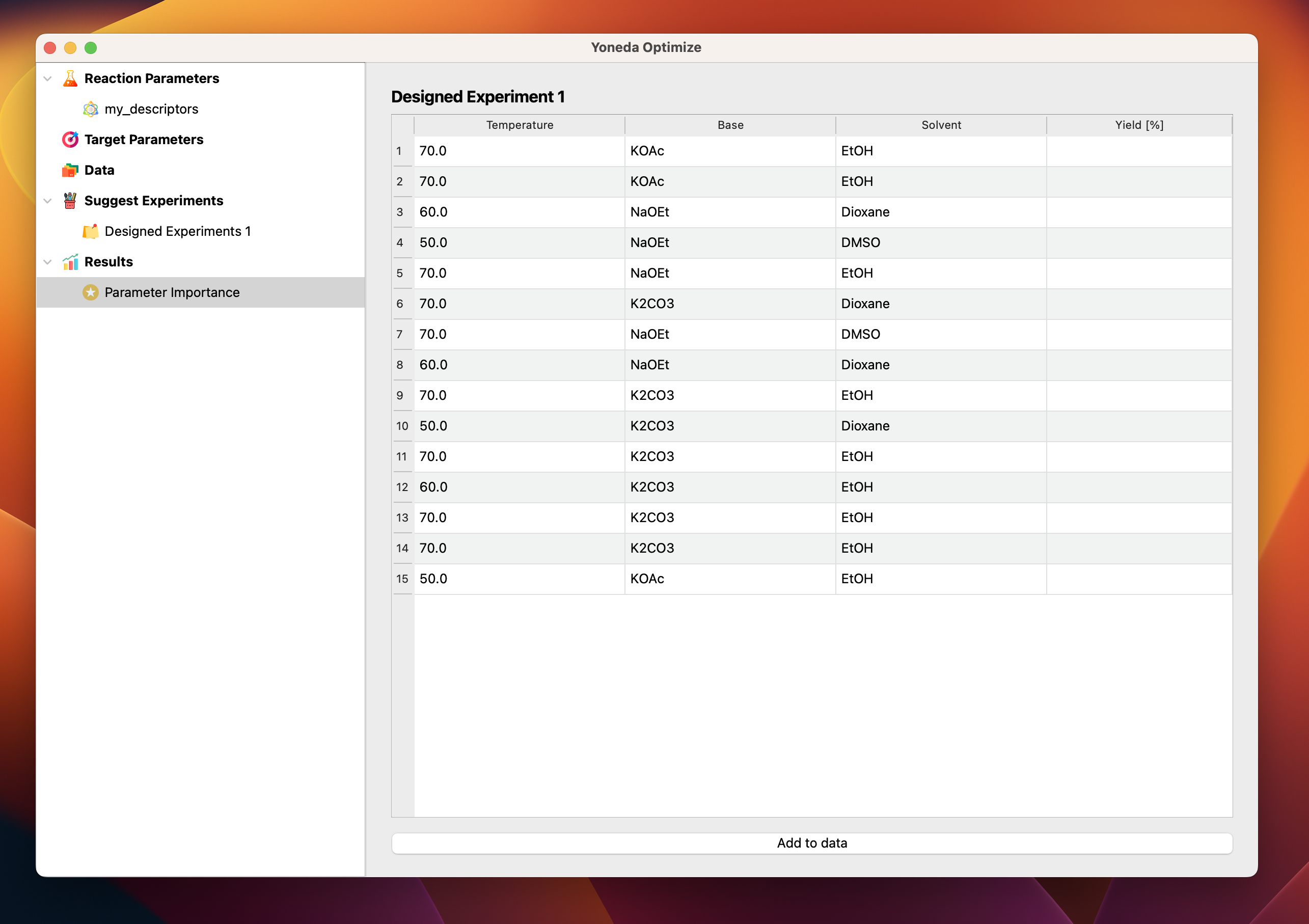
The flagship. A desktop application that runs fully offline - protecting sensitive IP - and uses statistical and machine-learning algorithms to recommend which experiment to run next. Incorporates chemical property descriptors. Cuts months to days.
Automates LCMS spectra analysis. Detects overlapping peaks, integrates data automatically. Saves approximately five minutes per chromatogram - which adds up fast when you're running thousands of experiments a year.
"We're not just optimizing reactions; we're redefining what efficiency and innovation means." - Andre de Vries, Director of Innovation, Symeres
All three co-founders met at the University of Cambridge. They brought complementary obsessions: one spent years failing at pharmaceutical chemistry, one worked with the world's sharpest quantitative traders, one built robots that win competitions. Together, they have the rare combination of deep domain chemistry knowledge and elite software engineering skill.
Computer Science at Cambridge, then Jane Street and Berkeley AI Research. Leads strategy and AI development. The translation layer between cutting-edge machine learning research and the chemical industry's actual problems.
Chemistry & Biology at Cambridge. Previously at Bayer and research institutes in Czechia and Austria. Ranked 8th, 10th, and 11th at the International Chemistry Olympiad - three years running. The founding frustration was his: hundreds of hours wasted on manual lab trials in pharma drug development.
Computer Science at Cambridge, software engineer at Cisco and Optiver, programming languages researcher. Won the Pi Wars robotics competition. Builds the infrastructure that makes the models fast, reliable, and deployable in offline environments.
Advised by Prof. Scott E. Denmark, a leading figure in synthetic chemistry.
In May 2025, Yoneda Labs published the results of a collaboration with Symeres, a transatlantic small-molecule contract research and manufacturing organization. The task: optimize transition metal catalyzed cross-coupling reactions - a critical class of reactions in drug synthesis.
The name Yoneda is not accidental. The Yoneda Lemma in category theory states, roughly, that an object can be fully understood by all the relationships it has with other objects. Applied to chemistry: a reaction can be understood by all the data that surrounds it - previous experiments, physical properties of reactants, known catalysts, solvent parameters.
The model needs approximately 20,000 carefully selected data points to cover three core organic chemistry reactions. That's not data they scraped from the internet. That's data they're generating themselves, in their own wet lab - a hands-on commitment that most AI startups skip entirely.
The Yoneda Optimize application runs fully offline - a deliberate choice. Pharmaceutical companies live and die by trade secrets. Putting reaction data on a vendor's cloud server is a non-starter for most. Running the model locally removes that objection entirely.
Literature chemistry data is incomplete, inconsistent, and irreproducible. Yoneda Labs generates their own proprietary experimental data to train models that reflect how reactions actually behave - not how they're reported in journals.
Yoneda Optimize runs as a desktop app with full offline capability. Pharma IP never leaves the chemist's machine. This is not a feature - it's the difference between a product pharma companies will and won't buy.
Statistical and ML algorithms suggest which experiment to run next, incorporating chemical property descriptors. Active learning - each experiment result makes the model smarter. Sequential optimization instead of brute force.
Yoneda Labs joins the YC Winter 2024 batch. YC partner Jared Friedman leads the cohort. The company launches publicly with its "Foundation Model for Chemical Reactions" announcement. Pre-seed funding of ~$500K.
Khosla Ventures leads the seed round. A who's-who of emerging Europe and global deep-tech investors joins the table. Total raised to approximately $4.5M across both rounds.
First public proof-of-concept: Symeres collaboration results show cross-coupling yields jumping from ~30% to 90%+. Yoneda Labs exhibits at BIO International Convention 2025.
"Like OpenAI for chemistry - a model chemists reach for whenever they need to make any organic small molecule." - Yoneda Labs founding vision
The name is a math joke. The Yoneda Lemma in category theory says an object is understood by its relationships. Chemistry, it turns out, works the same way.
Jan competed at the IChO three times. He placed 8th, 10th, and 11th at the International Chemistry Olympiad - the competition for the world's best high school chemists. The idea for Yoneda Labs came from his frustration as a working pharma chemist later.
They built their own wet lab. Most AI companies train on third-party data. Yoneda Labs runs physical chemistry experiments to generate their own proprietary training data - roughly 20,000 data points per three reactions.
The app runs offline. Pharma companies won't upload reaction data to a vendor's server. Yoneda Optimize runs as a desktop application with no cloud dependency. Data privacy is the product, not an afterthought.
Daniel won Pi Wars. Their CTO won a competitive robotics competition while at Cambridge. Building things that work under constraint, in the real physical world - turns out that background is useful when your customers run physical experiments.