The clean version of Dimittri Choudhury's story begins with momentum: a teenage founder builds an app, crosses an ocean, enters Y Combinator and starts work on a robot chef. The useful version begins with uncertainty. It has an education app whose success encouraged its makers to leave school, a developer tool born from the alerts that success created, and a customer-discovery campaign conducted with a four-figure pastry bill. Even the YC interview had bad Wi-Fi.
Choudhury grew up near Nîmes in southern France. In 2023 he moved to the Paris area to study computer science and economics at CY Tech. There he met Alexandre Klobb. Their first important product together was Meoria, built with Samuel Chomat to help French secondary-school students navigate the imposing menu of post-bac choices on Parcoursup.
Meoria made orientation feel closer to discovery than paperwork. Students entered grades, academic specialties and interests, then reacted to suggested paths through a swipe-based interface. The app ranked possible programs and explained the fit. Its name folded together “me,” orientation and the French initials for artificial intelligence. The proposition was serious; the interaction was intentionally light.
Act IThe app that ate the timetable
By March 2025, Meoria had passed 35,000 downloads. Choudhury said he was spending 90 percent of his time on it. The founders kept pushing, eventually reporting more than 100,000 users within six months. That number matters because it made the next decision less theoretical. Choudhury and Klobb had learned what it felt like to ship, watch people arrive and keep the service running. University was competing with a real company for their attention.
“I have a real desire to create projects.”Dimittri Choudhury, 2025
They left CY Tech. Choudhury later joked that Meoria was “the Duolingo for finding schools,” except it made its own founders drop out. The line is neat because the decision was not. An app built to broaden students' view of education had broadened its makers' view of what counted as one.
Traction did not settle the larger question. Choudhury did not see himself spending the next decade in education technology. He and Klobb closed that chapter, refused an investment that might have tied them more tightly to it, and looked for a problem closer to their operating experience. Walking away from working software can sound like impatience. In his account, it was a choice about where to spend the long years after the launch applause ends.
Act IIFifty alerts and one new company
Meoria had supplied the next complaint. On busy days, thousands of people used the app. The team pushed changes several times a day and relied heavily on user feedback. When they installed error monitoring, it could produce as many as 50 alerts in a day. For a two-person technical team, the tool that identified problems also became another problem to manage.
Sonarly began as an attempt to separate production signal from production racket. It connected to monitoring systems such as Sentry and Datadog, grouped duplicate alerts, investigated logs and code, and prepared a proposed fix. Choudhury framed the aim in practical terms: shorten the time between a user encountering a failure and an engineer understanding its root cause.
One partnership, three problem spaces
Meoria
Make a dense education search personal and easier to explore.
Sonarly
Turn a flood of production alerts into grouped causes and proposed fixes.
Mirabelle
Use vision and robotics to handle the repetitive work of preparing a meal.
The pair moved to San Francisco in November 2025 with hundreds of dollars. They shared a $50 hotel room in the Tenderloin and applied to Y Combinator. With roughly two weeks of runway left, they received an invitation to interview in person. During the meeting the Wi-Fi failed. Choudhury thought their thinking had failed with it. Six or seven hours later, the call came: Sonarly had a place in the Winter 2026 batch.
Acceptance produced access, deadlines and a recognizable badge. It did not make customer discovery automatic. A few months later, messages to CTOs and engineering leaders were receiving little response. Choudhury and Klobb chose a more edible interface.
The croissants were a growth tactic with butter in the attribution model.
They spent about $1,000 on croissants and pains au chocolat, then carried them to startup offices around San Francisco. Half the addresses were wrong. Some were old offices; one was a construction site. There were rides across town, miles on foot and the discomfort of appearing uninvited with a bag of French carbohydrates. There were also conversations with teams at companies including Pylon and Imgix. The pastries made the outreach personal enough to be answered.
Sonarly launched publicly in March 2026 on Hacker News and Product Hunt. The Hacker News conversation showed Choudhury doing the less cinematic half of launching: answering implementation questions, explaining how the product grouped alerts by root cause, and responding to an onboarding failure. One commenter worried that an agent would create a separate development process. Choudhury pointed to a Slack bot designed to keep the work in the team's existing flow. Another challenged the platform's relationship to open-source components. He described what it used, what had changed and where the company was still closed.
His best short description of the work may have arrived in a reply about complexity: “It's hard to make it simple.” Sonarly's promise was to hide a complicated investigation behind a smaller set of decisions. The founder's job remained full of the opposite: more edge cases, more tools and more reasons for a customer to hesitate.
Choudhury also used public writing as a kind of operating log. His posts did not merely announce milestones. They recorded the choices that looked disorderly while he was making them: refusing money for Meoria, leaving university, ending one product, landing in San Francisco and trying another. In a later reflection, he compared those decisions to pieces of context that only become legible when assembled. The analogy conveniently matched Sonarly's pitch, but it also revealed how he edits his own experience. Confusion becomes material. An awkward sales walk becomes a customer-acquisition lesson. A failed connection becomes the opening scene of an acceptance story. This instinct can make startup life look tidier than it felt, yet Choudhury usually leaves the embarrassing detail intact. The wrong office addresses remain in the croissant story. The blank mind remains in the YC story. Those details keep the lesson attached to an actual day.
Act IIIA hard pivot into the kitchen
By August 2026, the YC directory and Choudhury's public profiles showed a different company. Sonarly had become Mirabelle. The new product is a personal robot chef designed to chop, cook and serve fresh meals on demand. Klobb is founder and chief technology officer; Choudhury is founder and chief executive. The software founders are now proposing a machine with vision, motion and all the uncooperative physical reality a kitchen provides.
The category jump is dramatic. The pattern underneath it is steadier. Meoria gathered scattered information around a student's choice. Sonarly gathered scattered evidence around a software failure. Mirabelle wants to gather the many small actions around preparing food and hand them to a machine. Each product starts with a routine that consumes time because context and execution are split across too many steps.
There is another constant: Klobb. Companies often describe a pivot as though an abstract organization turned on a dime. Here, two young founders have repeatedly decided what to preserve and what to discard. They preserved the partnership through school, user growth, a transatlantic move, YC and a leap from cloud software into hardware. They discarded markets when the personal commitment no longer matched the years ahead.
None of this proves Mirabelle will work. A website and a batch listing are beginnings, and robot kitchens will be judged by what they can reliably do outside a demo. Choudhury's record offers a narrower piece of evidence: he can attract users, expose his work to criticism, and revise the plan without pretending the earlier version never existed.
The product kept changing. The method kept asking the same question: where is ordinary time being wasted?
At 20, Choudhury's story is necessarily unfinished. That is part of its appeal. The anecdotes have not yet hardened into mythology. The $50 room was uncomfortable before it became a tidy detail. The broken Wi-Fi felt like failure before the phone rang. The pastry walk was an awkward sales experiment before it became a shareable post. Even a 100,000-user product was allowed to become a former product.
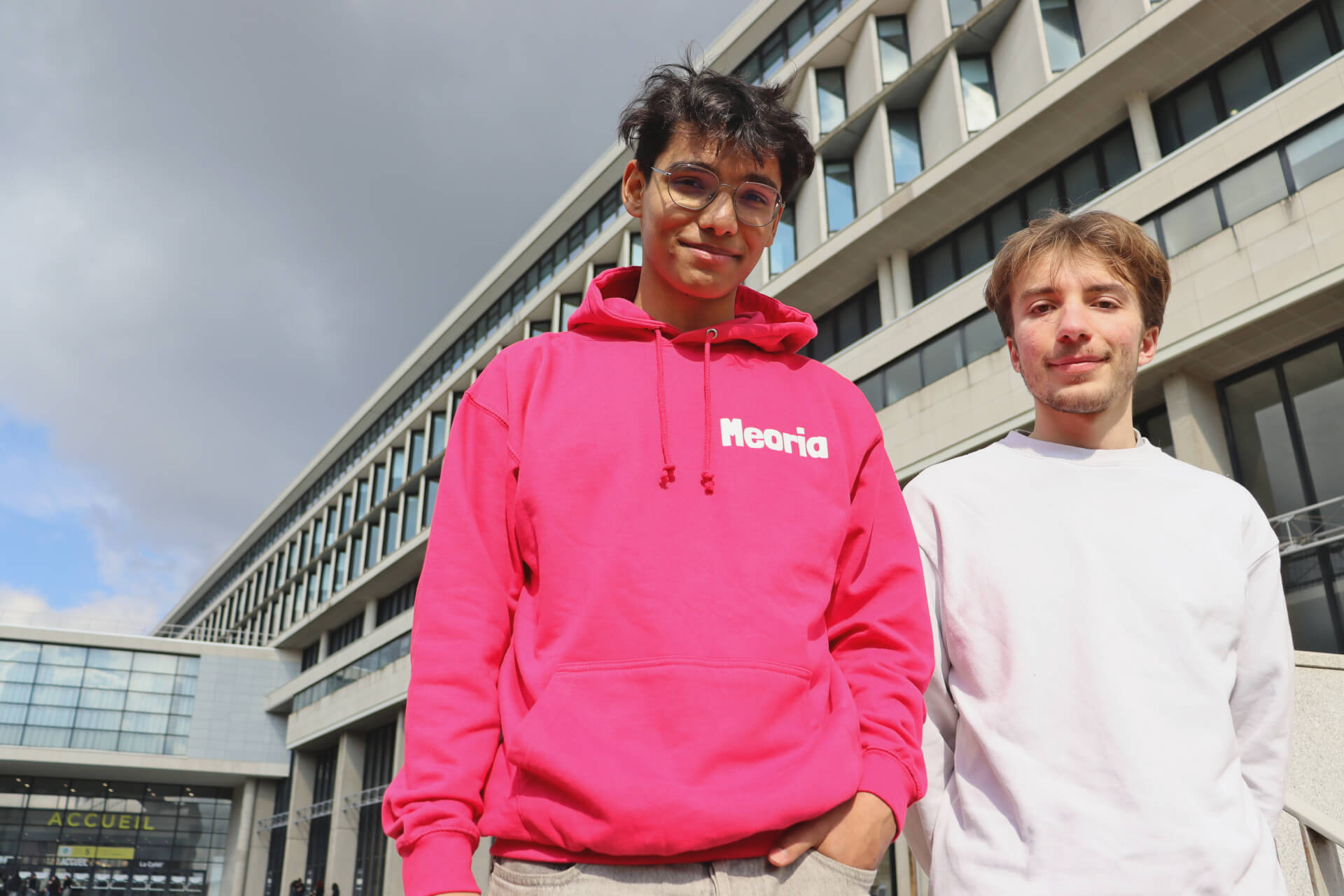
His own formulation from the Meoria period remains the least ornate: anyone can begin, he said, with much work and a little luck. So far, Choudhury has supplied plenty of the work and narrated the luck with a founder's eye for comic timing. The next chapter belongs to a robot, a kitchen and the same co-founder who was there when the hoodie still said Meoria.