Alberto Rosas has a problem most identity founders can only simulate: there is another person who looks very much like him. Alejandro, his identical twin, has been his training partner, rival, best friend and co-founder. The brothers joke that they have spent their lives impersonating each other. In a quieter decade, that would remain family material. In an age when software can borrow a face and voice, it becomes market research.
Their company, Didit, is an attempt to make knowing who is on the other side of a screen less awkward, less fragmented and more programmable. It combines identity checks, business verification, anti-money-laundering screening, biometrics and fraud signals in one platform. Alberto runs the outward-facing half of the operation: go-to-market, fundraising and hiring. Alejandro, the CTO, owns product and engineering. The division is neat. The lives behind it are not. They have learned, competed and built side by side for nearly three decades.
The double act is easy to romanticize, but Rosas describes it in practical terms. A twin gives you someone who can disagree without leaving, compete without becoming a stranger and remember every earlier version of you. “You always have a co-founder, a training partner, a rival and a best friend in the same person,” he writes. That arrangement became the durable structure underneath a career full of abrupt turns.
“You always have a co-founder, a training partner, a rival and a best friend in the same person.”Alberto Rosas
The education of a competitor
Long before authentication flows, there was a baseline and a ball. Rosas grew up playing tennis at a high level, ranked among Spain's stronger players for his age and traveling to tournaments. At fourteen, he says, he played a world championship. At fifteen, he stopped. The game had taught him the useful and unpleasant law of delayed returns: hours of repetitive work may pass before the result has the courtesy to appear.
At eighteen he returned to tennis on a scholarship in the United States. Six months later he came back to Barcelona and redirected the competitive impulse toward school. He studied electrical engineering at the Polytechnic University of Catalonia and finished with the best academic record across the engineering degrees at his school. The former teenager who had barely opened a textbook discovered that difficult material could produce its own dopamine.
Soon he was teaching himself artificial intelligence and working as a university researcher on deep-learning and sensor-data problems. He began advanced study in applied mathematics and wrote software for methods that researchers had left inconveniently scattered. One project migrated NVIDIA's StyleGAN2 architecture to TensorFlow 2 when an official version did not exist. Another packaged multiple-instance learning methods into a reusable Python library. The repositories are still public. They show an engineer interested in the plumbing, not merely the demo.
Electrical engineering at UPC, university AI research and the top engineering academic record at his school.
Open-source releases for StyleGAN2 and multiple-instance learning.
Gamium grows to 33 people, then fails to find product-market fit.
Didit emerges from the identity problem, enters YC W26 and moves its headquarters to San Francisco.
The expensive first draft
The brothers' first company was Gamium. It began with GPU farms mining Ethereum and expanded into blockchain protocols, smart contracts, a token and a decentralized metaverse. The company reached 33 employees. It also failed to find product-market fit. Rosas is unusually plain about the bill: they scaled too soon, lacked leadership experience and confused motion with proof.
Failure stories acquire a suspicious elegance once the next company works. Gamium's ending was useful because one part of the idea would not go away. Digital identity had sat inside the larger metaverse thesis. Strip away the virtual world, the token and the fashion of the moment, and a harder problem remained. People still needed a trustworthy way to prove themselves online. Companies still assembled too many vendors to perform one identity workflow. Real customers were rejected while skilled attackers slipped through.
Didit began in Barcelona in 2023. Its proposition kept getting narrower and its ambition kept getting wider. The product would be identity and fraud infrastructure, built for developers and designed for an internet where synthetic faces, deepfakes and automated attacks were ordinary. Instead of selling a mysterious enterprise contract before anyone could test the product, Didit published prices, opened its documentation and offered a self-serve sandbox.
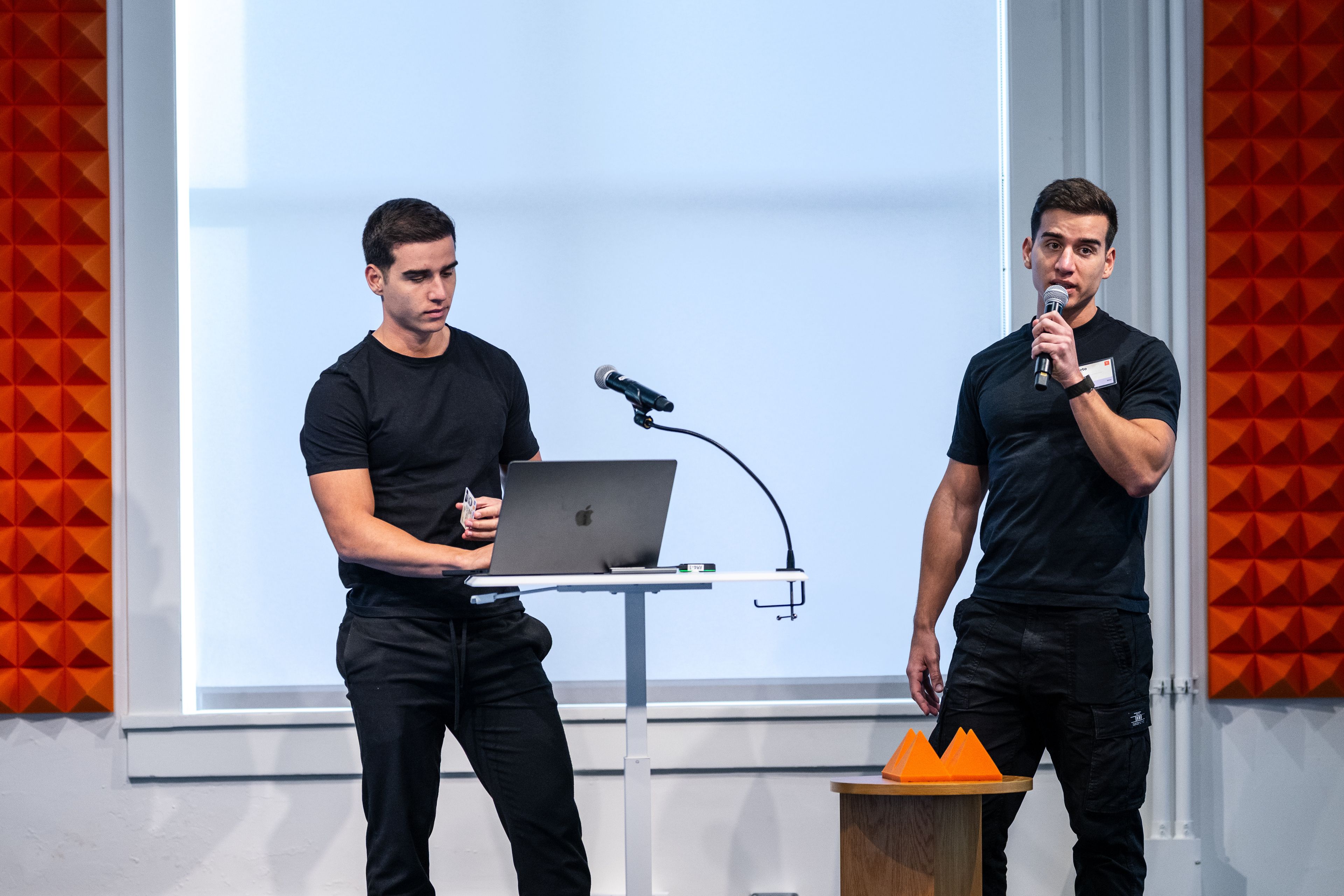
The CEO with the console open
Rosas calls building his form of art. The phrase risks becoming decorative until he explains the medium: product, code, distribution, customer conversations, then back to product. He likes owning that whole loop. At Didit, this means a CEO responsible for fundraising and hiring who still opens the console and conducts the live demo himself. The company makes a point of the absence of slides. Rosas performs an actual verification, in real time, where a lag or rejection cannot be edited out.
That closeness is part philosophy and part scar tissue. A founder who scaled before finding the market now wants the evidence near at hand. The product's appeal depends on reducing friction for two audiences at once. Developers need an API they can integrate quickly. End users need a verification they can finish without feeling as if they have applied for a minor diplomatic post.
The company compares its ambition to what Stripe did for payments. Rosas's exact line is: “We're doing to identity what Stripe did to payments.” The useful part of the comparison is mechanical. Payments were fragmented, country-specific and painful to integrate. A developer-friendly layer made them feel like a building block. Didit wants identity to become the same kind of primitive, broad enough to support a login, a payment, an age check or proof that a user is human.
“Most of the leverage lives in details nobody wants to look at.”Alberto Rosas
Rosas's taste for detail extends to how the company hires. Didit's public operating principles dismiss credential worship, divided ownership and corporate theater. The standard is care: ship the work, fix it when it breaks and notice the four pixels that disturb the image. This is perfectionism with an operations manual. The twins describe themselves as obsessed with detail, a trait that can produce either polish or paralysis. Their answer is speed plus ownership.
Narrow lane, long road
In early 2026, the brothers moved to San Francisco for Y Combinator's Winter batch. They documented the journey in Spanish on a new YouTube channel: packing up, finding an apartment in Dogpatch, explaining the company and dividing their roles as operator and architect. The camera catches something company announcements rarely do. Building in public can look remarkably domestic: two brothers at adjacent desks, each absorbed by a screen.
By May, Didit had announced $7.5 million in seed funding and a San Francisco headquarters. Its backers included Y Combinator, Pioneer Fund, Orange Collective and several other funds and angels. The company said it was profitable, growing revenue more than 30 percent month over month and serving more than 1,500 active B2B customers. By August, its own site put the organization count above 2,000.
Growth has also sharpened Rosas's view of focus. He has written that Didit initially wanted to serve everyone. The result was vague positioning and a go-to-market plan pointed in too many directions. Choosing identity and fraud infrastructure for developers clarified the message. The lesson is almost comic in its simplicity: a company may need to say no in order to become legible.
The aspiration remains enormous. Rosas imagines a reusable, private identity that moves with its owner, makes authentication nearly instant and helps distinguish humans from bots or synthetic doubles. That future carries difficult questions about consent, privacy and control. Didit's answer is to make the infrastructure modular, auditable and easier for builders to inspect. Trust cannot merely be demanded by a logo. It has to survive implementation.
There is a pleasing symmetry here. Tennis taught Rosas to tolerate invisible progress. Research taught him to turn messy methods into reusable tools. Gamium taught him that headcount is not proof. Twinhood taught him that appearances are fallible. Didit gathers those lessons into one product: evidence, delivered quickly, for a world that has become very good at appearances.
On his personal site, Rosas writes, “Building is my way of making art.” The sentence fits because his work is less about inventing a wholly new material than arranging difficult parts until the experience feels obvious. The artist's joke is that if the identity layer works, most people will barely notice it. A brief face check, a quiet result, and the internet lets them through. For a builder who loves the whole loop, invisibility may be the cleanest signature.