A signature is a wonderfully misleading thing. It looks like the moment a deal becomes real: a name, a flourish, perhaps a finger dragged across glass. For a bank, however, the difficult questions arrive earlier. Is this person real? Does the document belong to them? Can the institution explain why it opened the account? By the time anyone signs, most of the work should already be done.
- Signzy turns identity checks and compliance tasks into configurable onboarding workflows.
- Its buyers include banks, fintechs and credit-union software providers.
- The useful lesson: fix the handoffs around a task, and measure how many customers finish.
The signature comes last
Signzy began in 2015 with digital contract signing. Ankit Ratan, an engineering graduate, and his twin brother Arpit, a lawyer, had been debating the irritations of legal documentation. Ankur Pandey supplied the third founder’s technical expertise. Their first proposition had the pleasing simplicity of a good company name: signing made easy.
Then the boundary of the problem moved. As Ankit told Entrepreneur India in 2019, “signing was merely the last part of the process of verifying.” The team expanded into identity verification and background checks. The original idea had been too narrow. A lovely pen does little for a queue that has stalled three desks earlier.
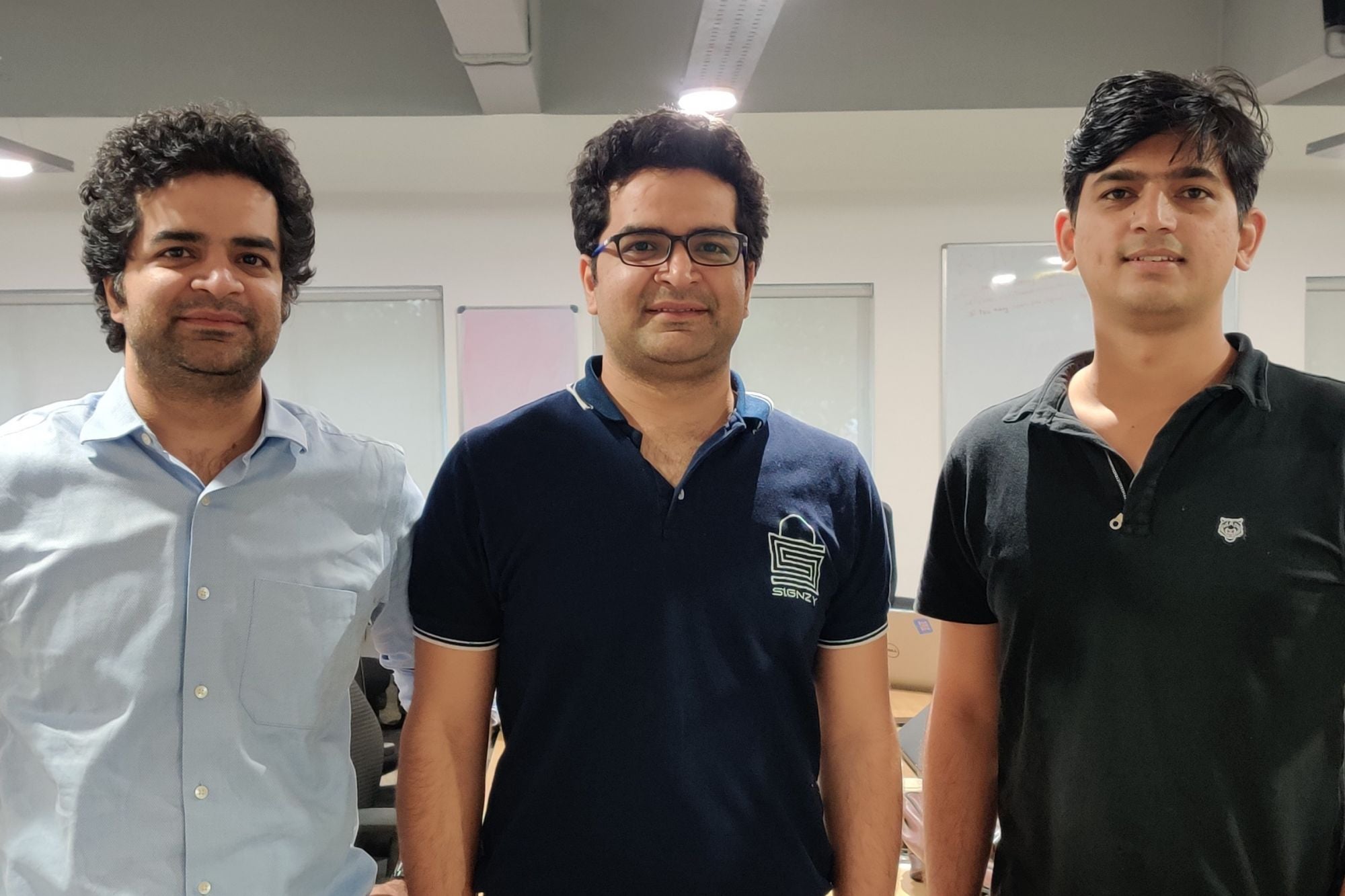
Today, Signzy sells the machinery behind those desks. It belongs to the RegTech market: software that helps businesses carry out regulated processes. Banks and financial companies buy its tools, while their customers encounter the document upload, selfie or verification prompt. The consumer supplies the evidence; the institution remains responsible for the decision.
A bank journey, built from parts
One Touch KYC combines document capture, optical character recognition, face matching, liveness checks and screening. Optical character recognition turns the text on an ID into usable data. Face matching compares images. Liveness tests look for evidence that the applicant is present, rather than a photograph or spoof. Each answers a different question. Passing one does not logically settle the others.
Business verification adds another cast of characters: companies, registration records and ultimate beneficial owners. Contract 360 handles templates, signatures and audit trails. Transaction monitoring follows financial activity after admission. The breadth is Signzy’s commercial argument: customers can connect related tasks instead of managing a separate supplier relationship at every checkpoint.
- 01CaptureDocuments + identity data
- 02CheckBiometrics + screening
- 03ContinueContracts + monitoring
GO, its no-code platform, lets teams assemble workflows from modules and APIs, the interfaces through which software systems exchange requests. A bank can arrange checks and decision rules around a particular product. Compliance and operations staff gain a way to revise the journey without treating every adjustment as a fresh software project.
That puts Signzy beside identity vendors such as Persona, Jumio, Veriff and Trulioo, with overlap depending on the job. The distinction worth testing is orchestration: how readily the checks, rules and existing systems work together. A broader catalogue can reduce handoffs. It can also require more careful configuration. Procurement should follow the actual journey, rather than an impressive list of features.
The Canadian test
Consider ASAPP, a financial-technology provider serving credit unions. Its published Signzy case study describes replacing a legacy verification provider within its Version 20 platform. Canadian data residency was part of the requirement. A quick check that sends sensitive information to the wrong place would solve one problem by creating another.
Signzy reports average verification below 60 seconds, more than 70 percent of onboardings proceeding straight through, fewer than 2 percent false positives and a 33 percent decrease in drop-offs. These are vendor-published case-study results, rather than promises for every bank. Still, the combination is instructive: speed, completion and mistaken suspicion belong on the same scorecard.
Reported in Signzy’s ASAPP case study. Results are specific to that deployment.
Beem, a US financial app, illustrates a different route. Its Signzy case study describes phone-based identity checks, prefilled information and multiple data sources used as fallbacks. The company reports roughly 100,000 monthly onboardings. The design lesson is useful beyond finance: ask people for information only when existing evidence cannot do the job.
Buying the next checkpoint
The business model follows usage. In the 2019 founder interview, Signzy described monthly or annual fees alongside charges for each customer onboarded, with those usage charges supplying most revenue then. Enterprise buyers need a deployment-specific quote. For them, the meaningful cost includes integration, reviews and the labour left behind after automation.
Expansion required capital. In September 2022, Signzy announced $26 million from Gaja Capital, Vertex Ventures and Arkam Ventures to develop its no-code offering and reach more financial institutions. This was money raised to build the business. It tells a reader little about the price of verifying one applicant.
In February 2024, it acquired fraud-risk provider Difenz in a cash-and-equity transaction reported at a $5 million valuation. The move added capabilities including anti-money-laundering screening and transaction monitoring. In April 2026, a partnership with Velocity FinCrime connected One Touch KYC with ongoing financial-crime monitoring, initially for the US and Canada. The product boundary was moving again, beyond account opening.
Trust has a maintenance bill
There is an uncomfortable test for a business that processes identity information: its own security. December 2024 reporting described Signzy’s confirmed security incident and a third-party investigation. PayU and ICICI Bank said they were unaffected. The incident makes security diligence part of any serious evaluation.
The form is the visible part. The decision is the product.
A buyer can copy Signzy’s original insight without buying Signzy. Map the entire process, identify where evidence is collected twice, and count completed journeys alongside fraud alerts. Choose software against the documents, jurisdictions and systems actually involved. Someone must still own exception handling, risk thresholds and compliance interpretation.
Signzy’s appeal lies in making that work easier to assemble and change. The useful question is whether a bank can welcome a legitimate customer, explain its decision and keep watching the relationship afterward. A signature records consent. Everything around it earns the right to ask.
Follow the checks
Explore Signzy · One Touch KYC · ASAPP’s reported results · The Beem case study
The founders’ original insight · The $26 million announcement · The Difenz acquisition · Security-incident reporting · The Velocity partnership
Watch: Ankit Ratan on building Signzy ↗
Watch: product explainers and customer conversations ↗