A soccer robot has little patience for a beautiful explanation. The ball keeps moving. Other players get in the way. Somewhere between seeing the field and reaching the right patch of it, an ingenious strategy can become a very expensive spectator. Abraham Heifets encountered this sort of judgment early, at Cornell, where he led artificial intelligence work for a championship-winning robotic soccer team.
His later career would acquire the familiar furniture of a technology founder’s biography: a doctorate, a co-founder, an accelerator, a succession of company names. But the soccer field offers a useful place to begin. It puts the work in motion. It also introduces a question that follows him through very different settings: what needs to function before the ambitious part has a chance?
A soccer field with no excuses
Heifets’s role on Cornell’s RoboCup team ran from August 1999 to June 2000. He built a real-time, networked system for decisions and strategy. Those adjectives earn their place. A decision was useful only while the situation it described still existed; a strategy depended on several machines behaving together. The intelligence had to make it out of the computer.
Cornell’s setup used cameras above the field to locate players and the ball. An AI program selected a strategy and transmitted commands to the robots. By 2000, the team had improved its signaling and given the machines a roller system that let them travel in different directions without turning. There was even a mechanism for dribbling. The sport had acquired engineers, and the engineers had acquired sporting problems.
It is tempting to treat an early robotics project as a charming prelude, the university anecdote before the serious career begins. Here it belongs in the main plot. Vision, decisions, communication, and movement were separate pieces of one performance. Each could spoil the others. A good system needed attention to the connections between them.
Heifets completed his Cornell bachelor’s degree in computer science in 2001 and his master of engineering in 2003. The master’s project concerned rapid search of approximate Cartesian graphs. That title is unlikely to improve a dinner party, but search would remain an important part of his work: how to find a useful route through a collection of possibilities without inspecting every route equally.
BS, computer science
MEng, computer science
PhD, computer science
The computer had reading to do
At IBM’s T.J. Watson Research Center, Heifets worked on high-performance data processing. One of the subjects was XML, the structured format used to move information between systems. Its appeal lay partly in making data legible and explicit. Its cost was that a computer had to do considerable work to read, check, and convert it.
Heifets was among the authors of the 2006 paper on XML Screamer. The project generated customized parsers from an XML Schema, combining tasks that conventional software often handled separately. Scanning, parsing, validation, and deserialization could be optimized together. The underlying concern was wonderfully practical: unnecessary copying and repeated passes through the same data consume time.
This was research in the machinery underneath other people’s applications. A user might appreciate the result without ever learning why it arrived sooner. The paper’s argument demanded close attention to software layers that were usually treated as distinct. Put them together, and opportunities appeared that were hard to see from inside any one layer.
The work also gives the career a useful scale. Before Heifets was asking what an AI company could become, he was working on what a processor actually did. Large ambitions and small operations share a biography here. A system’s future can depend on the stubborn present tense of copying a piece of data one more time.
A search tree, then a stopwatch
Heifets began his doctorate at the University of Toronto in January 2008, with Igor Jurisica as his supervisor. His research moved into computational chemistry and organic synthesis planning. The task was to find a sequence of reactions that could make a target molecule from starting materials. Chemistry supplied the possibilities and constraints; computer science supplied ways to search them.
In work presented in 2012, Heifets and Jurisica modeled synthesis as branching paths and used proof-number search, a technique associated with game-tree problems. They also assembled benchmark problems from undergraduate organic chemistry exams. The connection is specific: a search method developed around one kind of structured reasoning was being asked to handle another.
His other projects included SCRIPDB, a portal organizing chemical information from patents, and LigAlign, a tool for alignment and analysis. These projects addressed different parts of a researcher’s working day. Finding information and comparing structures are part of the preparation that makes a larger question answerable. Even an imaginative hypothesis needs something dependable to stand on.
There was another test waiting outside the research group. In 2013, Heifets placed second in the inaugural Ontario Three Minute Thesis competition. The format required a doctoral student to explain specialized work to a broader audience under a severe time limit. Years of thought had to fit into the space of a short conversation.
He described the opportunity as practice in explaining his work “honestly, accurately, simply, and succinctly.” Each word creates a different obligation. Accuracy can crowd out simplicity; simplicity can tempt an explanation past accuracy. The stopwatch prevents a speaker from solving the tension by adding another ten minutes. A researcher has to decide what the listener really needs.
He completed his computer science PhD in 2014. Read alongside the communication competition, the degree marks two kinds of work: learning how to pursue a difficult question and learning how to bring someone else into it. Both would become useful when a company required audiences beyond a department.
Coffee, a closet, and two months
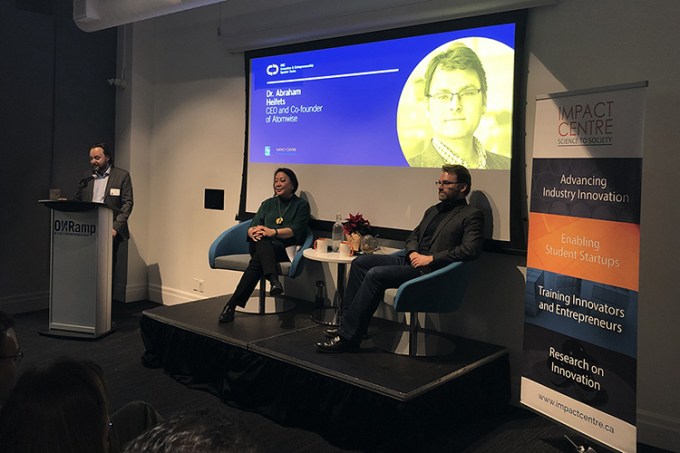
The company story began with coffee. In 2011, Heifets and his friend Izhar Wallach would talk about machine learning, the datasets becoming available, and the research questions those changes made possible. In 2012, they applied to Techno, the University of Toronto Impact Centre’s program for turning scientific work into companies.
Those conversations are a modest origin for a business. They leave room for the part usually squeezed out of a founding myth: thinking together before a plan has become official. Coffee does not make a company, but it provides a setting in which two people can keep asking whether an idea deserves the next piece of work.
Heifets later gave the early accommodation its proper description: “Our first office was a closet, but it was an office, and that was a big deal.” A closet is a comic location for technological ambition. It is also a place to put the ambition down, return tomorrow, and continue. The distinction between a conversation and an organization can begin with a door.
The Impact Centre’s contribution went beyond space. When money came close to running out and Wallach might have had to return to Israel, a commercialization postdoctoral fellowship helped him stay for another year. The team could continue. Support at that stage had a direct, human consequence: the collaborators remained in the same undertaking.
Heifets described another narrow passage before Y Combinator. He had spent an entire year trying unsuccessfully to raise money. At one point, the company was two months from bankruptcy. An engineer can calculate routes through a search space; a financing process adds people whose decisions cannot be scheduled like a processor’s.
Distance from bankruptcy at one point before Y Combinator.
A historical snapshot, not a measure of the current business.Atomwise joined Y Combinator’s Winter 2015 batch and moved to the San Francisco Bay Area. The company’s early years had already included Toronto’s Creative Destruction Lab and university support. By the time an accelerator entered the story, the founders had done considerable work simply to remain founders.
The change in setting brought another kind of engineering. Heifets came to emphasize that different audiences needed different language and evidence. A technical specialist and a business development counterpart could be discussing the same work while listening for different answers. Presenting one explanation repeatedly would not necessarily connect them.
“Success is a team effort.”
Abraham Heifets, 2018
His account of company culture placed empathy and curiosity beside clear thinking and communication. Those are explicit working values, with practical implications for collaboration across disciplines. People have to understand enough of one another’s problems to do useful work together. The founder’s job includes making that exchange possible.
The next experiment
Heifets’s public academic presence leaves room for amusement. An old résumé announced an objective involving robots and world domination. His university website introduces him with a joke about rushing where angels fear to tread. The humor sits comfortably beside a publication list. Someone who has spent time making machines cooperate is entitled to a theatrical ambition or two.
There is also a small clue in his advice to younger founders. In a 2018 interview, he directed them to xkcd comic 1827 when reading advice. It is an economical way to invite skepticism about lessons extracted from success. A tidy retrospective can make the available paths look simpler than they were to the people choosing among them.
Today, Atomwise is listed as Numerion Labs, with Heifets among its former founders. He is founder and CEO of WonderTx, a company in Y Combinator’s Summer 2026 batch. The new venture describes work on AI that can reason beyond its training data and on an automated design-make-test loop. These are the company’s stated aims, and they give his next chapter a recognizable computational question.
The names and settings have changed, but the career can be read through the tasks linking them. A robot must receive its instructions in time. A parser must avoid unnecessary work. A search method must find a path through branching possibilities. A researcher must reach an audience. A founding team must have the means to return tomorrow.
That last requirement has a particular charm in Heifets’s story. The future arrived with coffee, a closet, and a fellowship, alongside the algorithms. Building again at WonderTx, he brings an education in all of them. The next experiment has a new name; it still needs people, machinery, and enough time to discover what actually works.