The most revealing room in Phillip Wang’s early Gather office was upstairs. When prospective investors came to see him in late 2020, he could take them onto a rooftop overlooking a neon city. The company’s 25-person building cost $175 a month. The view, the rooms and the roof existed inside Gather. A property developer would have found the margins upsetting.
There was a practical point behind the scenery. Wang was inviting people into the thing he wanted them to understand. They could move around it, stand beside someone, enter a private room and experience a conversation that depended on where they were. A pitch usually asks an audience to imagine a future. This one supplied arrow keys.
The rooftop is an appealing place to begin his story, but the question underneath it is more familiar than the setting. How do you stay close to people who live somewhere else? How do you make room for the brief, unplanned encounter? Wang’s career has followed those questions through research, hardware, virtual worlds and, more recently, AI tools at Figma.
The invitation before the meeting
A scheduled video call starts after several decisions have already been made. Someone chose the participants, found a time and decided the conversation was worth a slot. Much of everyday social life happens before that threshold. You notice someone. You drift toward them. You discover that there is something to discuss only after you have begun.
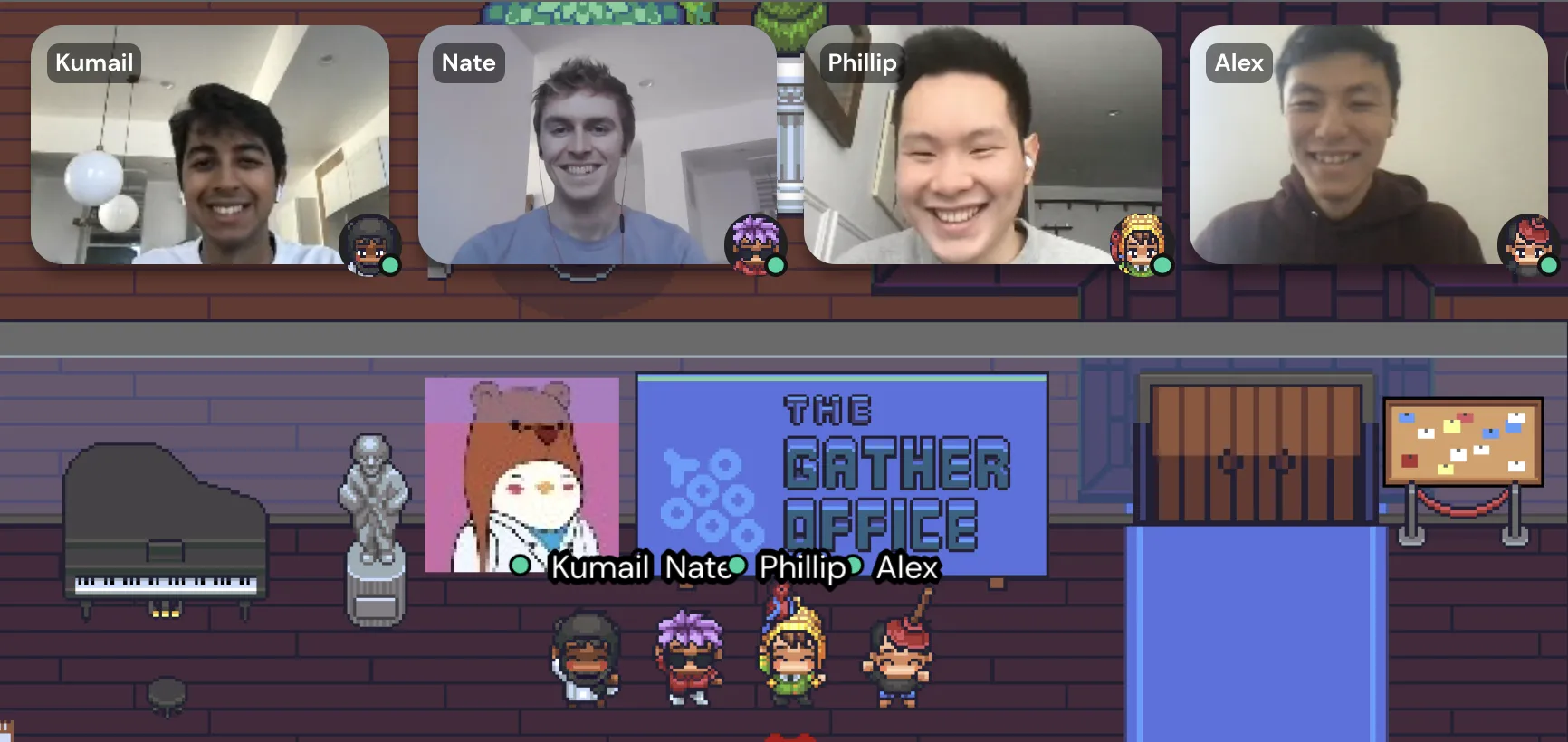
Gather gave those preliminary movements a visible form. People occupied a shared environment through small avatars. Moving nearer to someone could bring their audio and video into the conversation. Moving away let the encounter end. The spatial arrangement made an ordinary social action possible inside a piece of software: approach first, work out the agenda later.
When investors visited, Wang led them through hallways to a private room. Their positions relative to him contributed to a sense of being there together. The pixelated furniture supplied a setting for a more consequential design choice. Conversation belonged to a place, and users could decide which place to occupy.
Early users supplied their own ideas about what those places should contain. A Brooklyn team decorated its office for birthdays. Students could attend an admit weekend without a journey. People organized celebrations, gatherings and events. The same tools could carry a work question or a party invitation. Wang’s company had made a room; its occupants brought the occasion.
A builder with too many possible answers
Wang grew up in the Seattle suburbs and graduated from Carnegie Mellon in three years. Before Gather, his work already crossed several kinds of computing. He built language models for emails at Microsoft, worked on computer vision at Cruise and explored machine learning research. The range matters because his eventual virtual office came out of experiments with several possible ways to connect.
His personal project list includes a dating app, Subtle Asian Matches, and experiments with holographic video chat, noise-cancelling speakers and a humanoid robot controlled through virtual reality. His site carries a useful qualification about these undertakings: he usually worked with other people. Collaboration was part of the method before it became the subject of a company.
At Carnegie Mellon, he contributed to MineRL, which used Minecraft to study imitation learning and sample-efficient reinforcement learning. He also researched meta-learning with Brandon Amos and published an open-source implementation of SNAIL. Games could be places to play, environments to study and raw material for building something else. His later office would sit comfortably among those overlapping interests.
In 2019, Wang worked on Siempre, pursuing better ways to maintain relationships across distance. That November, he started a blog with modest expectations for its audience. He wanted to practise clear thinking and communication, and to share projects with friends or communities that might benefit. For someone building ways to connect, learning to explain himself was another useful experiment.
“Our approach at Gather is to be extremely pragmatic.”
Phillip Wang
A world with room to pass
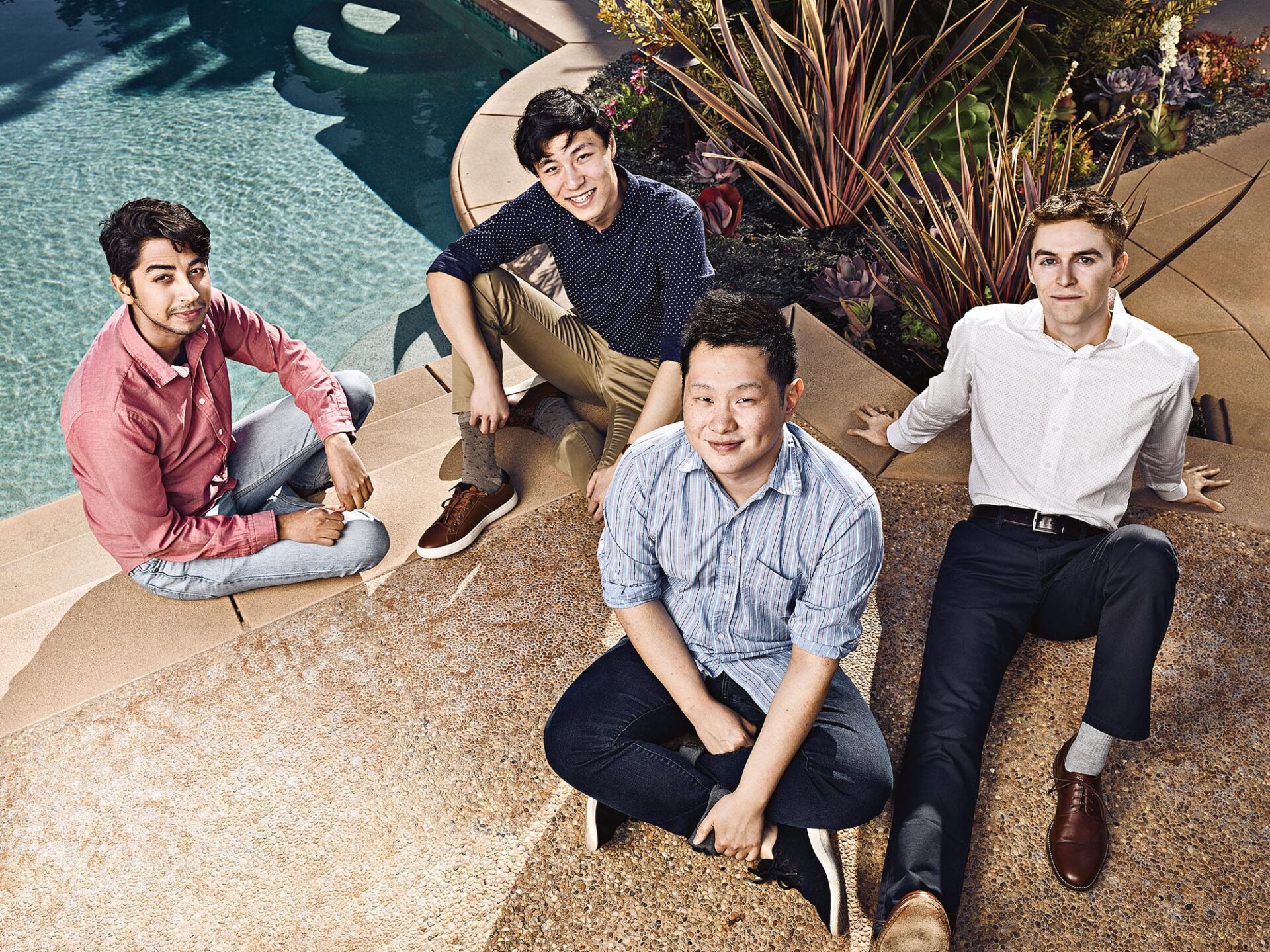
Wang’s first startup team went through Y Combinator in 2019 and skipped Demo Day. Gather launched in May 2020 with Wang, Kumail Jaffer, Alex Chen and Nate Foss. There was an unusual wrinkle in their own collaboration: the four built their company before they had all met physically. A virtual workplace had become part of their working lives as well as their product.
The apparent simplicity of a little person walking across a screen concealed considerable engineering. In a 2021 conversation about Gather’s architecture, Wang described work on both the servers receiving movement updates and the laptops rendering a game-like environment alongside video. A browser had to keep up with the people inside it. An inviting room that exhausted its visitor’s computer would make a poor host.
Large conferences added another problem: how to accommodate a crowd. The team connected many separate Gather spaces, allowing a doorway to move someone to another space. The experience could feel continuous while the underlying system divided the work. A building metaphor became a way to organize technical limits as well as social encounters.
Then there were the hallways. Avatars had fixed sizes, so crowds could clog a narrow passage. Organizers needed to think about corridor width. Holding the G key allowed someone to walk through other people. The digital world had acquired a traffic problem and a rather impolite solution, all while trying to make conversation feel natural.
A schematic of Gather’s proximity-based interaction, rather than a measure of usage.
Eight headsets, an open door
Wang’s enthusiasm for virtual reality survived the choice of a browser-based product. In a 2023 interview, he said he owned eight VR headsets. That is a substantial personal collection for someone helping sell an office entered with a keyboard. It also distinguishes curiosity about a technology from a decision about what to ask customers to use.
He had a wider concern about access. People could associate virtual worlds with games or unfamiliar equipment and conclude that the experience was meant for someone else. A browser made the first encounter easier. Users could discover what the environment did for them before deciding how they felt about the language surrounding it.
His thinking about an open metaverse drew on the open architecture of the internet and his experience with Linux, GitHub and shared code. He discussed identity, infrastructure and creation tools as separate layers where others could contribute. A world built for connection would need ways for people to enter, make things and move between experiences.
The customers also complicated any easy picture of who would enjoy a playful office. In 2023, Wang identified the United States, Japan and Brazil as Gather’s three principal markets. Japanese manufacturers, newspaper businesses and regional companies had shown interest. He spoke, too, about educational possibilities: learning materials could travel online while relationships between students and teachers still needed attention.
The office learns office hours
By 2023, Wang could describe Gather’s internal use in everyday workplace terms. People sat at desks, attended meetings and had short encounters nearby. He also acknowledged that the product had further to go in conveying whether someone was available. In a physical room, a glance can carry information that software has to work quite hard to express.
Time zones required decisions beyond the interface. Gather set up two two-hour global meeting blocks, one for American time zones and another for European ones. The point was to make availability legible. His advice included a simple working habit: come into the virtual office while working, and leave when finished. Even a digital building benefits from a closing door.
Wang later described Gather as having been “refounded” as its focus changed. He credited chief product officer Jinen Kamdar with helping the company become a work product, including decisions the original founders had lacked conviction to make. Naming Kamdar a co-founder recognized that contribution. The account leaves room for leadership to mean accepting another person’s judgment.
A smaller business, a continuing question
In February 2026, Gather announced that its remote-work product was profitable and growing, yet its prospects differed from the venture-scale business originally envisioned. It would become an independent, non-venture-backed company. The announcement promised a tighter focus on customers and their requests. It even singled out office pets for a return. The corporate restructuring contained a small piece of animal husbandry.
Its AI team would join Figma. Wang confirmed that he was going with them and expressed confidence in Samuel Smith to lead Gather alongside experienced colleagues. His public bio now identifies him as product lead for Figma Make. The move extended an interest in making work more pleasant and productive, with a phrase he used to describe the shared aim: “make work closer to play”.
The paths separated, but the original question remains useful. Someone wants to ask a colleague something. Someone wants to spend time with a distant friend. Someone has an idea they would like another person to understand. Wang’s work keeps returning to the conditions around that encounter. There is still plenty to design between an invitation and a reply.
Follow the conversation
WRITING, WORK & INTERVIEWS