The decisive product review arrived as an insult. Ian Tien and his colleagues had spent years building video games at SpinPunch, the company they took through Y Combinator in the summer of 2012. But the software that changed their direction was not a game, a game engine, or even something intended for customers. It was the office chat system. The hosted service kept crashing. Messages disappeared. Then the team tried to leave and discovered that roughly 26 gigabytes of its own conversations, analysis, and company memory would not simply come along.
The provider would not let them export the archive. Stop paying the subscription, Tien recalled, and the company was paywalled from its own information. It was a sour lesson in the bargain hidden inside convenient software: a tool can feel like your workplace while the landlord still owns the keys.
SpinPunch's response was practical. The team built an internal replacement. It worked well enough that they released it as open source, partly to see whether anybody beyond their own small circle cared. Somebody did. A contributor they did not know submitted a substantial pull request. For a team whose game technology attracted users but struggled to attract payment, donated engineering effort was a striking signal. This was not a compliment in a survey. A stranger had spent hours improving the thing.
“We were like, ‘This is a much bigger opportunity than the video games.’”Ian Tien on Mattermost's early signal
The career before the pivot
Tien arrived at that moment with a peculiar combination of builder's detail and product-manager distance. He had worked at Trilogy Software while studying at the University of Waterloo, then built engineering experience at Microsoft. There, he led teams across Office, SharePoint, business intelligence, dashboards, and data warehousing. He later crossed the corridor from engineering into product management, working on services that became familiar under newer names: SkyDrive became OneDrive; Hotmail became Outlook.com.
The patents from those years tell their own quiet story. They cover scorecards, dashboards, reporting, presentations, business logic, and real-time collaboration around data. Long before Mattermost, Tien was working on the connective tissue between information and people. The corporate nouns changed. The underlying problem did not.
In 2009 he entered Stanford Graduate School of Business. He served as a teaching assistant for former Intel chief Andy Grove and economist Myron Scholes, two people accustomed to turning complex systems into legible decisions. He also worked as vice president of product at Flickme, a movie-streaming startup. The education was formal and otherwise: engineering, product, management, media, then games.
Games supplied the memorable diagnosis. Tien has said they carry all the risk of a movie and all the complexity of a business-software product. SpinPunch's HTML5 engine promised one code base across Android, iOS, and browsers. It was technically appealing. Customers liked it free. The missing piece was economic urgency.
Technical promise
Urgent pain
External pull
Mattermost was the opposite. The team had built it because work was being interrupted and information was trapped. When outsiders deployed and modified it, they demonstrated not curiosity but need. The pivot did not require a mystical flash. It required respecting the stronger evidence.
Open source as a listening device
Mattermost became a company in 2016 with Tien as CEO and Corey Hulen as technical co-founder. Its early description was concise: an open-source, self-hosted alternative to Slack. That comparison helped people place the product, but it did not explain its center of gravity. Mattermost was for organizations that needed messaging to live under their own administration, connected to their own tools, on infrastructure they controlled.
Tien's phrase for the go-to-market logic is equally compact: “Software is adopted, not sold.” In open source, adoption can happen before a procurement process and beyond a vendor's line of sight. Developers install a tool, adapt it, connect it to their stack, and occasionally send the improvement back. The salesperson may arrive later, after the software has already earned a constituency.
That pattern helped Mattermost find serious work. Teams used it with development and operations tooling. Organizations deployed it on premises. Government and defense users brought requirements shaped by classified information, disconnected environments, low bandwidth, multiple security domains, and the awkward fact that a cloud service may be unavailable precisely when communication matters most.
By 2019, Mattermost announced a $20 million Series A and a $50 million Series B. The capital accelerated a business that had begun bootstrapped, but the product thesis stayed close to the original annoyance: customers should be able to control the system that contains their work.
A remote company with no romance about distance
Mattermost was remote from the beginning, before remote work hardened into a debate with slogans on both sides. Tien's operating rule for a mixed meeting is revealing. If five colleagues are together in a hotel room, each should still find a separate location and join the call individually. “Make everyone equal,” he said. A room should not become an inner circle merely because it has one speakerphone.
He has also been candid about the missing pieces. In Mattermost's employee-engagement surveys, the question about having a best friend at work scored lower than at conventional companies. The team knew why: remote colleagues do not casually wander toward lunch or linger over a drink. Mattermost responded with annual company gatherings in places including Lisbon, the Dominican Republic, and the Bahamas. Tien's conclusion was modest. Close bonds can form remotely, but they take longer.
This is typical of his management writing. The argument usually becomes a mechanism: a survey, a meeting rule, a weekly update, a public handbook, a repeatable process. Mattermost describes its culture as “high-impact openness,” publishing much of how the company operates. Openness is not presented as corporate sunlight for its own sake. It is meant to make information searchable, decisions inspectable, and collaboration easier across time zones.
“Make everyone equal.”Ian Tien's rule for remote meetings
From office chat to mission environment
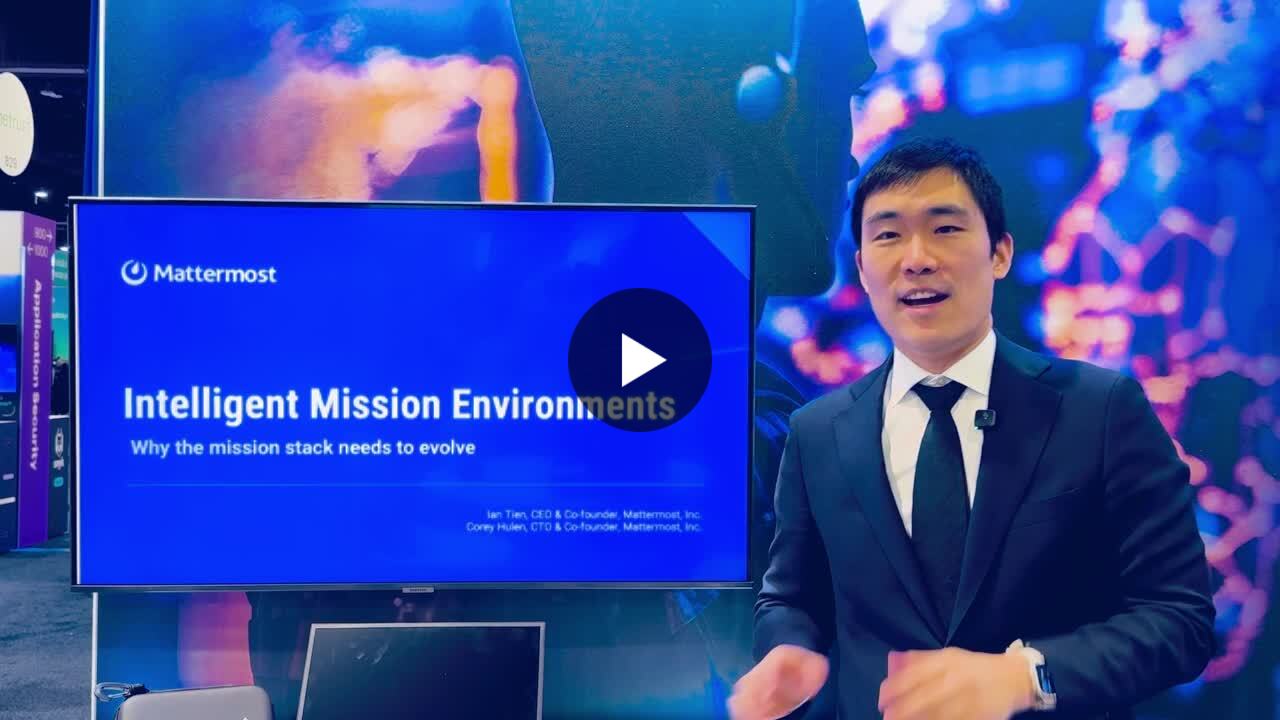
The company's vocabulary has changed as its deployments have become more consequential. Mattermost now calls itself a sovereign collaboration and AI automation platform for national security and critical infrastructure. Its Intelligent Mission Environment combines secure messaging, calls, workflow automation, project work, and AI agents while preserving deployment choices that include private cloud, on-premises systems, and air-gapped networks.
“Sovereign” can sound grand until translated into ordinary questions. Where does the data sit? Who can inspect the source? Can the system keep working without a public network? Can one organization collaborate with another without dissolving its own security policy? Who controls the AI model, its prompts, and the information it can retrieve? These are architecture choices, procurement choices, and, in the environments Mattermost targets, operational choices.
The 2025 launch of Enterprise Advanced made the direction explicit: attribute-based access control, hardened file handling, high availability, AI assistance, and workflows for multi-domain operations. Product releases through 2026 kept adding finer policy controls and user-created agents. Mattermost had traveled far from “chat alternative,” while remaining recognizable as the answer to the same question: what would collaboration look like if control were a product requirement rather than an account setting?
The founder becomes the interviewer
Tien's newest public role is host. In 2024 he started Tools for Tech Leaders, a video and audio series built around conversations with executives. The first guest, former Veritas CEO Mark Leslie, had once been his professor at Stanford. Other episodes have focused on engineering leadership, organizational communication, company scaling, AI adoption, and the awkward transitions that happen when a manager must hand work to someone else.
The show resembles an executive's field notebook with the microphone left on. Tien asks for a practical device, records the explanation, and sometimes tries it at Mattermost. In a later interview, he described adopting a system of short weekly updates from directors and vice presidents after hearing a guest explain it. Curiosity became process, which became another question for the next guest.
There is a pleasing continuity in that. The Microsoft engineer worked on dashboards that made organizations legible. The founder built a public handbook to make a distributed company legible. The podcast host asks leaders to explain the tools behind their decisions. The subject is still collaboration, though the interface keeps changing.
Mattermost began when a provider turned a team's memory into leverage. Tien's answer was to build software that could be inspected, moved, modified, and operated by the customer. The game studio disappeared into the origin story, but its failed plan left behind a durable instinct: when the official product is not working, look closely at the tool everyone uses to keep working anyway.