The useful thing about losing control of a conversation is that it clarifies what the conversation was worth. Before Mattermost was a company, it was an irritation inside another company. The team behind SpinPunch made Facebook games and used the usual channel-based tools to coordinate the work. Then a service changed hands. Reliability wobbled. Old messages became awkward to retrieve. The archive belonged, in the practical sense, to somebody else.
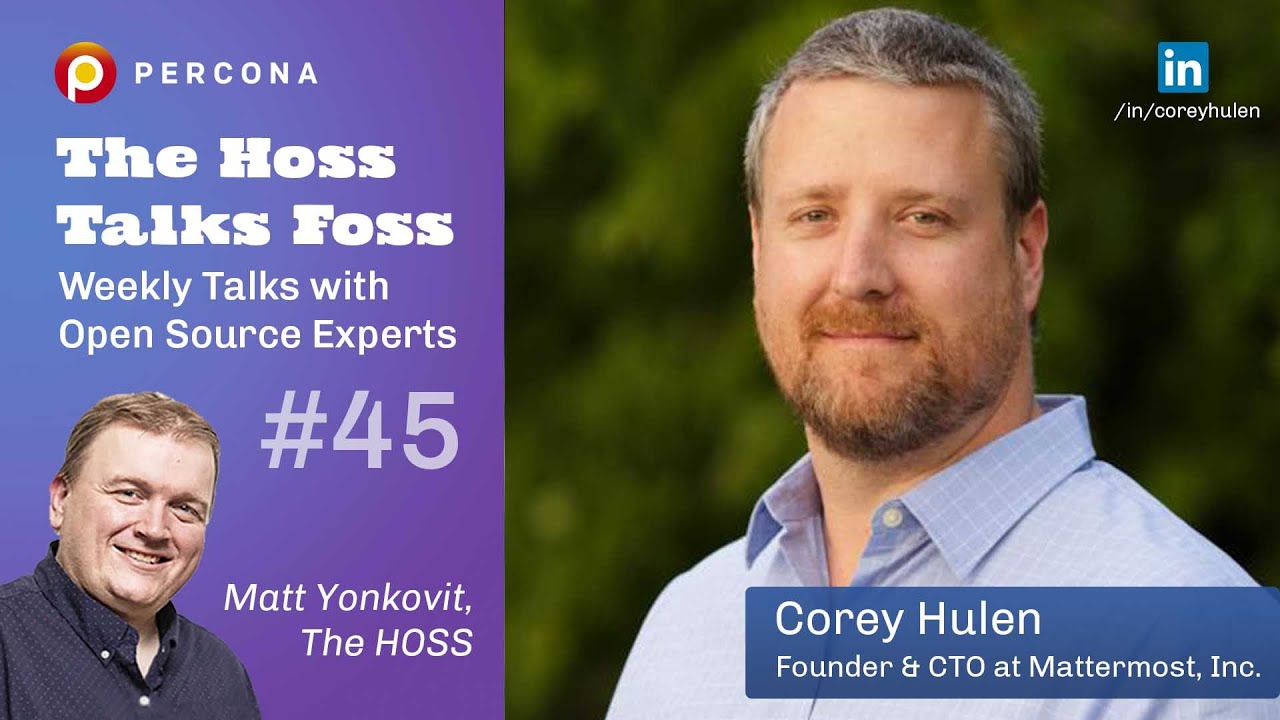
Corey Hulen, an enterprise-software engineer with a taste for systems and a low tolerance for unnecessary machinery, saw more than an inconvenience. Teams were conducting business inside a rented room, but the landlord kept the keys, the floor plan and, occasionally, the filing cabinet. Hulen and his longtime colleague Ian Tien began considering an alternative: messaging software that an organization could run, inspect and adapt for itself.
“You own the data. You control the data. It’s yours,” Hulen said when describing the premise years later. “It’s your intellectual property.” The phrasing is almost aggressively plain. So was the name of the early binary: platform. It was funny, Hulen conceded, but accurate. He and Tien did not imagine chat as a decorative app. They imagined a surface upon which alerts, software tools, decisions and human conversations could meet.
The proprietary apprenticeship
Hulen did not arrive at open source by the scenic route. After studying computer science at California Polytechnic State University, San Luis Obispo, he founded a consulting firm, Zot Technologies. He moved into enterprise architecture at VerticalNet, which sold supply-chain software to large companies, and then spent roughly six years at Microsoft. There, as a development lead and architect, he worked across Microsoft Office, SharePoint and business intelligence.
It was an education in making software at a scale few companies could match. It was also Microsoft before the company’s public embrace of open source. Hulen has recalled that employees were discouraged from even looking at outside source repositories because of legal concerns. Years later, when a Microsoft friend appeared carrying a company-issued MacBook, Hulen found the sight almost exotic. A laptop had become evidence of a cultural revolution.
The next turn joined three different habits of mind. At SRI International, entrepreneur Raj Singh recruited Hulen from Microsoft and Thierry Donneau-Golencer from SRI’s Artificial Intelligence Center. Singh brought mobile experience, Hulen brought big-data engineering, and Donneau-Golencer brought AI. Together they created Tempo, a calendar assistant designed to prepare people for meetings by drawing context from email, contacts, location and other personal data.
Tempo was clever, useful and eventually acquired by Salesforce. Hulen nevertheless tells the story with comic deflation, calling it a “very, very minor success.” What stayed with him was not the exit so much as a sense of debt. The distinctive SRI technology was only the tip of the product, he said. The other 99 percent rested on open-source work. He felt, in his word, like an impostor standing on the backs of open-source giants.
Paying the software debt forward
Mattermost became a practical answer to that discomfort. The team rewrote its messaging technology in Go and released the project as open source in 2015. The choice served strategy as well as conscience. If messaging was to become a ubiquitous platform, Hulen reasoned, making it easy to examine, deploy and extend was a persuasive route. The company would sell enterprise capabilities and support, while much of the code remained available for customers and contributors to see.
Building in public felt strange at first. Hulen had made small contributions before, but he had never worked at this scale with a community on the other side of the repository. The arrangement changed who counted as part of the engineering effort. A contributor did not need a company badge to improve the product. A customer did not need to accept a black box on faith. Openness became at once a distribution method, a recruiting surface and a claim about trust.
By the release of Mattermost 6.0 in 2021, Hulen was writing less like a keeper of a chat application and more like a student of organizational friction. He said the launch mattered partly because of what the company had learned: developers and technologists were being asked to carry responsibilities that sprawled well beyond code. The product expanded around channels, structured playbooks and project work, an attempt to keep the discussion and the action from drifting into separate systems. His description of the CTO job was revealing. He had to spend as much time learning as leading. For an architect accustomed to diagrams, the organization itself had become another system to observe, debug and carefully revise.
His personal blog offers a miniature history of the engineer beneath the executive title. Under the cheerfully unfashionable banner “Geekout,” posts explain Cassandra indexes, Java performance counters and unattended EC2 installation. One cache design is praised for being “simple and fast,” then praised again, in case the reader missed the governing religion. The prose has the texture of a working notebook: find a recurring annoyance, make a tool, show other people how it works.
Chat grows consequences
The more serious Mattermost’s customers became, the less adequate the word chat sounded. Hulen’s work moved toward operations in which a message can become an instruction, an acknowledgment can establish that somebody has seen it, and a missed notification can waste more than an afternoon. In 2023 he stepped in to lead the company’s Small Business Innovation Research program. His team developed and tested capabilities across four active contracts, including message priority, acknowledgment and persistent notifications.
One test arrived on an immense map. U.S. Air Force Air Mobility Command used custom ChatOps capabilities during Mobility Guardian 2023, an exercise spread across nearly 13 million square miles of the Indo-Pacific. The figure is so large that it makes a chat window look absurdly small. That is precisely the point. A modest interface can sit atop logistics, command decisions and distributed teams, provided that the system beneath it remains available and intelligible.
Today Hulen is CEO of Mattermost Federal, co-founder of Mattermost and, in the company’s current description, CTO Emeritus. His attention is on defense, intelligence and other constrained environments. Some are disconnected. Some are air-gapped. Some cannot send sensitive operational data to a conventional cloud service. They still need current tools, integrations and automation, but they need those things to enter on local terms.
This is where his open-source argument has sharpened. In regulated or federal settings, Hulen says, the ability to audit the code is a powerful feature. Proprietary software may conceal precisely what a cautious operator wants to inspect. Open code does not guarantee secure code, of course, but it permits scrutiny. His ambition is to bring modern technology into environments often burdened by older systems without asking them to surrender sovereignty in exchange.
Less meeting, more mountain
For somebody in the collaboration business, Hulen is notably suspicious of scheduled collaboration. Mattermost was remote-first before remote work became a mass experiment. He has written that the company “abhors unnecessary recurring meetings,” preferring asynchronous work until an impasse makes a quick video call useful. His practical counsel for those calls includes two homely rules: make the bed and turn on the camera. A theory of distributed organizations, reduced to laundry and eye contact.
Colleagues quoted on his professional profile describe a leader focused on customers and shipping on time, with deep technical knowledge and an ability to keep highly technical teams motivated. Hulen’s own advice is less managerial. Be passionate about technology, he says, and apply it to a real problem. Contribute to open-source projects. Share the work. Meet people. The network follows the artifact.
Away from software, he hikes, backpacks and fishes. His particular enthusiasm is Tenkara, a Japanese form of fly fishing that uses a long rod, a fixed line and no reel. Hulen seeks it out on remote alpine lakes and streams. The analogy to his engineering taste is tempting and should not be tortured: remove mechanisms, understand the environment, retain direct control. At minimum, Tenkara provides a splendid escape for someone who has spent a career arranging ever more consequential streams of messages.
His lighter answers reveal an engineer who has not entirely evicted the child with the telescope. Asked to name a favorite planet, he chose Saturn, remembering the first time he saw its rings without an impossibly powerful instrument. Asked which animal he would keep, he chose a horse for his daughters and a dolphin for himself, then conceded the obvious infrastructure problem.
The story began with a game company that could not comfortably recover its own words. It now reaches rooms where the words may be classified, networks may vanish and ordinary consumer assumptions no longer apply. The lesson is not that every conversation needs a fortress. It is that consequential conversations deserve architecture equal to their consequences. Corey Hulen has spent a decade making the room sturdier, then handing its occupants the keys.