The strange thing about Red Hat is that its customers can see the recipe. The source code is open. The upstream projects are public. A clever engineering team can download many of the ingredients without paying Red Hat a dollar. And yet banks, airlines, hospitals and government agencies sign subscriptions. They are not buying secrecy. They are buying the relief of knowing that someone has tested the combination, documented the ugly corners, certified it against thousands of other products, promised a support lifecycle and will pick up the phone when a Tuesday patch turns into a Wednesday crisis.
That distinction turned a North Carolina Linux outfit into the first open-source software company to pass $1 billion in annual revenue, then into the object of IBM’s roughly $34 billion acquisition in 2019. By 2024, IBM said Red Hat had grown to about $6.5 billion in annual revenue, roughly twice its size when the deal was announced. The company’s portfolio now stretches from the operating system to Kubernetes, automation and artificial intelligence. The red fedora remains; the box of Linux CDs does not.
The original gambleFirst, kill the box
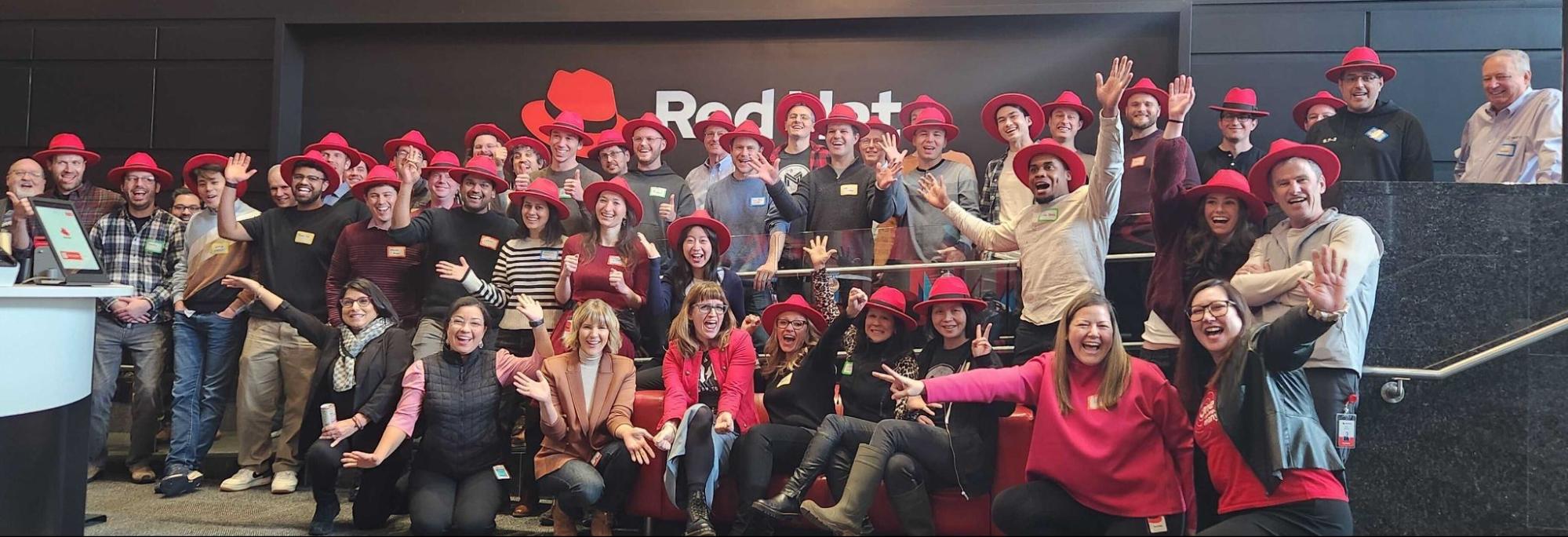
Marc Ewing was the technical founder, building a Linux distribution from his home in Durham. Bob Young was the businessman with a computer-supply catalog. Young kept selling out of Ewing’s discs, so the pair joined forces in 1995. The name was already waiting for them: in a college computer lab, Ewing wore his grandfather’s red Cornell lacrosse cap. If somebody needed help, the instruction was simple - find the guy in the red hat.
The early business looked familiar. Burn the software onto CDs, shrink-wrap the box, load it onto a truck and hope customers bought the next release six months later. That worked for enthusiasts. It failed first at the point where Red Hat wanted serious corporate workloads. A large company could not rebuild its estate twice a year to chase features. It needed hardware certification, compatible enterprise applications, round-the-clock help and a migration whose benefit exceeded its risk.
So Red Hat attacked its own revenue. In 2001-02, it ended boxed Red Hat Linux, then its main source of income apart from a little merchandise, and replaced it with Red Hat Enterprise Linux sold by subscription. Internally, the decision was controversial. The code would remain open, but the offer became stability, updates and accountability. Fedora arrived as the community lane for people who wanted new technology early and often. RHEL became the lane for people who wanted their database to behave the same way next quarter.
“When we said ‘ship it,’ we meant it literally.”Red Hat, remembering the CD era
What customers actually useFrom the kernel to the boardroom headache
Red Hat Enterprise Linux is still the foundation: an operating system for servers, clouds and edge devices with long support windows and a vast certification ecosystem. OpenShift sits above it, giving development and operations teams a managed way to build and run containerized applications with Kubernetes. Ansible Automation Platform turns repeatable instructions into infrastructure and network workflows. Middleware, API management, security, consulting, training and technical account management fill in the connective tissue.
The customer’s problem is rarely “we need more open source.” It is usually “we have three clouds, an old data center, a regulator, a backlog and too few specialists.” Red Hat’s open hybrid cloud pitch is that the same platform and operating practices can follow a workload across on-premises hardware, AWS, Azure, Google Cloud and the edge. That portability is not frictionless, but it gives a buyer leverage that a single-cloud design may not.
Telefónica offers a useful picture. It first put business-intelligence applications on OpenShift 3. As its older Telco 3.0 environment ran into resource contention and scaling trouble, the successful container deployment changed the team’s mind. In 2019 it began moving core applications to OpenShift 4. Red Hat’s 2024 case study said 75 percent of Telco 3.0 was then deployed on the platform across more than 10 clusters. The attraction was not a dazzling demo. It was better isolation, consistent management and the option to move applications among clouds.
Revenue grew after software stopped being the scarce thing
Rounded milestones. Red Hat crossed $1 billion as a public company; IBM later reported the business at roughly $6.5 billion.
The competitive trickA moat made of maintenance
Canonical and SUSE compete in enterprise Linux. SUSE Rancher, VMware Tanzu and the big cloud providers compete around Kubernetes. Puppet, Chef and cloud-native tools overlap with Ansible. The cheapest alternative is upstream software plus an internal team willing to own the consequences. Red Hat’s difference is breadth: one commercial relationship across the operating system, application platform, automation and now AI, backed by an ecosystem of hardware makers, clouds and integrators.
Its moat is cumulative labor. Each certification, security advisory, compatibility test, support case and upstream contribution makes the next enterprise renewal easier to justify. Competitors can copy code faster than they can copy twenty years of institutional memory. This is also why the model produces wonderfully boring marketing nouns: consistency, lifecycle, interoperability, compliance. In production infrastructure, boring is often a feature with a purchase order attached.
The approach has limits. A small team running disposable workloads may be better served by Ubuntu, a managed Kubernetes service or community software. OpenShift can be more platform than a simple application needs, and subscriptions only pay off when downtime, audit demands or operating complexity are expensive. Companies also need people and process discipline; buying automation does not make a tangled estate coherent.
There is a sharper tension, too. In 2023, Red Hat made CentOS Stream the sole public repository for RHEL-related source releases. Red Hat argued that Stream was the proper collaboration point; downstream rebuild projects saw a commercial gate closing. The episode exposed the seam in the business: openness supplies the raw material, while controlled packaging funds the factory. Red Hat has to keep both sides believing the exchange is fair.
The next repeatCan enterprise AI become boring?
Red Hat’s AI portfolio repeats the old formula. RHEL AI supports models on individual servers. OpenShift AI handles model development, tuning, serving and governance across Kubernetes clusters. Red Hat AI 3 added distributed inference, while the 2026 AI Enterprise release joined infrastructure, models and agents into a “metal-to-agent” platform. The proposition is less about producing the cleverest model than about letting a regulated company deploy one near its data, monitor it and move it without rebuilding the operating environment.
Lightwell takes the logic further. In May 2026, IBM and Red Hat announced a $5 billion commitment, backed by more than 20,000 engineers, to use AI and human review to find and remediate vulnerabilities in open-source dependencies. By July, Lightwell Network launched with more than 6,500 remediated, signed package versions. In plain English: instead of forcing a bank to make a disruptive major upgrade, patch the version it already runs, validate the fix and deliver the evidence its auditors need. Once again, the free component is not the complete product. Confidence is.
The code is open. The bill is for making it predictable.The Red Hat proposition, in one line
The copyable partSeparate the fast lane from the safe lane
Founders can copy Red Hat’s structure without copying its scale. Let an open or experimental community move quickly. Give production customers a deliberately slower edition with clear compatibility promises. Charge for the expensive work around the artifact: integration, migration, security, documentation, training and a named person who owns the problem. Publish lifecycle dates. Make the free version genuinely useful, because it feeds adoption, talent and feedback rather than acting as a crippled trial.
- Split audiences by risk tolerance. Experimenters and production operators should not be forced into the same release rhythm.
- Sell a measurable promise. Support response, certified combinations and maintenance windows are easier to renew than vague “enterprise features.”
- Contribute upstream. A company that only extracts from an open ecosystem eventually loses trust and access to its best ideas.
- Know when it will not work. If failure is cheap, compliance is light and the buyer has deep in-house expertise, a premium reliability layer may be needless overhead.
Red Hat’s achievement was not proving that free software could be sold. It proved that “free” describes the license, not the customer’s operating risk. The company found the budget attached to that risk and built an organization around reducing it. From a lacrosse cap to a $34 billion acquisition, the through-line is almost comically consistent: if you need help, look for the person in the red hat.