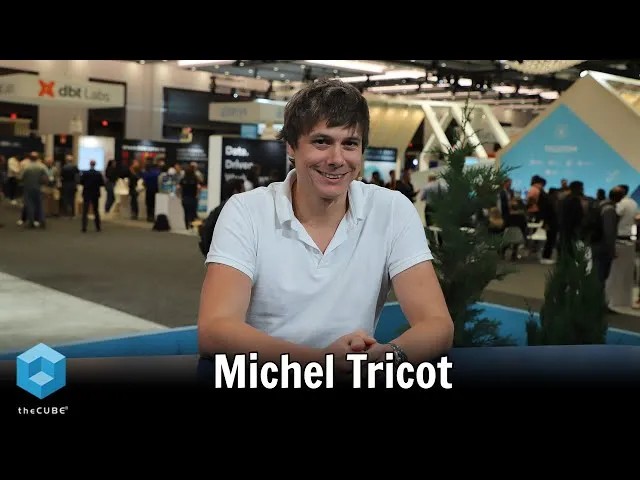
Michel Tricot did not begin Airbyte with a flash of revelation. He began with repetition. Across jobs, industries, and scales, the same dull problem kept returning: useful data was trapped in one system while somebody needed it in another. The solution was usually another connector, another script, another quiet maintenance obligation. Years later, when Tricot and his co-founder Jean Lafleur were searching for a company to build, that repetition became more persuasive than novelty.
It helped that Tricot had always liked collections. He has recalled gathering books, movies, games, and interesting websites as a child. The pleasure was not simply possession. Put enough raw pieces together and a larger picture begins to appear. His professional life became an industrial version of that instinct: finding information, moving it, and making it usable.
After studying computer science at EPITA in France, he started as an R&D engineer at FactSet in Paris in 2008. The work introduced him to financial data. In 2011 he moved to San Francisco to join Rapleaf, whose data-onboarding operation became LiveRamp. Over seven years, he helped build and scale more than 1,000 connectors moving hundreds of terabytes each day. The volumes were large; the annoyance was basic. Customers and engineering teams kept rebuilding access to the same kinds of systems.
A problem looking for a company
Tricot later joined rideOS, a mobility-infrastructure startup, as a founding member and director of engineering. By July 2019, he had left and decided it was time to start a company. He took a month away from work, then resumed a long-running conversation with Lafleur. The two had met around 2012 or 2013 and tried several side projects together. None became the business, but they served as low-stakes rehearsals for a partnership.
Their first serious attempt was not Airbyte. They applied to Y Combinator with an idea connected to remotely supporting autonomous vehicles, then backed away days later after Uber and Lyft announced something similar. Instead of defending the idea, they built a process for replacing it.
Each Monday, possibilities went onto a whiteboard. They were ranked by founder-market fit, the team's excitement, and the severity of the customer's pain. The method was useful because it gave attachment a deadline. A clever concept could survive only if conversations made it sturdier.
They entered Y Combinator's winter 2020 batch as a pre-idea company and incorporated under the name Daxtarity. During the first month, they pivoted repeatedly through versions of a data marketplace, an engine running in a customer's cloud, an answer to analytics traffic blocked by browsers, and a system for controlling customer data. They set aggressive goals for meetings, an alpha, and paying customers. Speed was a way to create evidence.
“If you're building a perfect product, you're not moving fast enough.”Michel Tricot
When the customer list went quiet
By early 2020, the team had a product aimed at marketers and promising conversations to support it. Then the pandemic arrived. Marketing teams were cut, plans froze, and email replies sometimes came back with a blunt message: the address no longer existed. Tricot and Lafleur had hired three engineers. They had a product, but the market beneath it had thinned almost overnight.
One pivot candidate was an AI-enabled assistant. In 2020, they judged it less compelling than the path they eventually chose. The more important choice was operational: they stopped treating the existing product as something that deserved rescue. From April into July, the founders spent as much as eight hours a day speaking with people. Video calls replaced building. Hundreds of interviews reduced a broad data problem into a repeated sentence: even teams that bought integration software still maintained custom scripts for missing or unsuitable connectors.
In July, they changed the rhythm. Calls would continue, but the team would also build an idea for one month. If nobody pulled at it, they would move on. The first candidate was an open-source data-integration platform. This one did not get killed.
The rough product people refused to abandon
The open-source choice answered two problems at once. It could meet engineers at the moment they were considering an internal build, and it could make the long tail of connectors extensible. No vendor team could anticipate every obscure database, regional service, or oddly configured API. A community could inspect the code, adapt it, and contribute what it learned.
Tricot and Lafleur had used and contributed to open-source projects, but they had never maintained one. A conversation with GitLab co-founder Sid Sijbrandij sharpened their approach. Reduce the time between trying the project and experiencing value. Accept that an open-source company may never know every person running the code. For two people whose careers centered on data, that second lesson carried an irony they appreciated.
Airbyte's alpha arrived in September 2020. Tricot later described the first version as terrible. Yet users went out of their way to make it work. Around 100 people tried it in the first week. Their frustration with the product was less informative than their refusal to leave it. A polished demo can win compliments; an inconvenient alpha reveals whether the alternative hurts.
Capital followed usage. Airbyte announced a $5.2 million seed round in March 2021, a $26 million Series A in May, and a $150 million Series B in December at a reported $1.5 billion valuation. The compressed fundraising story is tidy. The operating story was messier. By mid-2021, community adoption threatened to overwhelm the team's ability to support users and improve the product. Growth created a maintenance bill.
The numbers from that first year capture the speed and the strain. Airbyte said 600 companies had moved data with the project by the seed announcement. Less than three months later, the figure had passed 2,000, while its Slack community had grown beyond 1,300 members. Each new installation could reveal an edge case, request a connector, or require help. Open source lowered the door for adoption; it also turned support into a public operating system for the company.
Tricot's response was not to close the door. The team paused enough feature work to consolidate the foundation and make the product more dependable. That distinction matters. A community can accelerate distribution and development, but it cannot substitute for maintainers who set standards, review contributions, and own the boring failures. Airbyte's promise depended on both sides: outsiders could extend the system, while a company remained accountable for turning a fast-growing project into infrastructure.
“Connectors behave like living systems in production.”Michel Tricot
From moving records to supplying context
That maintenance burden explains one of Tricot's recurring metaphors. Connectors are living organisms. An API changes. Authentication expires. A schema drifts. A provider introduces a rate limit. Shipping the code is the beginning of the obligation. The real product is continued reliability.
For Airbyte's first years, the dominant destination was the analytics stack: extract records from operational systems, load them into a warehouse, and let teams transform them into metrics and dashboards. Version 1.0 arrived in 2024 after years spent hardening that core. By 2025, Airbyte 2.0 added a broader platform story around movement, activation, deployment choice, and AI readiness.
Tricot now frames the next infrastructure problem around context. An analytical query may need a clean table. An AI agent acting for a company may need to understand that a charge in Stripe, a contact in Salesforce, and a support case in Zendesk refer to the same customer. It also needs current permissions, identity relationships, unstructured documents, and a reliable way to write back to operational systems.
In May 2026, the company launched Airbyte Agents, an agent SDK, and an MCP offering as pieces of that context layer. Tricot's writing has grown more frequent and more architectural: state machines, approval gates, memory, ontology, idempotent writes, and rate-limit-aware orchestration. His argument is consistent with his earlier work. Intelligence stalls when access is fragmented, and infrastructure should remain inspectable and controllable when agents can act with company data.
The habit beneath the strategy
Tricot's career can be read as a series of enlarging collections: financial records, internet data, mobility signals, business systems, and now the context required by software agents. Yet the more useful through-line is maintenance. He learned to notice work that companies repeat privately, then ask whether an open standard could make that work shared.
He also carries the operating discipline formed during Airbyte's least certain months. Talk to the people with the problem. Make idea selection explicit. Build quickly enough that behavior can replace opinion. Invite pushback. Tricot has said he often gives Andy Grove's High Output Management to people he sees as rising stars. It is a revealing gift from a founder whose story is less about a single idea than a system for producing better decisions.
The destination keeps changing. First the data served analysts. Now it must serve agents that read, reason, and take action. The pipe still has to work. That stubborn, uncelebrated requirement is where Tricot has chosen to stay.