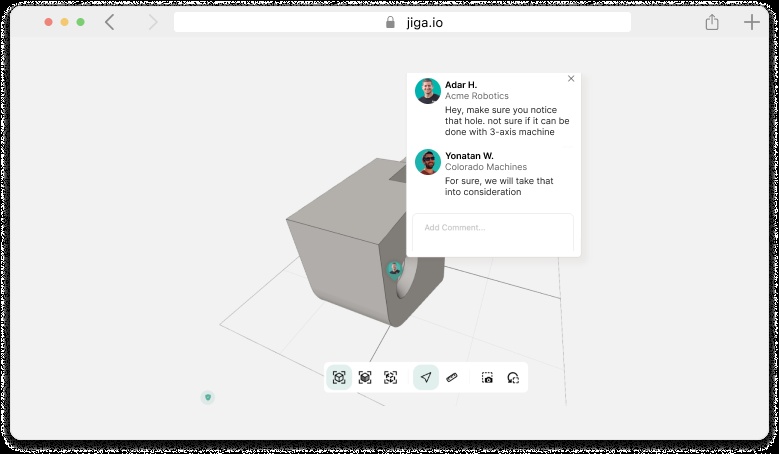
On Jiga’s website, a machinist asks a wonderfully small question. Can a hole be drilled to 18 millimeters instead of 13, to leave room for the tap and the chips? The engineer agrees, provided the required thread depth remains intact. The exchange is brief. It is also the sort of exchange on which an expensive machine quietly depends.
We tend to imagine manufacturing as a contest of machinery: a finer cutter, a faster printer, a more capable robot. But between the drawing and the finished object sits a conversation. Someone must notice the ambiguity. Someone must answer. Jiga, founded in 2020, has made that conversation the center of its business.
- Source custom parts from vetted manufacturers you can speak to directly.
- Compare quotes, follow orders and keep drawings and messages together.
- Onboard Jiga as one supplier of record across its manufacturing network.
- Start free; pay for the parts you order.
The parcels in Assaf’s house
Before Jiga, co-founder Assaf Geuz ran a manufacturing service. In a public account of those days, he remembers hundreds of calls and messages, accompanied by the smell of grease and powder. Connecting customers to the production floor was the difficult part. The machine could do its job. The surrounding coordination demanded constant attention.
Starting a company did not immediately make that work disappear. “Packages arrived at my home before every shipment,” Geuz recalled. The problem, he wrote, had changed shape. There was still considerable work behind the scenes. He credits those early challenges with teaching the team the importance of efficiency, transparency, communication and trust.
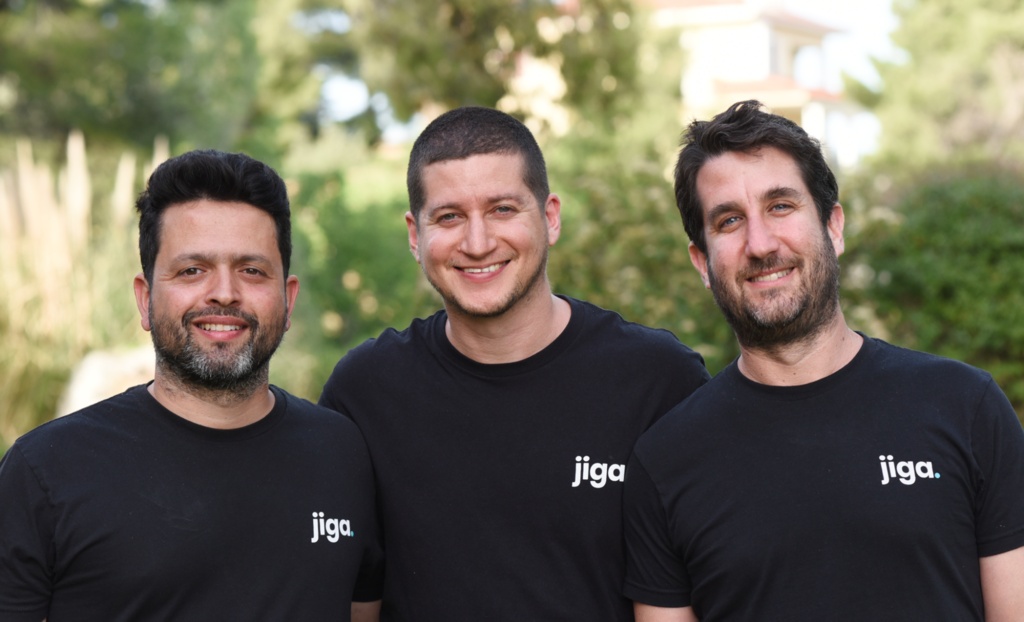
Geuz became COO, Adar Hay CEO, and Yonatan Wolowelsky CTO. Jiga joined Y Combinator’s Winter 2021 batch. Its expertise joins software to the less tidy business of finding suitable shops and getting actual objects delivered. That background helps explain a product philosophy: keep the manufacturer within speaking distance.
A thousand parts, one place to look
Consider Carbon Robotics. Its LaserWeeder uses computer vision and lasers to remove weeds. According to Jiga’s customer case study, each machine has more than a thousand parts on its bill of materials. Finding vendors, comparing quotes and qualifying components created one workload. Remembering what had been ordered and what was arriving created another.
Purchasing agent Colten Brandenberg brought those activities into Jiga: requests sent to several manufacturers, prices and lead times compared together, conversations attached to the relevant order. He reports that parts previously taking eight weeks could arrive in two or three. The result belongs to this customer’s experience; it is no universal delivery promise.
Less time waiting for parts
The workflow begins with drawings, models and specifications. Jiga’s quoting tools return human-reviewed offers and design-for-manufacturing feedback. Its collaboration tools let buyers exchange files and discuss details on 3D models. Tracking tools follow status and delivery, while revisions remain attached to the work they describe.
Its manufacturing partners cover CNC machining, sheet metal, injection molding and 3D printing. Jiga therefore sits in the market for made-to-specification components, serving engineers and procurement teams. Aerospace, defense and robotics are prominent markets. Wearable robotics company Humotech, industrial group ICL and student team Global Formula Racing illustrate the range of work.
The bill has two columns
There is the price of the part. Then there is the time spent getting it. Jiga currently advertises free signup and payment for sourced parts. A February 2023 report described a small markup on parts and subscriptions for selected features and integrations. That was the business model reported then; current purchases depend on their quotes.
Humotech’s case study supplies a more useful accounting exercise than a grand claim about efficiency. It reports 10% lower costs, 35% improved lead times and five engineering hours saved per order. These are company-published customer results. They suggest what a buyer should measure: money, elapsed time and the hours talented people spend administering a purchase.
Humotech results reported by Jiga; customer-specific.
Other routes exist: work directly with a machine shop, or use digital manufacturing services such as Xometry, Protolabs or Fictiv. Jiga’s pitch combines a platform with continuing supplier relationships. For Global Formula Racing, the attraction was being able to resolve questions directly while managing complicated student-designed parts.
“If they have a question, they ask us.”
Justin Weller, steering lead, Global Formula Racing
Jiga still occupies a commercial role. It serves as supplier of record, handling onboarding and coordinating support, payments and logistics. Buyers can retain an approved supplier list. The distinction is useful: direct technical access can coexist with a single company responsible for the commercial relationship.
Twelve million, with the lights already on
In November 2025, Jiga announced a $12 million Series A led by Aleph, with Symbol and Y Combinator participating. It said it was already profitable. The stated plan was to expand production capabilities, deepen AI-assisted quality assurance and develop enterprise infrastructure. Earlier, in February 2023, it had announced a $4.1 million round led by Symbol.
Inside the company, the transparency theme reappears. Jiga describes remote, asynchronous work, shared financial numbers and decisions made by the person closest to a problem. Its recruiting page asks for an applicant’s favorite ice cream. A business devoted to industrial precision apparently allows some latitude on dessert.
The practical lesson is small enough to copy tomorrow: tie every question to the correct drawing revision, compare promised delivery with price, and establish who will resolve a problem. A sensible trial starts with one part. Program-specific qualifications, inspection requirements and shipping terms still need attention. Software cannot negotiate away a physical tolerance.
In an April 2026 podcast with Bananaz CEO Or Israel, Hay discussed a less cinematic obstacle to industrial AI: customers’ digital maturity. The episode describes many target customers as roughly two or three on a five-point scale. That makes adoption a practical question about existing habits, security and traceability. A system has to earn its place in the purchasing routine. For a procurement team, evidence from one completed order may be more persuasive than a demonstration full of promises.
Jiga uses AI to extract requirements and flag risks; people remain responsible for consequential decisions. That division makes sense. An alert can identify a missing document. A machinist can explain why a hole needs five more millimeters. For the engineer waiting on the other end, the valuable thing is getting the answer before the metal is cut.