A machine shop with an empty production slot and an engineer desperate for a part ought to be good news for each other. First, they have to meet. Then come the drawings, questions, prices, delivery dates and another email asking whether anyone has seen the last email. Xometry built its business in that gap. Its invitingly ordinary proposition: upload a design, get a price, order the part.
There is nothing ordinary about pricing an object that has never been made. A custom bracket carries no supermarket barcode. Its cost depends on geometry, material, machine time, finish and quantity. Xometry’s software turns those variables into a purchasing decision, then connects the order with a manufacturer able to execute it. The shopping cart is the easy part to understand. The factory work behind it is the company’s real test.
By 2025, that proposition had produced $686.6 million in annual revenue, up 26%. Xometry is a business-to-business manufacturing marketplace whose customers include engineers, procurement departments and hardware startups. Consumer products are among the things those customers make; Xometry itself sells the means to get custom components made.
01An algorithm meets a cutting tool
The service menu stretches from CNC machining and sheet-metal fabrication to polymer and metal 3D printing, injection molding, casting and stamping. A designer can order a prototype enclosure, a purchasing team can source production components, and an engineer can compare manufacturing choices before committing to a drawing. Different processes solve different problems. A printed prototype and a molded production part are separate purchasing decisions, even when they begin with the same shape.
Xometry’s expertise lies in interpreting those differences commercially: what a design will cost, who can make it and what documentation the buyer needs. In July 2026, it announced upgraded models that consider application and materials alongside geometry. The company reported roughly 15% better CNC cost-prediction accuracy. That is a claim about its internal models, not a promise that every customer’s invoice falls 15%.
Human expertise remains visible in the service. Applications engineers advise on manufacturability; quality specialists help define inspection requirements. The available checks include dimensional reports, coordinate-measuring-machine inspection and first-article reports. A beautifully rendered CAD file can still leave unanswered questions about the surface that must seal, the hole that must align or the paperwork required at delivery.
- 01SpecifyModel + drawing + requirements
- 02PriceProcess + material + timing
- 03MakeSupplier + inspection + delivery
A simplified view of the buying journey. Complex work calls for engineering review.
02NASA’s problem was a weld
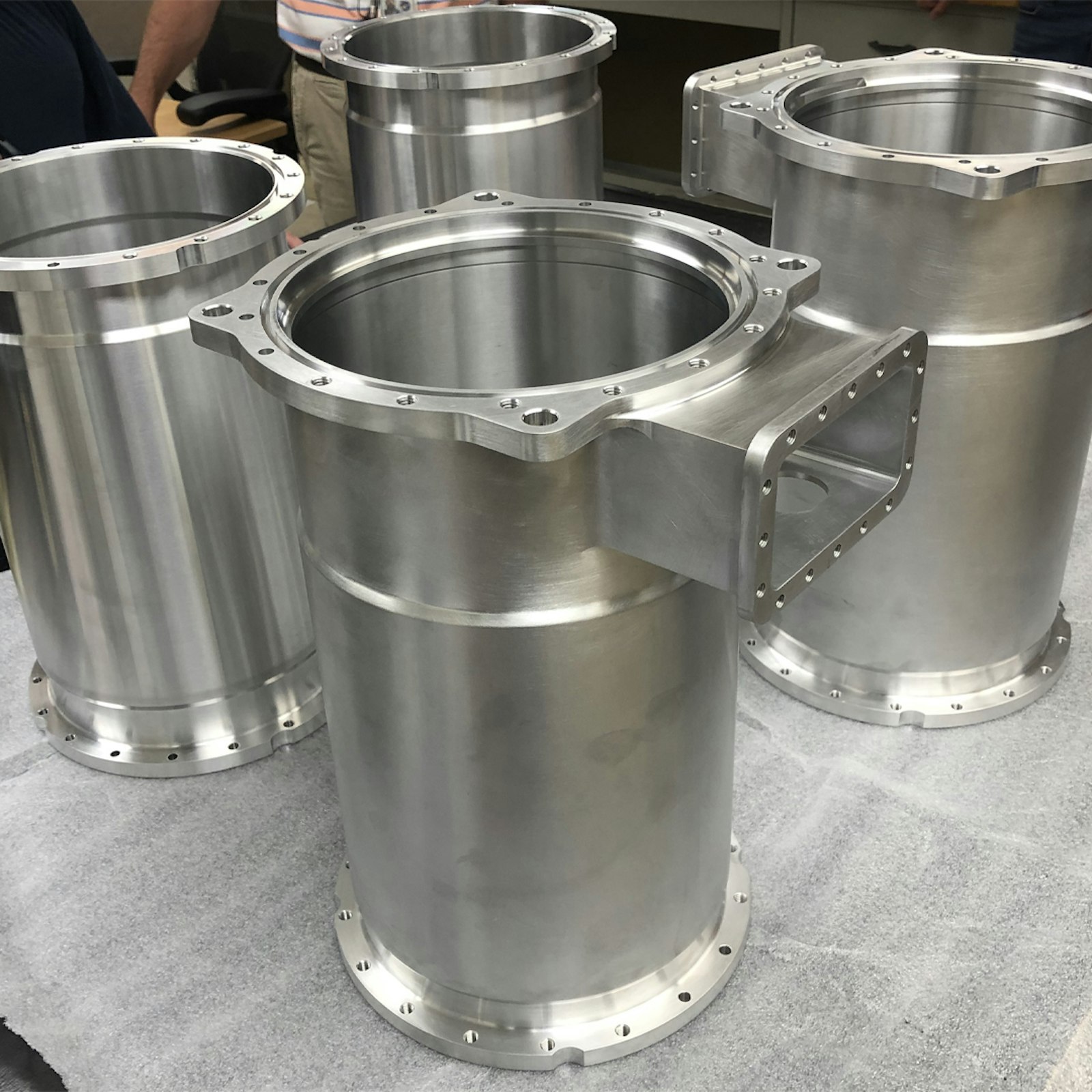
One of Xometry’s most revealing customer stories concerns NASA’s Four Bed Carbon Dioxide Scrubber, developed for the International Space Station. Engineers had planned cylindrical hardware assembled through welding. The certification process threatened the schedule. Making the beds smaller would compromise performance, so the team switched to a one-piece barrel design and sought outside machining capacity.
According to Xometry’s case study, the company sourced specialty aluminum and a manufacturing partner within a requested four-week window. It arranged inspection before NASA’s verification testing. The account describes a production schedule compressed from three months in-house to one month. It is a particular project’s result, with a particular bottleneck.
NASA engineer Jimmy Hill put the consequence plainly: “Parts are so fast and cheap that we can change the way we work and design.” Lower costs let the team contemplate multiple versions in parallel. The useful lesson for other engineers is to question the fabrication route when a schedule stalls. A different supplier becomes more valuable when it makes a different design practical.
03The marketplace collects more than a referral fee
Randy Altschuler and Laurence Zuriff founded Xometry in 2013. The IPO prospectus records a modest beginning: its first transaction was a 3D-printed part. In their founders’ letter, they described an industry still organized around local relationships and limited digitization. Their ambition was to make manufacturing capacity accessible through a web marketplace.
Xometry occupies a consequential position in the transaction. It sells the part to the buyer and directs a manufacturing partner to fulfill the work. Its financial statements therefore recognize marketplace sales as a principal. Readers should not mistake the revenue figure for a software commission or the total value of introductions on a directory.
Thomasnet supplies another route into the business: industrial supplier discovery, accompanied by advertising and marketing services for manufacturers. Xometry announced its acquisition of Thomas in December 2021 for $300 million, about $198.5 million in cash and $101.5 million in stock. The logic was to put a large pool of sourcing activity beside a marketplace capable of completing transactions.
Supplier relationships also extend beyond individual orders. Workcenter gives shops software for managing jobs and operations, with financial-service access connected to their workflow. A supplier can use the platform to organize work as well as find it. For Xometry, those repeated interactions provide reasons for manufacturers to return after the first purchase order.
04Growth came with a bill
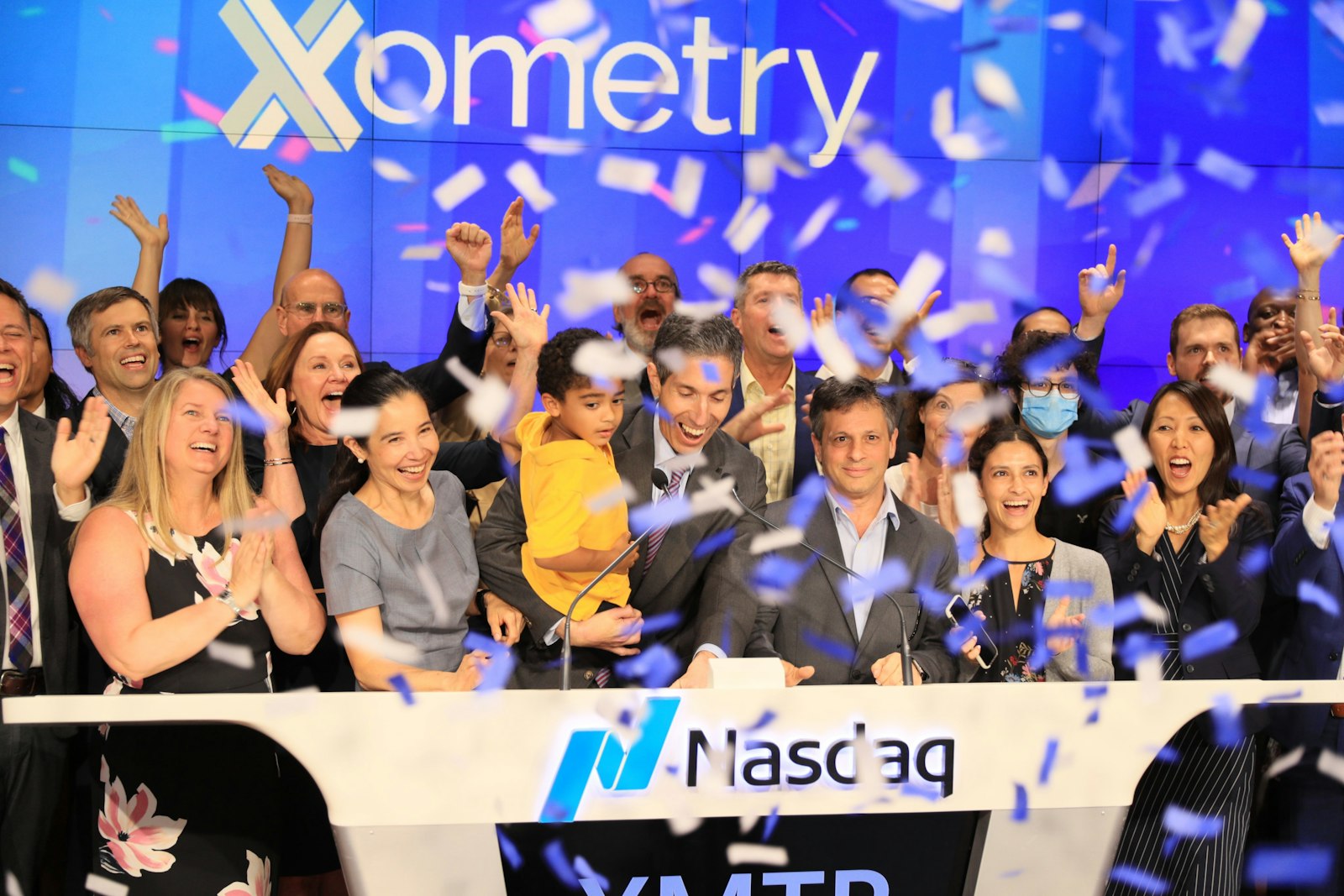
The network was financed with substantial outside capital. A $75 million Series E in September 2020 brought disclosed funding since inception to $193 million. T. Rowe Price-advised investors led that round, joined by investors including BMW i Ventures, Dell Technologies Capital and Robert Bosch Venture Capital. At the 2021 IPO, the base offering comprised 6.875 million shares priced at $44: $302.5 million before fees and the underwriters’ option.
Expansion did not make every experiment worth keeping. Xometry exited its U.S. tools and materials business in 2023. The closure reduced annual supplier-services revenue by roughly $6 million compared with the previous year. Its strategic priorities that year included larger accounts, a broader manufacturing menu, international growth and better operating economics. Selling supplies to shops had proved dispensable to that agenda.
The profit measures require equal care. In 2025, Xometry generated positive adjusted EBITDA of $18.5 million while recording a $61.7 million GAAP net loss attributable to common stockholders. The loss included a $16.4 million debt-extinguishment charge. Adjusted EBITDA strips out costs included in standard accounting; the two figures answer different questions. Rising orders and improving operating economics can coexist with a bottom-line loss.
The Thomas announcement had anticipated full-year profitability in 2023. Actual 2023 adjusted EBITDA was negative $27.5 million. That gap gives the acquisition story a useful edge: buying access to more customers does not set a timetable for profits. Investors still have to watch what each additional dollar of business costs to serve.
Bar lengths compare absolute amounts. *Attributable to common stockholders. Adjusted EBITDA excludes several expenses included in GAAP results.
05The next checkout is inside the drawing
Xometry has long tried to meet engineers inside their existing tools. In March 2021, it launched an Autodesk Fusion 360 app in collaboration with Autodesk, bringing quoting into the design workflow. The attraction is practical. A price discovered while the design is still flexible can influence the drawing; a price discovered after approvals may arrive too late to change much.
A May 2026 partnership with Siemens takes that approach further. The companies announced plans to embed Xometry’s manufacturability, pricing, sourcing and execution intelligence in Siemens Xcelerator. Siemens backed the relationship with an approximately $50 million equity investment. The promised integration makes procurement part of a design conversation, with orders followed through to delivery.
The leadership changed soon afterward. Sanjeev Singh Sahni became CEO in July 2026, succeeding Altschuler, who became Executive Chairman. Sahni had joined as president in January 2025 after working at Wayfair. Altschuler retained a role in strategic growth and major partnerships. The handover puts an executive with e-commerce experience in charge of a business where software promises must survive contact with physical production.
“To make the world’s manufacturing capacity accessible to all.”
Xometry’s stated mission
06A bigger network still needs a good shop
By June 30, 2026, Xometry reported 89,557 active marketplace buyers, meaning buyers who had purchased during the preceding 12 months. Second-quarter revenue reached $229.3 million, up 41%; adjusted EBITDA was $14.1 million and GAAP net loss attributable to common stockholders was $5.3 million. The company also completed a June share offering that brought in $248 million net. Growth remains a project it is funding.
Its alternative is not simply a telephone and an address book. Protolabs combines its own digital factories with Protolabs Network, offering another route from online quoting to manufactured parts. Direct relationships with specialist shops remain an option too. Xometry’s distinguishing proposition is the breadth of a marketplace and a common purchasing interface across suppliers and processes. Buyers still need to compare the actual job.
That comparison should include quality and coordination. A familiar specialist may be attractive for a program requiring continuous engineering collaboration. An online marketplace may be useful when the buyer needs another process, more capacity or a shorter sourcing cycle. Neither arrangement makes an incomplete specification complete. The relevant question is who can deliver this part, with these requirements, on this schedule.
Xometry’s stated culture stresses curiosity, purpose and ownership. Its supplier support has a concrete public example: the Xometry Foundation’s July 2026 partnership with MxD aims to reduce cybersecurity-compliance barriers for smaller manufacturers. Such programs address an awkward reality of digital procurement. A shop can possess the right machines and still lack credentials needed to compete for particular work.
07Before you press order
For a prospective customer, the sensible starting point is one well-specified part. Upload the model, attach the drawing, identify critical tolerances and compare material, process, quantity and delivery options. Request the inspection and traceability documentation the application needs. The quote becomes more useful when the buyer understands which requirements are essential and which are simply inherited from an earlier design.
There is no universal Xometry price. The company prices the job, and a purchasing team should compare total delivered cost against alternatives. Tooling, finishing, inspection and timing can matter as much as the headline part price. A manufacturing change that saves money on a prototype may need another look before a production order.
The broader lesson is available to anyone building a marketplace: make a difficult purchasing decision easier to evaluate, then do the work required to honor it. Xometry’s case turns on that second obligation. An instant quote wins attention. The part that fits gives an engineer a reason to order again.