The expensive thing about a prototype is not always the part. Sometimes it is the engineer waiting for it. A design sits ready, a test cannot happen, and another week disappears into the machinery of getting a quote. Fictiv was built around that awkward interval. In April 2025, Japanese industrial supplier MISUMI put a price on the business: a $350 million acquisition agreement. Fictiv announced it had joined the group that June. The announced deal; the completed acquisition.
The appeal is easy to understand if you have ever needed something made rather than merely delivered. Fictiv lets a team upload a design, obtain manufacturing feedback and pricing, and order custom mechanical parts through a managed supplier network. Behind the browser are people handling manufacturing, quality and logistics. The customer gets a way to buy production capacity without assembling an entire supply chain first. Fictiv’s service model.
The kitchen came before the cloud
Dave and Nate Evans started in 2013 with a MakerBot. Their proposed test was admirably concrete: if they could earn back the cost of the printer in one month, perhaps there was a business in connecting engineers with available machines. Dave handled coding and manufacturing; Nate handled business and design. “So life started in our kitchen,” Dave recalled in a 2016 question-and-answer session. San Francisco apartment economics had denied them the regulation startup garage. The founders’ account.
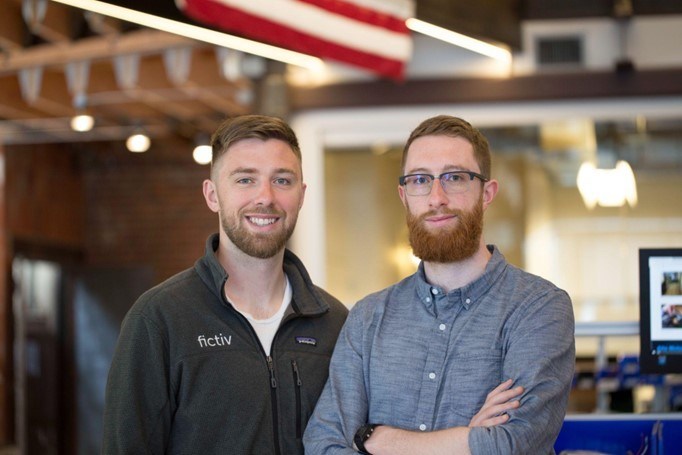
“So life started in our kitchen.”
Dave Evans / Co-founder, Fictiv / 2016
Dave’s frustration had a professional origin. At Ford’s Silicon Valley Innovation Lab, he had watched sourcing and supplier management consume time that mechanical engineers could have spent developing products. The initial problem was the slow route from design to physical evidence: finding capacity, getting answers and managing handoffs. His later account describes building software around a vetted network, with automated feedback and human help, instead of pouring the company’s capital into factory equipment. Evans’s account of the Ford years.
That distinction explains why Fictiv outgrew the label “3D-printing startup.” A printer was a small-scale way to test the coordination problem. The more valuable business was helping customers order across processes and suppliers as their designs matured. By 2016, Fictiv was offering CNC machining alongside printing. The kitchen experiment had become a service engineers could use for more than a plastic first draft. The 2016 CNC expansion.
A CAD file goes in. People get involved.
Fictiv’s menu now includes CNC machining, industrial 3D printing, injection molding, urethane casting, sheet metal and die casting. These are different routes to a physical part, with different economics and design constraints. A team can use additive manufacturing to explore a shape, machining for a functional metal component, and molding when a plastic design needs repeatability. Fictiv’s commercial proposition is to keep the sourcing relationship useful as those requirements change. Manufacturing capabilities.
- 01 / SpecifyDesign, material, quantity
- 02 / ReviewQuote and manufacturability
- 03 / MakePartner production and inspection
- 04 / DeliverLogistics and order visibility
The digital order is the beginning of a physical process.
Injection molding makes the human contribution particularly visible. Fictiv describes support for tooling design, material choices and manufacturability, alongside on-site quality engineers and online inspection information. Its service includes overmolding and insert molding as well as conventional plastic parts. For a buyer, the useful question is whether that combination reduces the number of technical conversations they must coordinate themselves. A tidy ordering screen alone cannot settle a tooling decision. How the molding service works.
The business is therefore best understood as quoted manufacturing and supply chain services enabled by software. Customers buy parts and production support. The platform helps organize that purchase; the central transaction is not a monthly software seat. Fictiv sits between the engineering team and the physical network, taking on work that would otherwise land in the buyer’s inbox. Its production offering extends that relationship into sourcing, quality and logistics. Production services.
The savings show up between iterations
Medical device developer TransMed7 offers a revealing example. In Fictiv’s published case study, the company reported cutting selective laser sintering turnaround from two or three weeks to three to five days. Injection molding moved from months to weeks. Lead design engineer Robert Sauchyn said, “Working with Fictiv let us keep the momentum going on product iterations.” The alternative had been setting projects aside and spending time re-engaging when parts finally arrived. TransMed7’s account.
The case also makes a more interesting argument than “outsourcing is cheaper.” TransMed7’s founders described saving millions in infrastructure, people and time costs while keeping their internal team lean. Weekly meetings brought in technical, materials and molding specialists as needed. The lesson is about where a team places its expertise: keep developing the device while drawing on an external organization for the manufacturing work surrounding it.
The customer base stretches beyond medicine. Honeywell and Lunar Energy appear in Fictiv’s production materials; consumer oral-care brand quip describes using the company across prototyping and production. On Fictiv’s molding page, quip’s Bill May reported getting a mold running in three to four weeks while other partners took six to eight weeks just to produce initial tool samples. Different products, similar complaint: the next stage cannot start until the previous supplier answers. Customer accounts; quip’s tooling comparison.
The bill behind the browser
Building this system took substantial capital. Fictiv announced a $100 million Series E in May 2022, led by Activate Capital, with participants including Accel, Bill Gates and G2 Venture Partners. The release put cumulative investment at $192 million. It also reported more than 19 million parts delivered to over 3,000 product companies. Those are dated company figures, useful for understanding the business’s scale at that moment. The Series E announcement.
Series E round
Announced acquisition consideration
The acquisition price belongs in a separate column from venture funding. MISUMI agreed to buy the company, with the announced consideration subject to closing adjustments. Its own announcement described roughly 400 employees and about 250 manufacturing partners. The rationale included expanding MISUMI’s reach from equipment manufacturing into product development. Buying Fictiv gave it a relationship with engineers earlier in the life of the product. MISUMI’s acquisition rationale.
For a customer, the cost calculation is more specific. Each part has its own quotation; material, process, geometry, quantity and delivery requirements shape the purchase. The practical comparison should include the time spent sourcing and managing the work, not just the unit price. That is an editorial inference from Fictiv’s service model and customer accounts: a low quote is less attractive if it leaves an expensive team unable to test its next design.
Why the network went global
In a November 2025 interview, Dave Evans described two stages of Fictiv’s development. The first emphasized engineering speed. Around 2019-2020, the focus widened toward helping customers move from design into global production. The pandemic made that second problem harder to ignore. His account presents the change as an expansion of the original mission, driven by what customers needed once getting a prototype quickly was no longer enough. Evans’s 2025 interview.
Geography consequently became part of the offering. Fictiv operates with teams and manufacturing centers in the United States, China, India and Mexico. Its April 2025 EVCO Plastics partnership supplied a concrete example of how countries can share a program: GlobalFlex uses tooling inserts made in China for production in the U.S. and Mexico. EVCO contributes molding capacity; Fictiv brings sourcing, program management and logistics. The arrangement is more specific than a promise to move everything closer to home. The EVCO partnership.
It also creates an operational burden. Someone must understand what the customer specified, what the factory can make and what the shipment requires. Fictiv’s careers page calls employees “fictors” and lists creator spirit, service mentality and continued learning among its values. The service mentality fits the business: people across manufacturing operations and software have to cooperate on a result the customer can hold, measure and reject. Fictiv’s stated working culture.
Instant is a quotation, not a factory
Fictiv introduced instant injection molding quotes in March 2026, promising immediate cost and lead-time visibility. Materials.AI, launched in February 2024, had already added an assistant for exploring manufacturing materials. Both tools target decisions before production. That is a useful place for automation, provided the buyer remembers what has accelerated. A quote does not eliminate the time needed to make tooling, manufacture parts or inspect them. The quoting launch. The Materials.AI launch.
Fictiv also operates in a contested market. Xometry offers online access to a vetted manufacturing network, and Fictiv itself names Xometry and Protolabs as alternatives. Network access and digital quoting are therefore insufficient distinctions on their own. Fictiv’s pitch rests on combining those features with managed programs, manufacturing expertise and its growing relationship with MISUMI. Buyers can compare those services against a platform competitor or a direct supplier relationship. Xometry’s network; Fictiv’s named alternatives.
For teams evaluating that pitch, a sensible trial is a bounded project with clear drawings, acceptance requirements and a useful deadline. Review manufacturability before committing to tooling. Compare the quoted options against the purpose of the part: a visual model, a functional test and a production component ask different things of a supplier. This approach is an inference from the workflow, not a guarantee of savings. It works best when the buying team knows what a successful part must do.
In June 2026, MISUMI Americas announced a broader platform spanning standard, configurable and custom components, with Dave Evans leading the business. The ambition is to serve more of the bill of materials through one relationship. Fictiv’s next test is whether that wider offering makes procurement simpler in practice. The original kitchen experiment asked whether one machine could pay its way. The larger business has to keep proving that it can give engineers their time back. The June 2026 platform announcement.