At three in the morning, during finals week, Rishabh Dhariwal and his friends had the conversation he would later trace Zarna back to. The hour is wonderfully inconvenient. Exams already offer plenty of opportunities to question your future; adding a company is an ambitious way to complicate the syllabus. Yet the company that emerged would spend its time on a rather practical question: what happens to work after somebody promises to do it?
Dhariwal is Zarna's co-founder and CEO. The San Francisco company builds AI associates for private equity, with a particular focus on business development at middle-market firms. Its work includes keeping relationship records current, preparing meetings and finding opportunities. Those tasks sit close to the machinery of a deal, where a conversation has to become a record and a record has to become a useful next step.
The interesting part of his story lies in the distance between that late-night beginning and the daily obligations of running the business. An idea can survive on friendship and enthusiasm for quite a while. A client has a calendar. There are meetings on it, and somebody expects the preparation to be finished before they begin.
The microphone before the customers
In a photograph from an early-2025 Silicon Valley pitch competition, three young founders stand in front of a screen. One holds a microphone. There is no elaborate set, no theatrical lighting, just people presenting something they hope will matter. Dhariwal later described the company at that point as having no customers and an improvised demo. Hrishi Joshi was working from Seattle and was absent from the picture.
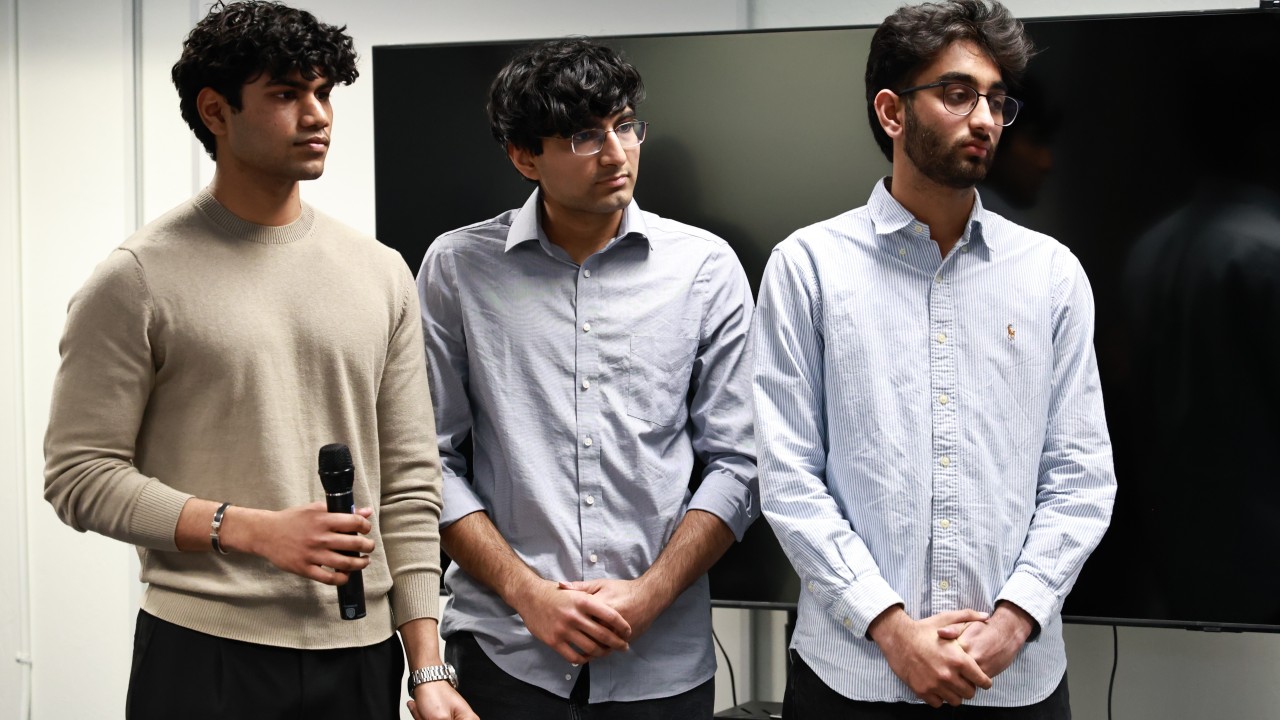
It is an appealing image because it leaves the uncertainty intact. The founders are at the stage when describing the future is easier than demonstrating that anyone needs it. A microphone gives you the floor. It cannot make the audience buy. The photograph catches the interval between being ready to speak and having something the market is ready to use.
Zarna entered Y Combinator's Fall 2025 batch. The company has four co-founders: Dhariwal, Joshi, Rakesh Mehta and Vivan Agrawal. In announcing the backing, Dhariwal called his partners his brothers and thanked the people who had helped them, including Pete Koomen for guidance through the YC process. His acknowledgments extended to mentors and family. The success had a substantial supporting cast.
A company within walking distance
Berkeley occupies a particular place in Dhariwal's account of the beginning. He studied economics there, and his LinkedIn education entry says he graduated in two and a half years. More revealing than the speed is the company he kept. In a later post, he reported that his entire apartment floor had got into Y Combinator.
There is something faintly comic about an apartment floor acquiring an accelerator cohort's worth of ambition. Most buildings manage a shared laundry room. His description makes entrepreneurship sound as close as the next door. The point is his own: he valued Berkeley as a place to meet friends who wanted to build useful things.
That is a more personal account of opportunity than a university name printed on a résumé. It puts people within reach of each other before they have titles. A friend can hear an unfinished idea without requiring a slide deck. A conversation can continue after the sensible hour for ending it. The eventual founding team has names, but the early environment was also a set of ordinary proximities.
Friendship did not supply a complete business plan. It supplied people with whom a business could be attempted. That distinction matters in Dhariwal's telling: the bonds predated the company, and the company became an undertaking they could share. The finals-week conversation belongs to that account of mutual commitment.
Before the startup, the deal team
Dhariwal's professional path also put him inside the kind of organization Zarna would eventually serve. Before co-founding it, he led AI enablement initiatives at AEA Investors, working with investment teams on automating deal workflows. His earlier background includes investment banking at Deutsche Bank and strategic advisory work involving Pepsi, Rajasthan Royals and LATAM Airlines.
Those names cover a soft-drink business, a cricket franchise and an airline. They give his pre-startup experience an unusually varied set of settings. His present responsibilities at Zarna combine product and go-to-market work: figuring out what the company should deliver and how to get it into the hands of the firms that need it.
The team describes spending months embedded at AEA Investors before leaving to build Zarna. Working inside a deal team means encountering the connective tissue of a business: the documents people consult, the records they update, the tasks that depend on somebody remembering a previous conversation. Zarna's proposition places those connections at the center of the product.
That background helps explain the specificity of its current audience. The YC listing describes business-development teams at middle-market private equity firms and names Outlook and Teams as the places where the agents operate. An inbox is a less glamorous address than a shiny new dashboard. It is also an address where the client already lives.
A schematic of Zarna's described approach, not a performance measurement.
The tenth message
One of Dhariwal's customer stories begins at SuperReturn. He met a firm there that was interested in trying other ways to assemble its own AI workflow. The conversation did not immediately become a sale. His team kept in touch as the product changed. Three months after that first meeting, Zarna travelled to Florida to onboard the client.
The detail worth pausing over is his identification of a tenth message as the one that restarted the conversation. Sales histories are often tidied into a neat meeting followed by a neat decision. Here, there was an interval, and somebody had to keep the relationship alive through it.
Ten messages can sound excessive in the abstract. A buyer's situation gives them a context: a team is trying to solve a problem, choosing among approaches, and deciding whom to trust with the implementation. Dhariwal's interpretation of the experience emphasized the people behind the product and their ability to help as the underlying technology changes.
For a founder, that introduces a different clock from the startup's own. Software can change between meetings. A client still needs time to make a decision. Staying in touch requires something more durable than the pleasure of shipping a feature.
Who owns the next step?
Dhariwal's August 2026 essay on building agents for private equity begins with workflow mapping. He asks firms to walk through jobs by role, identify who owns each step and decide where humans and agents should lead. In his account, deployment starts with understanding the organization, including its handoffs and exceptions.
He gives the human investor control of the conversation, while agents handle preparation and records around it. His playbook also calls for evaluating both agents and people and tracking business outcomes such as new deals sourced and bids placed. It is a practical expression of his product interests: responsibility has to be assigned before work can be handed over.
Read as an account of the founder, the essay shows where he chooses to spend attention. The question of ownership is easy to overlook when a demonstration produces a fluent answer. In an actual firm, somebody must decide what happens next. A task without an owner has a remarkable ability to become everybody's background concern.
The company describes screening opportunities against a firm's investment criteria, filing deal documents and preparing briefs before banker calls. These are its stated capabilities. The recurring idea is continuity: carrying a piece of work from the conversation that creates it into the systems where the team can act on it.
An education in the pause
By September 2026, Dhariwal said he had given more than 350 demos in a year. In reflecting on that period, he treated communication as a skill he was still learning. The volume had not persuaded him that he had finished the course. His advice included slowing down, pausing and listening.
“Usage = Utility.”Rishabh Dhariwal
That short equation is his test for usefulness. He argued for watching what people actually do with the product, keeping client incentives aligned and concentrating effort on problems worth paying to solve. It is a demanding standard for a founder who spends so much time explaining the company's promise: the explanation ultimately has to survive contact with someone's working day.
A demo invites a response in the room. Usefulness has a longer appointment. It has to show up when the meeting is over, when the user is busy, and when the novelty of the technology has worn off. The distinction gives the pitch photograph another meaning. A year of building can change what a founder considers evidence.
Cricket, old songs, and the return journey
There is life beyond the pitch calendar. Dhariwal lists history, geopolitics, cricket, basketball, heritage craftsmanship and debates among his interests. His team biography names A Thousand Splendid Suns as his current reading and the Asha Bhosle and Mohammed Rafi recording of Abhi Na Jao Chhod Kar as a song on repeat.
The sporting connection reaches into his working life. He has said he spent the 2024 IPL season working under Jake Lush McCrum at Rajasthan Royals. Cricket appears both in his interests and in his professional history, a useful reminder that the person running a software company arrived there through more than software.
Chicago is another strand. Dhariwal says he was born there and lived there until he was eight. In an October 2026 update about returning for ACG's Midwest Capital Connection, he described the visit as coming full circle. The work was taking him back to a place that belonged to his life before the company.
That return gives his story a human scale. The founder moves between familiar friends, former colleagues, prospective clients and a city he knew as a child. Zarna gives those journeys a current purpose. The work after the pitch is made of such encounters, and of the less photogenic obligation that follows them: remembering what was said, and doing something useful with it.