A revealing photograph in Anshul Paul’s startup story contains very little startup furniture. No whiteboard thick with arrows. No solemn row of laptops. Instead, Paul and his co-founder, Vaibhav Agrawal, have placed their smiling heads above two stick-figure bodies assembled from resistors, capacitors, diodes and bent wire. Between them sits the red Y Combinator sign. It is a founder announcement fashioned as an electronics-shop joke.
The picture belonged to the first public chapter of BaseFrame. Paul and Agrawal entered Y Combinator’s Winter 2026 batch to help hardware teams catch design gaps and compare tradeoffs before committing to a board. The product has changed since then, more than once. The photograph remains a useful diagram of the partnership: technical, legible and willing to look cheerfully peculiar.
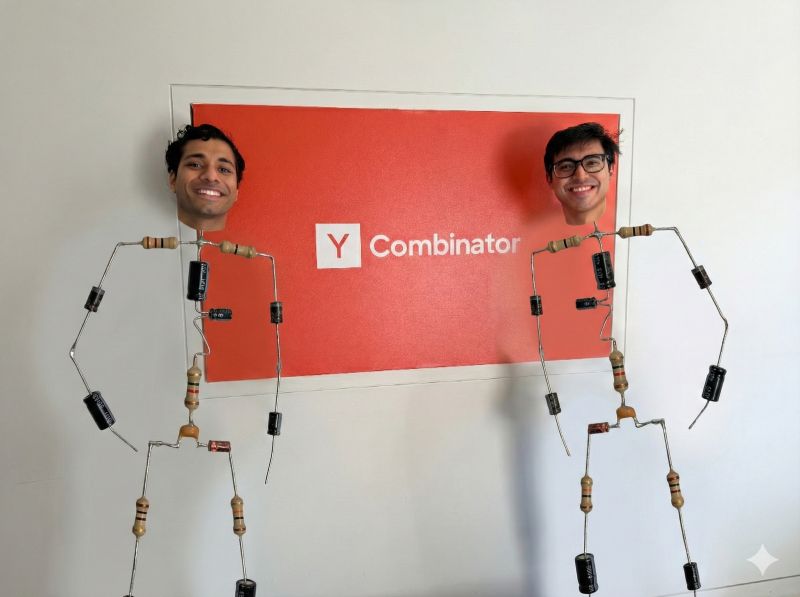
It also makes the later pivots easier to understand. BaseFrame moved from hardware design intelligence to an AI-agent security project called Clam, then to its current work: showing companies what their employees can usefully automate. The nouns shifted from boards to firewalls to workflows. The verb stayed remarkably stable. In each version, the company tried to expose a costly thing before it became a costly surprise.
First, make the work visible
BaseFrame’s present thesis begins with a mundane corporate failure. A company buys access to capable AI tools. Employees receive the broad instruction to “use AI.” The tools wait patiently. So does the work. People may know they repeat themselves, but few carry a ranked inventory of their repetitive tasks, the hours each consumes, or the right system for handing each one off.
Paul’s response is to begin with evidence instead of a demo. BaseFrame examines the historical record already on an employee’s computer: email, documents, Slack, calendars, browser history and files. It looks for repeated patterns and identifies high-value automations. The company says local models perform the analysis so sensitive data does not need to leave the system. A useful automation can then be specified for a tool the team already uses and shared with colleagues.
“Every company wants their team to use AI. But automation tools assume people already know what to automate, and most don’t.”Anshul Paul, launching BaseFrame’s workflow-discovery product
There is a pleasing modesty to the order of operations. Observe. Rank. Specify. Only then automate. In an industry fond of presenting every new model as a thunderclap, BaseFrame is interested in the office equivalent of checking the lost-and-found. Where did Tuesday afternoon go? Why does this report take three hours? Which handoff keeps returning with a loose screw?
The BaseFrame loop
The product starts from historical traces rather than continuous screen recording, then sends specifications toward a team’s existing automation stack.
A career in handoffs
The interest did not arrive fully formed. At the 2023 UC Berkeley AI Hackathon, Paul joined Arda Akman and Mehmet Deniz Birlikci to make Blueberry AI, a personal voice secretary that could place a phone call on a user’s behalf. Their prototype combined Twilio, Flask, OpenAI and a speech pipeline. A user could assign the task, provide necessary details and watch the conversation appear as a live transcript.
Blueberry’s build notes are refreshingly unvarnished. Twilio was difficult. Context management was difficult. When one part became a roadblock, the team improved another part, kept its momentum, then returned to the obstruction. This is less romantic than the myth of a flawless overnight prototype, and much more useful. Software often advances by leaving one headache briefly unattended while making the rest of the machine work.
The prototype foreshadowed Paul’s next job. He joined HappyRobot in March 2023 as a founding engineer, when, in his telling, the company was handling a few hundred calls a day. By the December 2024 announcement of its $15.6 million Series A, he wrote that HappyRobot had passed one million calls and expanded into texts and emails. He worked on omni-channel communication, AI evaluation, observability and enterprise integrations as the company moved from seed stage to Series B and grew beyond 100 employees.
Freight gave the abstraction wheels. Paul described seeing a truck on the road and wondering whether a HappyRobot phone call had booked its driver. As the product widened, that truck might also have involved a safety text, a processed document, an identity check or the coordination of goods from port to destination. The anecdote reveals what seems to hold his attention: not a model performing in isolation, but an AI system touching a real chain of work.
His HappyRobot chapter also supplied a network of teachers. When announcing BaseFrame’s YC acceptance, Paul thanked founders Pablo Palafox, Javi Palafox and Luis Paarup, along with the wider team, for the guidance that led there. Their replies described him as integral from early in the company. Public gratitude can become syrupy online; here it reads more like a ledger kept honestly.
The pivot has a spine
Paul and Agrawal had known each other before BaseFrame. They were roommates at Berkeley, and they partnered during a computer-security course. Paul studied Electrical Engineering and Computer Sciences alongside business in Berkeley’s Management, Entrepreneurship, & Technology program, graduating in 2024. Agrawal studied computer science. Their original BaseFrame problem came from the hardware and robotics work around them: design mistakes discovered late, tabs full of component datasheets, and tradeoffs that became obvious only after money and time were already committed.
Surface project gaps, compare components and clarify design tradeoffs before a board is spun.
Scan traffic around broad-access AI agents for leaked secrets, prompt injection and malicious code.
Find repetitive work in historical activity, rank what matters and prepare it for tools a team already uses.
During YC, the founders also launched Clam, a “semantic firewall” for AI systems with broad account access. It scanned incoming and outgoing messages for private information, prompt-injection attempts and malicious code, while injecting secrets at the network layer so an agent would not need to retain them. The product was different. The founder vocabulary was familiar: observe the system, find the dangerous edge case, intervene before trust becomes regret.
By spring 2026, BaseFrame was describing itself as the discovery layer for workplace AI. Paul made the contrast explicit: the company did not want to be another orchestration layer. It wanted customers to use the agentic tools they already paid for. In June, he introduced BaseFrame Analyst for small businesses, framing it as a guide that helps each employee decide what to hand to AI, creates the relevant prompts and keeps finding more work to remove.
The products changed. The recurring job did not: find the invisible constraint, make it legible, and give someone a chance to act before it gets expensive.
What the map is for
There are obvious questions around any software that studies work. Does observation become surveillance? Who decides that repetition is waste? Can a system distinguish a boring handoff from the small human judgment that makes the whole process safe? BaseFrame’s stated answer to the first question is architectural: use historical data rather than screen recording, run small models locally, and keep personal data on the machine. The harder questions will be answered in practice, employee by employee.
That is why Paul’s background in evaluation and observability matters as much as his fluency with automation. An agent capable of acting is merely the beginning. Companies also need to know what it did, why it did it, and where it will fail. His path from a monitored hackathon phone call to enterprise AI operations and now automation discovery reads like a gradual widening of the frame.
BaseFrame is still a two-person company, and its history already contains enough product identities for a small theatrical troupe. Pivots do not guarantee wisdom. They do, however, provide evidence of what founders refuse to stop caring about. Paul and Agrawal keep returning to tools that reveal uncertainty before a consequential handoff.
The current ambition is practical and broad. Paul wants BaseFrame to help each employee know what to hand off, get more from tools already under contract, and remain confident that the delegated work is being done properly. The company’s pitch avoids asking a business to discard its stack and begin a grand digital renovation. It offers to find the loose hours first, then write directions for recovering them.
That choice carries its own discipline. A recommendation engine for work must earn the right to recommend. It must understand that two tasks with similar clicks can demand very different judgment, and that an employee’s odd little workaround may encode years of institutional memory. The map cannot merely count repetition. It has to respect consequence. Paul’s earlier work on AI evaluation gives the wager a certain continuity: useful automation is measured not by motion, but by whether the right job survives the handoff.
For Paul, the current chapter also completes a small circle. Blueberry AI began with a user watching a transcript while software handled a call. HappyRobot expanded the number and kind of communications an AI system could manage. BaseFrame now steps back and asks which task should enter such a system in the first place. The frame has widened from one conversation to the operating habits of a company.
The component figures in their YC photograph therefore look less like a souvenir from an abandoned idea and more like a family portrait. Every resistor exists to manage a current. Every capacitor holds something briefly, then releases it when needed. The joke, perhaps accidentally, survives the pivot. Good systems depend on seeing where the flow goes.