A grocery robot has an unglamorous job description: find dinner, spare the eggs, keep moving. Ocado has spent a quarter of a century turning that assignment into an elaborate combination of software, machinery and delivery planning. Its harder assignment is persuading supermarkets that the whole operation will earn its keep.
That distinction now defines the British company. Kroger has closed three Ocado-powered warehouses in the United States. Asda has signed up for ecommerce technology built around stores and dark stores. In Denmark, nemlig wants a new automated warehouse while keeping its existing webshop. These are different answers to the same question: where, exactly, should a grocer automate?
Ocado Group sells the systems behind online shopping, from the screen where customers assemble a basket to the machines that retrieve products and the software that plans delivery. Its name also sits above a UK supermarket business, Ocado Retail, owned equally with Marks & Spencer. The distinction matters: one sells groceries; the other sells much of the machinery and know-how that make online groceries possible.
01 The supermarket was the laboratory
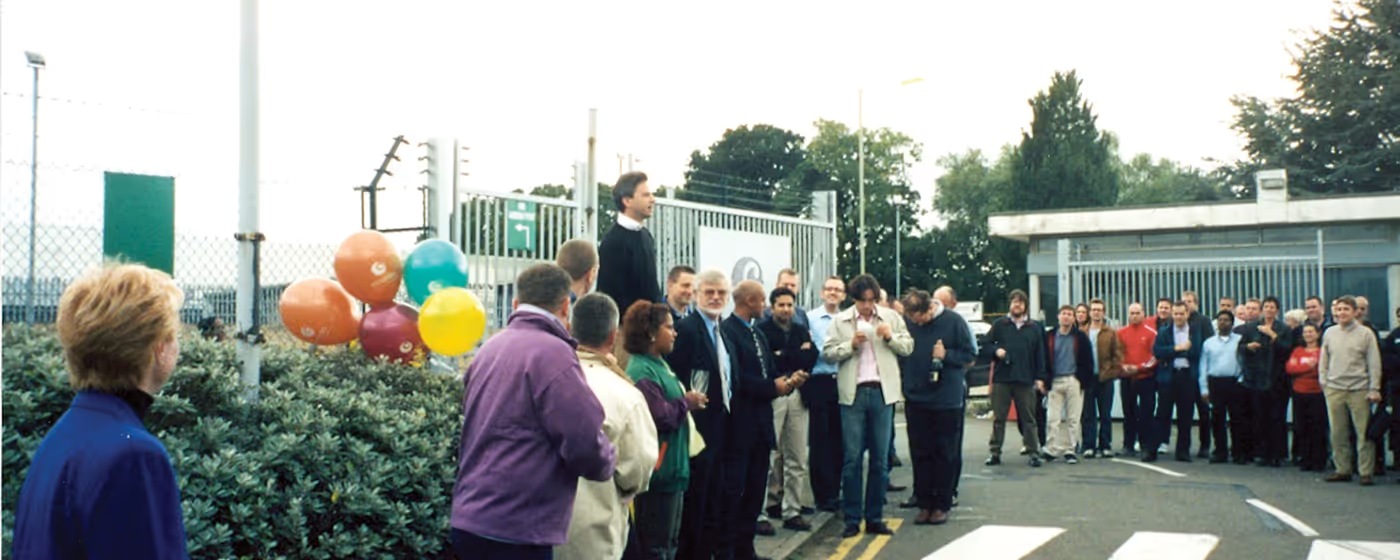
Tim Steiner, Jason Gissing and Jonathan Faiman, former Goldman Sachs colleagues, founded Ocado in 2000. Pilot deliveries followed, then the Hatfield fulfilment centre in 2002. The idea placed the warehouse at the heart of grocery shopping. Customers could skip the aisles; the business would organise their orders away from a conventional shop floor.
The early machinery was less polished than today’s demonstrations suggest. Ocado describes a suspended monorail intended to move product containers around the warehouse. It proved inefficient and was abandoned. Another approach, keeping pickers in zones and bringing items to them, became foundational. The company was learning which movements mattered by paying to make them.
By 2005, off-the-shelf software was constraining its ambitions, and Ocado began developing its own. In 2009 it built a simulation of Hatfield’s zone-picking system. Virtual experiments gradually became trusted enough to influence physical designs. Its later hive system was developed with simulation informing machines, layout and control software from the outset.
The useful lesson is quite practical. Before changing an expensive physical process, model how the changes interact. A faster machine can simply deliver work to the next bottleneck sooner. Ocado’s history gives substance to that warning: engineering progress came through discarded ideas as well as working inventions.
02 The weekly shop is an awkward engineering brief
A grocery basket is a collection of incompatible objects. Some need chilling; others need freezing. Packaging bends, products bruise, and customers change their minds before checkout closes. Delivering that basket asks more of an automated system than moving identical boxes from one conveyor to another.
Ocado Smart Platform, or OSP, connects four jobs: ecommerce, supply-chain planning, fulfilment and the last mile. Forecasting helps decide what stock to hold. Warehouse software coordinates retrieval and packing. Delivery planning deals with the journey beyond the building. Retailers can adopt the full system or selected capabilities that fit their existing operations.
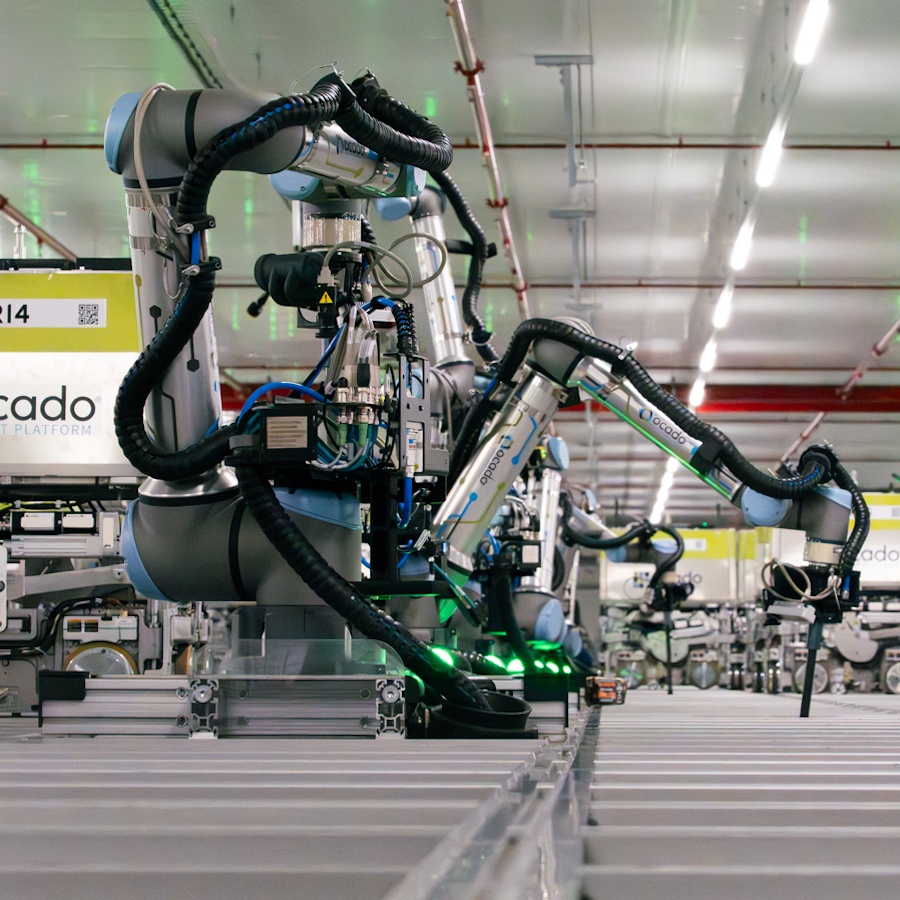
The photogenic part is the grid. Storage-and-retrieval bots travel above stacks of containers, bringing products to picking stations or rearranging inventory for later work. Ocado’s 600 Series Bot has more than half its components 3D printed. Its lower weight permits lighter grids, which the company says can cut installation time by up to 40 percent against the preceding grid system.
Picking an individual item is a separate challenge from moving its container. On-Grid Robotic Pick uses arms, sensing and machine vision to select groceries and pack them. Automated Frameload handles another physical task: loading completed orders onto delivery frames. Each product attacks a particular movement or handoff rather than making a warehouse magically run itself.
03 Selling the system, paying for the build
Ocado sits between enterprise software and industrial automation, with an operating grocery business in its family tree. Technology customers pay implementation and recurring fees; live installed capacity is an important driver of recurring revenue. Its UK logistics operation earns service fees and cost recharges. This is a relationship involving deployment, support and operations, not simply a robot bought off a shelf.
The expertise travels across borders. Customers include AEON in Japan, Coles in Australia, ICA in Sweden and Lotte in South Korea. Ocado Intelligent Automation, launched in 2023, takes warehouse technology beyond grocery; its first agreement was with McKesson Canada. Pharmaceutical distribution gives the same broad engineering capabilities another kind of inventory to move.
Developing that capability requires money long before all the recurring fees arrive. In June 2022, Ocado raised approximately £578 million through an equity placing and arranged a £300 million revolving credit facility. The latter was access to borrowing, not another pot of equity. The announcement linked the financing to technology investment and customer commitments.
Ocado’s FY2025 results reported £1.362 billion in group revenue and £178 million in adjusted EBITDA, alongside £213 million of underlying cash outflow. The coexistence is the point: an earnings measure that excludes certain costs does not settle the cash question. Retail’s move to associate accounting also means old consolidated sales figures require care when making comparisons.
FY2025 / Three different measures
Revenue, adjusted earnings and cash flow describe different things. Figures rounded from Ocado’s FY2025 reporting.
04 The warehouse met the neighbourhood
The North American retreat exposed the consequences when a network misses financial expectations. In November 2025, Kroger disclosed an expected $2.6 billion of impairment and related charges covering closures and underperformance across its automated fulfilment network. That was Kroger’s accounting charge, not Ocado’s construction bill or a cheque paid to Ocado.
Three sites closed in January 2026. A separate settlement provided $350 million of compensation to Ocado for those closures and a cancelled Charlotte project. The remaining relationship continued. The episode was a substantial reset of an ambitious rollout, rather than a clean exit from the technology.
“Stores are our most important asset.”
Ron Sargent, Kroger CEO · November 2025
Sargent’s reasoning was geographical: existing stores were close to customers, making short delivery journeys easier. He also recognised better results for automated facilities in some dense areas with strong demand. The lesson is less cinematic than a verdict on robots. A warehouse can be productive inside its walls and still sit in the wrong delivery network.
That creates a demanding buying test. Thin order density, weak utilisation or customers expecting very rapid delivery can undermine a large central facility’s advantages. Retailers already possessing nearby stores have another asset to consider. The appropriate comparison includes labour, buildings, stock, transport and service promises across the complete order.
05 A different answer in Australia
Coles provides a useful counterweight. In August 2026, Ocado reported that the Australian retailer’s two CFCs had achieved positive EBITDA in their second year. Those facilities opened in Melbourne and Greater Sydney in 2024, serving an established online grocery business previously built around manual fulfilment.
Coles expanded catchments, introduced same-day delivery and added automation, including robotic picking and frame loading. Existing volume gave the new machinery work to do. Positive EBITDA remains a narrower claim than recovering the investment, but it is meaningful operating evidence. The two retailers’ experiences resist a neat universal verdict.
For a prospective customer, this is where evaluation should begin: an actual order book, the locations of shoppers and the service they already buy. Forecast growth can support a plan, but transferring demonstrated demand is a different proposition from waiting for customers to materialise around new capacity.
06 Ocado learns to sell in pieces
By December 2025, mutual exclusivity had ended across most of Ocado’s partner markets. In May 2026, Asda agreed to use its ecommerce technology across stores and dark stores, with an early-2027 launch planned. The scope includes webshop, in-store fulfilment and last-mile software. It puts an existing retail estate at the centre of the agreement.
Nemlig’s Danish deal shows flexibility from the other direction. Announced by name in August, it envisages a CFC near Copenhagen taking existing orders in 2028. Nemlig will keep its webshop and manage its last mile, handing completed orders to third-party delivery partners. Ocado supplies the automated fulfilment without replacing every customer-facing system.
Meanwhile, Lotte’s first automated CFC opened in Busan in August 2026. Its Auto-Freezer brings hive-and-bot technology into temperatures down to -25°C, and the site supports delivery before 7am. Local shopping habits are shaping the engineering brief. The important product detail is the service a retailer can offer with it.
07 What to borrow before buying a robot
Ocado’s stated working values emphasise learning, autonomy, trust and collaboration. Its public engineering record supplies a more tangible illustration: simulation before construction, lighter hardware to simplify buildings, and products aimed at specific operational tasks. Its technology organisation even publishes open-source work, including the Ocava simulation framework.
A reader can borrow that sequence without ordering a warehouse. Find the repetitive work. Measure what constrains the whole service. Test changes cheaply. Then choose the scale of investment that existing demand can support. Automation suppliers, internal engineering teams and store-based delivery services all deserve comparison against that same operating problem.
Ocado’s advantage is the breadth of work it can connect, informed by years of running grocery operations. The obligation that comes with that breadth is equally large: making the parts add up economically. The robot still has to spare the eggs. The business has to make the trip worthwhile.