OXIPITAL AIPresident & CEO Mark Chiappetta30+ years in roboticsiRobot → Soft Robotics → Oxipital AI"Once you take out humans, it's hard to go back."100% synthetic training dataBedford, MassachusettsSeries C · ~$84M raisedSpots bruises, fat, burn marks at line speedOXIPITAL AIPresident & CEO Mark Chiappetta30+ years in roboticsiRobot → Soft Robotics → Oxipital AI"Once you take out humans, it's hard to go back."100% synthetic training dataBedford, MassachusettsSeries C · ~$84M raisedSpots bruises, fat, burn marks at line speed
A robotics lifer who has run eyes, hands, and brains - and decided to sell them one at a time.
Person · Executive · Robotics
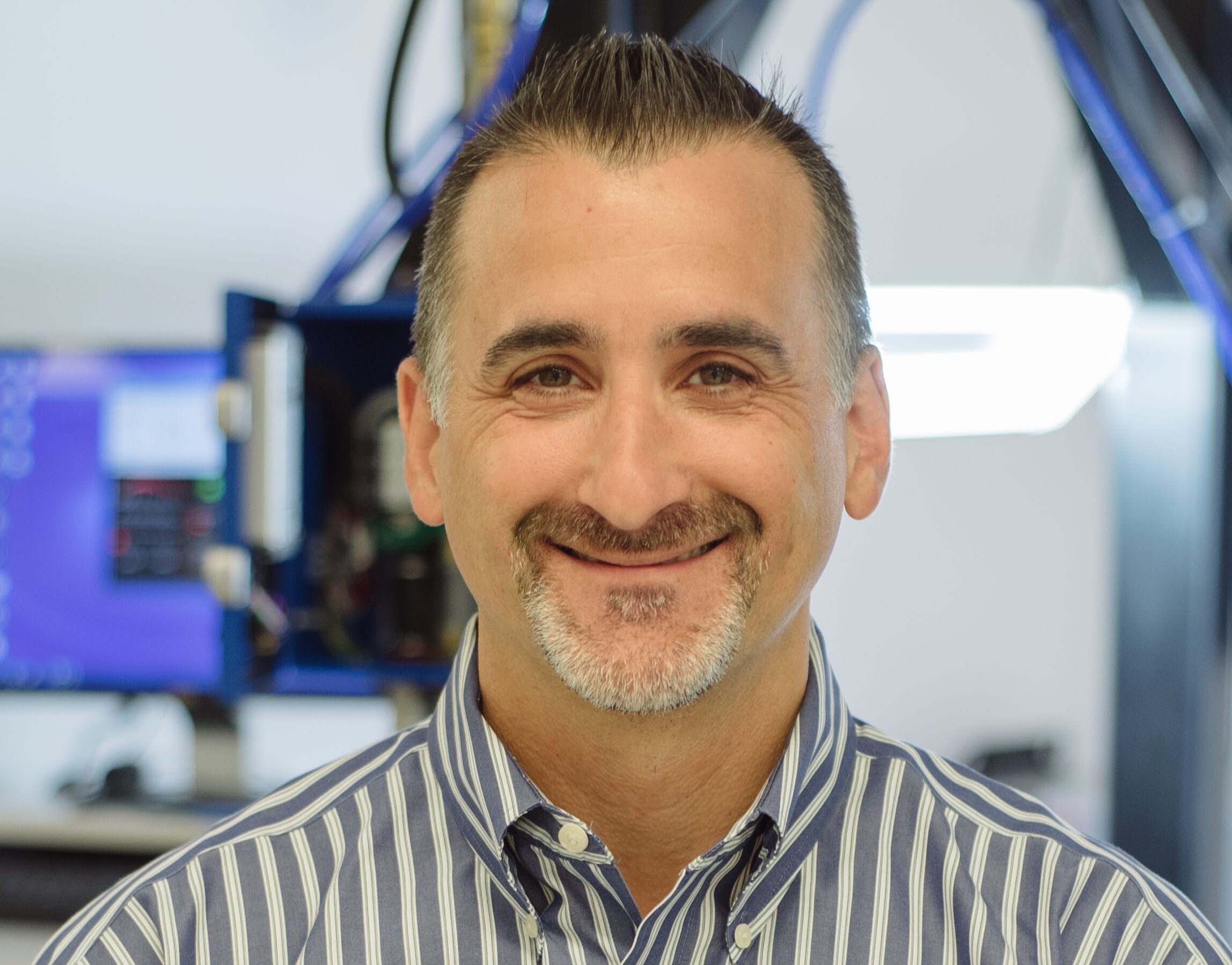
Mark Chiappetta
He spent eight years teaching robots to pick chicken. Then he decided the robots should learn to see before they learn to grab.
PRESIDENT & CEO / OXIPITAL AI / BEDFORD, MA
The Pivot
He sold the robot hands and kept the eyes
Most executives change course when the product fails. Mark Chiappetta changed course when it worked. Soft Robotics made good grippers - soft, food-safe, air-powered pincers that could handle a raw chicken thigh without bruising it. The trouble was not the hardware. The trouble was that the customers he wanted, the food processors running high-speed lines, were not lining up to rip out human labor and bolt in robots.
So in 2024 he did something unusual for a newly minted CEO. He took the top job at Soft Robotics in February, and then presided over its disassembly: the gripper hardware business was sold off, and the company's 3D vision and machine-learning software - a stack called mGripAI - was spun into a new, independent company called Oxipital AI. Chiappetta kept the same title in the new outfit. The name Soft Robotics, in effect, became the thing he no longer sold.
The logic is almost boringly rational once you hear him say it. A food plant that installs a picking robot has crossed a one-way threshold. "Once you take out humans, it's hard to go back," he told The Robot Report. Vision is different. A camera that watches the line and flags defects does not require anyone to be laid off, does not require the plant to rethink its labor model, and can be sold today. Robots are a purchase a plant makes once it is ready. Vision is a purchase it can make now.
That reframing solves a problem Chiappetta had been living with for years. "Without focus, it's difficult to survive," he said. "I had many conversations with strategic partners who didn't know how to look at a company that's eyes, hands, and brains." Being all three at once made Soft Robotics hard to categorize and hard to bet on. Oxipital AI is one thing: the eyes and the brains. The hands can come from anyone - the software is built to run on existing industrial robot arms and automation gear.
There is also a quieter business point buried in the switch. "Soft Robotics' business was 100% dependent on robot sales," Chiappetta noted, "but Oxipital's won't be." A company whose revenue rides entirely on selling expensive hardware into a hesitant market is fragile. A company that sells software - inspection, defect detection, counting, measurement - has more ways to make money and fewer ways to stall.
30+
Years in robotics
8
Years at Soft Robotics
4
Roles, one company
100%
Synthetic training data
Without focus, it's difficult to survive. I had many conversations with strategic partners who didn't know how to look at a company that's eyes, hands, and brains.
- Mark Chiappetta, on why Oxipital AI became one thing
The Climb
Four jobs, one company, no job-hopping
Chiappetta did not collect titles by switching logos. He joined Soft Robotics as its founding chief technology officer in 2016, and over eight years moved through the org chart until he owned it - CTO, then COO, then CEO, then founder of the spinoff.
Earlier career
Corporate VP of Advanced Systems & Technology at iRobot, running a large R&D organization and steering strategic acquisitions. Earlier still, SVP of Engineering & Product Development at BionX (BiOM), where he led the turnaround of a bionic-prosthetics medical-device startup. His resume also traces back to Pitney Bowes.
2016
Joins Soft Robotics as founding Chief Technology Officer, building the technical foundation of an early-stage gripper startup.
2021
Promoted to Chief Operating Officer, taking on the day-to-day running of a company now recognized for robotic picking and inspection.
Feb 2024
Appointed President and CEO of Soft Robotics. "I'm honored to have been chosen to lead Soft Robotics into its next phase of commercial growth."
2024
Leads the split: gripper hardware business divested, mGripAI vision and AI technology spun into Oxipital AI. Same job, new company, sharper focus.
Now
President and CEO of Oxipital AI. Also serves as a Board Director at Tekscan and a Board Advisor at Infineon Technologies and GHSP.
What The Machine Sees
A camera that knows a bruise from a shadow
Oxipital AI's systems are trained entirely on synthetic data - no real factory photographs, no humans hand-labeling thousands of images of chicken. The result is software that inspects at line speed and flags things a tired human eye would miss.
01 / PRODUCE
Bruises
Spots discoloration and bruising on fruit and vegetables before it ships.
02 / PROTEIN
Excess fat
Measures fat and trim quality on meat and poultry cuts moving down the line.
03 / SNACKS
Burn marks
Catches scorching and defects on baked and fried goods.
04 / COUNTING
Conveyor counts
Counts and tracks items as they move, no manual tallying required.
05 / SORTING
SKU classification
Tells products apart and segments attributes for routing and grading.
06 / VOLUME
Volume estimation
Estimates size and volume for yield, portioning, and quality control.
In His Words
Chiappetta, on the record
"Food processors aren't ready to rip out human picking lines and replace them with robotic lines."
On the real pace of automation
"Once you take out humans, it's hard to go back."
On why robots are a one-way door
"When COVID was happening, the talk was, 'We don't have a choice.' It's a matter of keeping up with demand."
On the pandemic automation rush
"Soft Robotics' business was 100% dependent on robot sales, but Oxipital's won't be."
On the new business model
"Without focus, it's difficult to survive."
On the discipline of doing one thing
"I'm honored to have been chosen to lead Soft Robotics into its next phase of commercial growth."
On taking the CEO job, Feb 2024
The Engineer
From Roombas to chicken breasts
Chiappetta is an electrical engineer first. He earned a BS in electrical engineering from the University of Rhode Island and did further study at New York University's Polytechnic School of Engineering. The career that followed reads like a tour of what robots have actually been asked to do over three decades: vacuum a living room floor at iRobot, restore motion to a human leg at BionX, and grade a poultry line at Soft Robotics and Oxipital AI.
The through-line is not the machines. It is the pattern of joining hard technical problems and staying long enough to turn them into a business. At iRobot he ran advanced systems and technology and helped steer acquisitions. At BionX he led a turnaround. At Soft Robotics he was employee-grade founding technical leadership who ended up in the corner office.
That last part matters more than the org chart suggests. Chiappetta has worked with former Soft Robotics CEO Jeff Beck for more than 15 years across multiple ventures. When Beck handed off, he described Chiappetta as "the perfect leader" for the company's next phase. In a small industry where the same names surface across companies, that kind of long partnership is its own form of capital.
Oxipital AI today runs roughly 110 people out of 32 Crosby Drive in Bedford, Massachusetts. It has raised on the order of $84 million across its rounds, most recently a Series C. Its promise to a customer is not a robot uprising. It is a web-based dashboard, a no-code interface for setting quality rules, and a set of pre-trained object models that a plant can point at its line and put to work - inspection first, automation later, on the customer's timetable rather than the vendor's.
It is a patient bet. The flashy version of food robotics is the arm that picks and places. Chiappetta's version is the camera that watches, learns, and reports - the part of the system that a nervous industry will actually buy. He spent years being eyes, hands, and brains. Now he is selling the eyes, and betting the hands will follow.
Good To Know
Questions people ask
Who is Mark Chiappetta?
He is the president and CEO of Oxipital AI, a Bedford, Massachusetts company building AI-powered machine vision for food, agriculture, and consumer-goods production. He is an electrical engineer with more than 30 years in robotics.
What is Oxipital AI?
Oxipital AI is a machine vision and AI company spun out of Soft Robotics in 2024. Its technology handles visual inspection tasks like defect detection, volume estimation, SKU classification, conveyor counting, and robotic pick-and-place, mainly for the food industry.
What did he do before Oxipital AI?
He was founding CTO, then COO, then CEO of Soft Robotics. Earlier he was Corporate VP of Advanced Systems & Technology at iRobot and SVP of Engineering & Product Development at BionX (BiOM).
Where did he study?
He earned a BS in Electrical Engineering from the University of Rhode Island and did further study at New York University's Polytechnic School of Engineering.
How is Oxipital AI different from Soft Robotics?
Soft Robotics sold robotic grippers and depended entirely on robot sales. Oxipital AI sells AI vision and inspection software that runs on existing robots and lines, so its business is not tied to hardware sales.