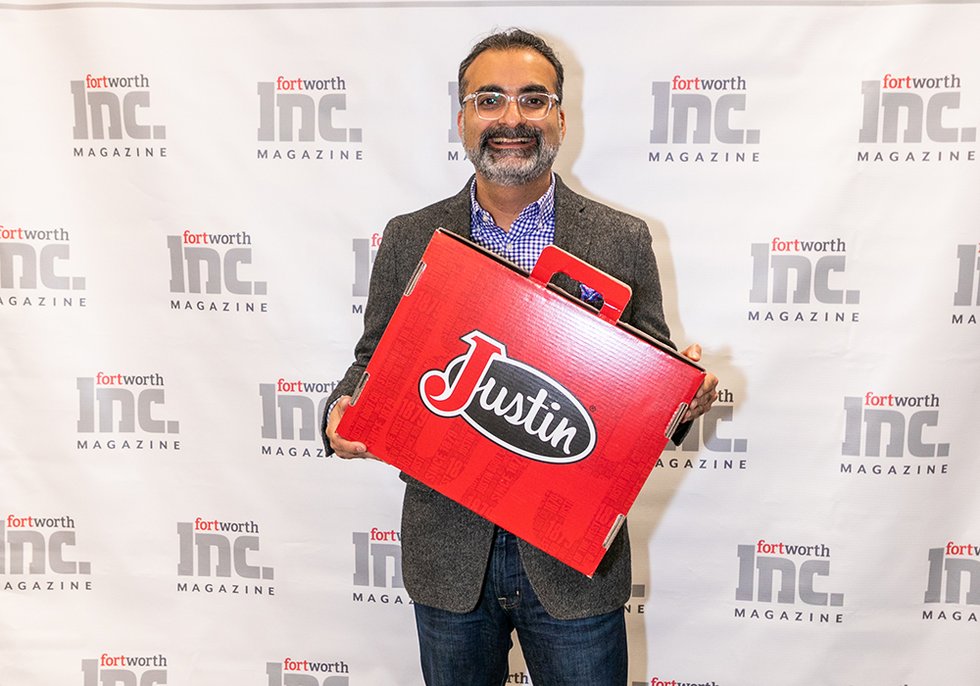
A red boot box is an unusually persuasive business trophy. In a photograph from March 2021, Rishi Khanna holds one across his chest, smiling in front of a wall of magazine logos. Inside is the reward attached to his 2020 Entrepreneur of Excellence recognition: custom-made Justin boots. Texas had found a way to make an award ceremony useful on uneven ground.
For someone who had spent years selling work that lives on screens, the object had a pleasing solidity. Here was a thing you could pick up. Khanna had won in the Tech & E-commerce category, but his prize belonged to an older technology: leather, craftsmanship, a good fit.
The fit is worth considering. Khanna, the Dallas-based founder and CEO of ISHIR, works in an industry that regularly invites its inhabitants to become entirely new people by next Tuesday. He has been running his business since 1999. Across that span, his vocabulary has changed with the work: outsourcing, digital transformation, product innovation, enterprise AI. A recurring concern has remained: how to decide what is worth doing before everyone gets busy doing it.
The family business could wait
Entrepreneurship was familiar territory long before ISHIR existed. Both of Khanna’s parents ran businesses. His father eventually sold his business and joined his mother’s. His sister became a CEO and entrepreneur too. “Imagine four entrepreneurs on a dining table growing up,” he recalls. One suspects the phrase “pass the salt” occasionally required a business case.
The expected route was to enter business, perhaps the family business. Khanna wanted some room to decide for himself. At the University of Texas at Austin, he initially studied computer science, then switched to business economics. He enjoyed programming; he enjoyed the economics and business classes more. The change kept technology within reach while giving him another way to think about its uses.
After graduation, he joined Deloitte. Consulting offered a view across business problems without requiring him to inherit a ready-made answer about his own future. He stayed for sixteen months. That is a short employment history for a conventional executive biography, but a useful apprenticeship for someone still deciding where to begin.
He dates ISHIR’s founding to November 14, 1999. The starting budget, in his account, was $1,000, enough to buy an HP Pavilion desktop. He wanted to make IT outsourcing available to startups and smaller businesses. Then the dot-com market collapsed, and the young company nearly went under. The lesson arrived early: an appetite for starting a business does not confer control over the conditions in which it must operate.
He has a more playful way of explaining the businesses that grew around the software work. In an earlier description, remote staffing was the Mini Cooper, digital transformation the BMW, and ENO8’s product innovation work the Rolls-Royce. The comparison made different services understandable without a diagram of corporate entities. It also suggested an executive willing to let an ordinary conversation do a job that business language often makes unnecessarily difficult. Customers could picture a car; they could ask which journey required it.
before entrepreneurship
founding year
Excellence award
The pause before the product
There is an awkward commercial question inside Khanna’s present approach. A software company earns money by making software. What happens when its first useful contribution is to question the software a customer wants?
His answer is to investigate the problem before committing to the build. ISHIR’s Innovation Acceleration approach combines design thinking, lean product development and agile methods. The sequence creates room to understand a need, test an assumption, and then develop something with a clearer purpose. He treats that understanding as work to revisit as circumstances change.
That changes the early conversation. A request for a feature becomes an opportunity to examine the task behind it. A confident description of a market becomes something to test with customers. The pause has a cost, of course. Meetings happen. Assumptions become less comfortable. Someone may have to explain why the lovingly prepared feature list needs another look.
By January 2026, the argument had acquired another home: ISHIR’s Texas Venture Studio. Its support for early-stage founders runs through four stages, beginning with problem discovery and validation, then product design and development, go-to-market planning, and scaling support. It gives the question about demand a formal place ahead of the engineering.
“Ideas fail without customers.”
Rishi Khanna
The economy of that sentence suits the point. A founder can spend a great deal of effort making an idea more articulate without making it more wanted. Customer validation introduces other people’s priorities into a story the founder has usually been telling alone. For Khanna, that interruption belongs near the beginning.
- 01Find the problemDiscover and validate
- 02Shape the productDesign and develop
- 03Reach the customerPlan the go-to-market
- 04Support the next stagePrepare to scale
When faster work changes the bill
AI makes that discipline more consequential. If a team can produce working software faster, it can also commit itself to an unhelpful direction faster. A shorter journey offers little consolation when the destination needs explaining.
Khanna’s argument also reaches into the invoice. Software services have often been sold in units of human effort. When tools reduce the time required, the relationship between effort and price becomes harder to defend. He has discussed outcome-based pricing, shared upside and different approaches to intellectual property as possibilities for the business. These are experiments in what customers should pay for as delivery changes.
He has put himself inside the same examination. In describing ISHIR’s direction for 2026, he identified the final quarter of 2025 as a point when incremental improvements seemed insufficient. An enterprise AI partner would need different ways of organising people, agents, responsibilities and delivery. The changes would reach further than a new item in a sales presentation.
“My transformation journey as a CEO came before ISHIR’s transformation.” His account includes returning to more direct founder involvement, working toward smaller teams with embedded agents, and reconsidering incentives and accountability. It is an admission with some weight after more than twenty-six years: the person setting the direction may also be carrying assumptions that need replacing.
In July 2026, he returned publicly to the importance of engineering judgment, product thinking and domain knowledge when competitors can access the same AI models. Access alone offers little explanation of how a company will use the technology well. His concern is the application: which decisions the team makes, which problems it understands, and whether the work produces a useful result.
An equation that fits on a napkin
Khanna’s attention to decisions extends beyond customers. He has described reaching business milestones and then questioning what they meant for his own life. Company-building could supply plenty of activity without settling the question of purpose. His response was to create more room for reflection.
On Paper Napkin Wisdom in March 2025, he laid out a compact framework connecting quiet time, clarity, confidence, outcomes, habits and self-reflection. The first move is almost suspiciously inexpensive for a technology executive: stop long enough to think. There is no procurement meeting attached.
Clarity → Confidence
Confidence → Outcomes
New habits = new results
Self-reflection = self-mastery
The framework puts confidence downstream of understanding. That is a useful reversal of the familiar performance expected from a founder, who is often asked to sound certain while still discovering the facts. It leaves room to admit that direction needs thought, and that repeated habits deserve as much attention as ambitious intentions.
His mentoring supplies another setting for those concerns. His advisory work has included The DEC in Dallas, Entrepreneurs’ Organization’s Accelerator program, Google Startup Weekend, Techstars, TCU and Capital Factory. He has also judged entrepreneurship competitions. These roles place him near people at the stage where choices still look wonderfully reversible, just before they become expensive.
The same attention turns up in his account of managing people. He wants employees’ strengths, personal goals and career ambitions to be understood alongside the client’s requirements. A development team contains several ideas of what progress looks like. Giving those ideas some attention requires a manager to ask questions beyond the next delivery date. The connection to his product work is clear enough: understand the people involved before deciding what success should look like.
His description of referrals is equally social. Customers recommend the company; some carry the relationship into their next job. Employees, former employees and people in adjacent professions can introduce new work too. He puts relationships and continued contact ahead of elaborate referral machinery. It is a useful detail in a career spent building remote teams: technology can move the work across borders, while people still decide whom they trust with it.
He describes wanting to help aspiring entrepreneurs use his failures as material for their own decisions. There is generosity in making those episodes available. A polished career summary tends to remove the wrong turns; a useful mentor needs to remember where they were.
Keep the boots. Reconsider the plan.
Khanna has more than one way to account for his career. There are the businesses, the awards, the advisory roles and the years. There is also his habit of ranking founding ISHIR as his second-best decision. Marrying Priyanka, he says, comes first. It is a small correction to the usual founder arithmetic, which can make the company large enough to obscure everything around it.
What connects the computer purchase, the validation work and the AI reorganisation is a willingness to make a decision and then examine it again. Starting required conviction. Continuing has required revision. Those qualities can coexist, though they are rarely as comfortable together as a founder’s retrospective makes them sound.
The boot box offers a fitting last image: a tangible reward for work in a business whose tools keep changing. Khanna can keep the boots. The plan will need another look.
Continue the conversation
Find Rishi
Watch & read
Video / Behind the AgencyBuilding a resilient development agency ↗Video / Paper Napkin WisdomClarity, confidence and the five-step framework ↗Video / InnovationKhanna on innovation and its barriers ↗News / Dallas InnovatesWhy founders should love the problem more than the idea ↗Writing / ISHIRKhanna’s articles on products, engineering and AI ↗