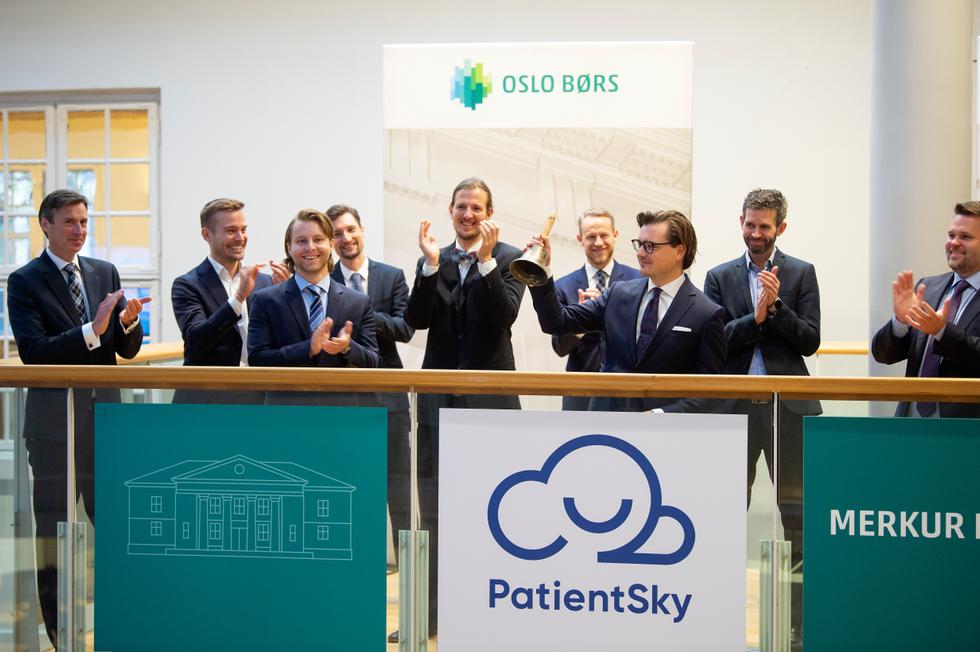
A stock exchange bell is a persuasive accessory. It makes a business look like a completed sentence. There is the photograph, the gathered colleagues, the ceremony that turns years of private effort into a public event. In the photograph from PatientSky’s listing period, Laust Wilster Axelsen is holding the bell. He has reached a moment that many founders spend their working lives trying to arrange. About a year later, he is talking about finding his old hoodie.
His announcement is unusually specific about where he thinks he belongs. After more than seven years at PatientSky, including acquisitions and a public listing, he wants to work at the beginning again. He describes returning to the garage and brushing up his programming. The decision has a domestic footnote: his third child is due the following day. A fresh company and a fresh baby make a fairly emphatic answer to the question of what comes next.
Today, he is co-founder and co-CEO of Embla with Nicholas Syhler. But the interesting thread in his career starts before the titles. It concerns the pleasure of making things, the irritation of seeing them made carelessly, and the people willing to join him for another attempt. His career has moved forward while repeatedly circling back to the workbench.
A company in his father’s name
Axelsen grew up in the Danish countryside, on a farm. His recollections include a landline telephone, food his parents grew, livestock, and bicycle rides to school and friends. It is a childhood described through ordinary, physical arrangements: things produced somewhere, by somebody, and journeys completed under your own power. Later, software would give him a very different set of materials.
At 15, he says, he started a company that had to operate under his father’s name because of his age. He wrote code and sorted out problems created by people considerably older than himself. There is affectionate mischief in his account of that period. Inexperience, remembered from a safe distance, becomes a kind of freedom. He could get on with the work before he had accumulated a comprehensive inventory of reasons to hesitate.
His own account divides entrepreneurship into three ages: 15, 26 and 33. Each comes with a different operating philosophy. The teenage chapter belongs to enthusiasm. The next belongs to effort. By the third, patience has become useful. That is a more interesting progression than a succession of increasingly grand job titles: the same person discovering that the method which got him started need not govern every later decision.
The product person in the listing document
He studied digital media at the IT University of Copenhagen. By the time PatientSky prepared its admission document in 2020, his biography had become the compact, practical sort that corporate documents favour. It identified him as a co-founder, with the group since 2014, and chief product officer. It also recorded experience as a front-end lead and UX developer, plus an earlier co-founding role at EENI.
Those details matter because they place him close to the interface: the point where a company’s ambitions have to become something another person can use. A product title can cover a great deal of territory. Front-end and user-experience work make that territory more concrete. There are screens, choices, interactions and the small decisions that determine whether a user proceeds comfortably or starts looking for somebody to blame.
The bell photograph supplies the ceremonial counterpart to that brief biography. Axelsen stands among the people involved in the listing, holding the object everyone has come to hear. A company that began in 2014 had reached the public market in 2020. The image is a useful pause in his story, though his subsequent decision gives it a different meaning. He had learned what it took to get there. He still preferred the earlier stages.
An old friend, a new beginning
Syhler was already a long-time friend when the two started Embla. Their friendship preceded the company by years. In a later joint conversation, they recalled meeting through common friends while studying at different universities in the same city. They had talked, stayed in one another’s networks, and nearly worked together before the timing finally suited them.
That history gives the partnership a texture that a founding date cannot supply. A business relationship often begins with a compressed assessment: skills, incentives, availability. These two had the advantage of an acquaintance that had survived beyond a single promising conversation. The eventual company was new. The conversation between its founders was already well under way.
Embla’s Danish corporate record places both men in the executive team from November 2021, with Axelsen becoming board chair in August 2022. His present job combines founding ownership with shared leadership. The paperwork provides the dates; the friendship explains something about the route between them. In his case, starting again meant carrying an existing relationship into a new setting, alongside the experience of having already built a business with other people.
Twelve seconds worth caring about
His eye for product detail has survived the executive titles. Opening Aula, the Danish school and daycare app used by his family, he encountered a row of repeated placeholder labels. He treated the little failure as an invitation to discuss software craftsmanship. The repetition was funny. The implication, for someone who has worked on interfaces, was less amusing: a person had opened an app to do something ordinary and met unfinished work.
He argued that a large development organisation or budget does not guarantee a thoughtful experience. His admiration went instead to small teams attentive to the brief moments people actually spend using a product. This is a recognisable developer’s complaint, delivered with a parent’s exasperation. The error is tiny enough to dismiss and visible enough to make the dismissal difficult.
There is an appealing consistency here. A founder who wants to return to programming also notices when the seams show in somebody else’s software. His attention lands on the part a user touches. In the abstract, a product can be a strategy, a market position or a budget line. On a phone, it becomes a few words and a sequence of taps. Placeholder text has an excellent talent for puncturing abstraction.
“Big budgets don’t build good products. People who care do.”Laust Wilster Axelsen
The workbench has a drinks menu
Outside software, he follows a similarly practical curiosity. He has described trying to make cardboard, acquiring a violin he never mastered, and buying a metric ton of oats. The list is funny partly because it refuses to settle into an elegant personal brand. Cardboard and a violin make awkward neighbours. Curiosity is often tidier when it has been prepared for an audience.
Home brewing became another experiment. Dissatisfied with the beers he could find, he tried making his own. Some batches went down the sink. What remained was an education in yeast, water chemistry and waiting. A brewing day can mean four to six hours of manual work with a friend, which also leaves ample time for conversation. For friends’ tenth wedding anniversary, he made two kegs rather than shopping for a conventional present.
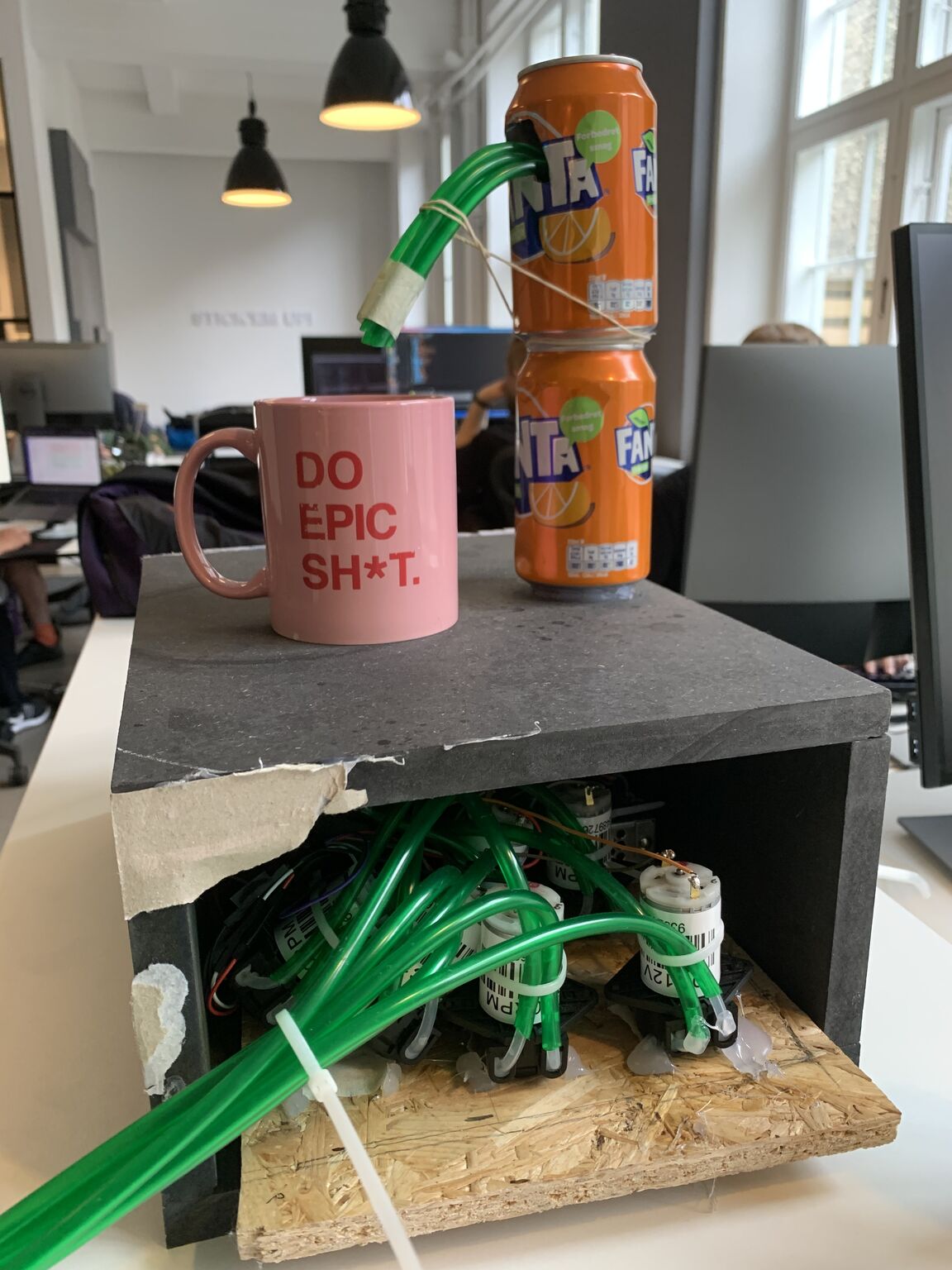
Then there is SirMixALot v1.0. At a team workshop, aquarium equipment, sprinkler pumps, scraps and a Raspberry Pi became a cocktail machine. The occasion involved learning to work together after introducing a new product owner and processes. The device’s improvised appearance is part of its charm. A machine with tubes and a mug offers a wonderfully concrete assignment: sooner or later, everybody can see whether the thing works.
Who comes back for another round?
Ask Axelsen why he wanted to become a founder and his answer returns to the people. Some colleagues have followed him through several companies. His description of them is personal and precise: unusual questions, code that runs beautifully, ideas improved beyond the specification, patient debugging, and the difficult work of keeping product decisions organised. It is a portrait of complementary abilities rather than interchangeable enthusiasm.
That preference extends to the financial relationships around the business. In responding to VentureFriends, an Embla investor, he stressed that founders also choose whom they invite into a company. He praised a combination of calm, curiosity, strategy and execution. Read alongside his affection for returning colleagues, it suggests a consistent question about company building: who will be in the room while the work is happening?
He also gives space to the people outside that room. In a Christmas reflection, he acknowledged missed dinners, late nights and being mentally absent while physically at home. Families and partners, he wrote, provide stability that makes a startup possible. It is a useful complication to the familiar founder portrait. Company progress takes place inside a larger arrangement of other people’s time, attention and patience.
A different relationship with the clock
The change he describes at 33 is a change in tempo. In his twenties, longer hours seemed to promise better results. Later, with experience and children, he became more selective about the challenges worth taking on. He began to value technique and patience alongside speed. His account remains ambitious, but it allows room for enjoying the years spent building.
It is tempting to arrange an entrepreneurial life as a ladder: first business, larger business, public company, next business. Axelsen’s own choices suggest a less orderly shape. The hoodie reappears. Familiar colleagues return. A product leader continues to object to a poorly finished screen. Somewhere alongside the formal company machinery, somebody is investigating how to make beer or persuade a small computer to pour a drink.
There is something reassuringly unfinished about that picture. He can point to the listing bell and still be interested in the next thing that needs assembling. He can have years of experience and still choose an experiment with a decent chance of going down the sink. For a person whose working life began with code under his father’s name, the next beginning continues to hold its appeal.