The first surprise at TechFarms is that the place does not look like an altar to technology. It sits in a metal building on Holley Circle in Panama City Beach, not far from a Navy base and the businesses of Thomas Drive. The second surprise is what waits inside: offices and conference rooms beside 3D printers, woodworking and metalworking tools, CNC equipment and the people who know how to use them. For a founder staring at a sketch and wondering how it becomes an object, this is a useful arrangement.
TechFarms calls itself a technology incubator, but that label captures only part of the operation. It is also a coworking space, a prototype lab, a light-manufacturing resource, a business-address provider and a gathering point for advisers and investors. The mixture is deliberate. Early companies do not fail in tidy categories. A hardware team can need an enclosure milled on Monday, a mobile interface reviewed on Tuesday and an introduction to a prospective backer before Friday.
Founder and CEO Steve Millaway opened TechFarms in 2015 with a regional problem in mind. Northwest Florida had engineering talent, military expertise and technical ideas, but comparatively little private-sector startup infrastructure. Promising founders could leave for a city with denser networks and deeper pools of capital. Millaway's answer was not to imitate a coastal accelerator. It was to assemble the missing pieces locally.
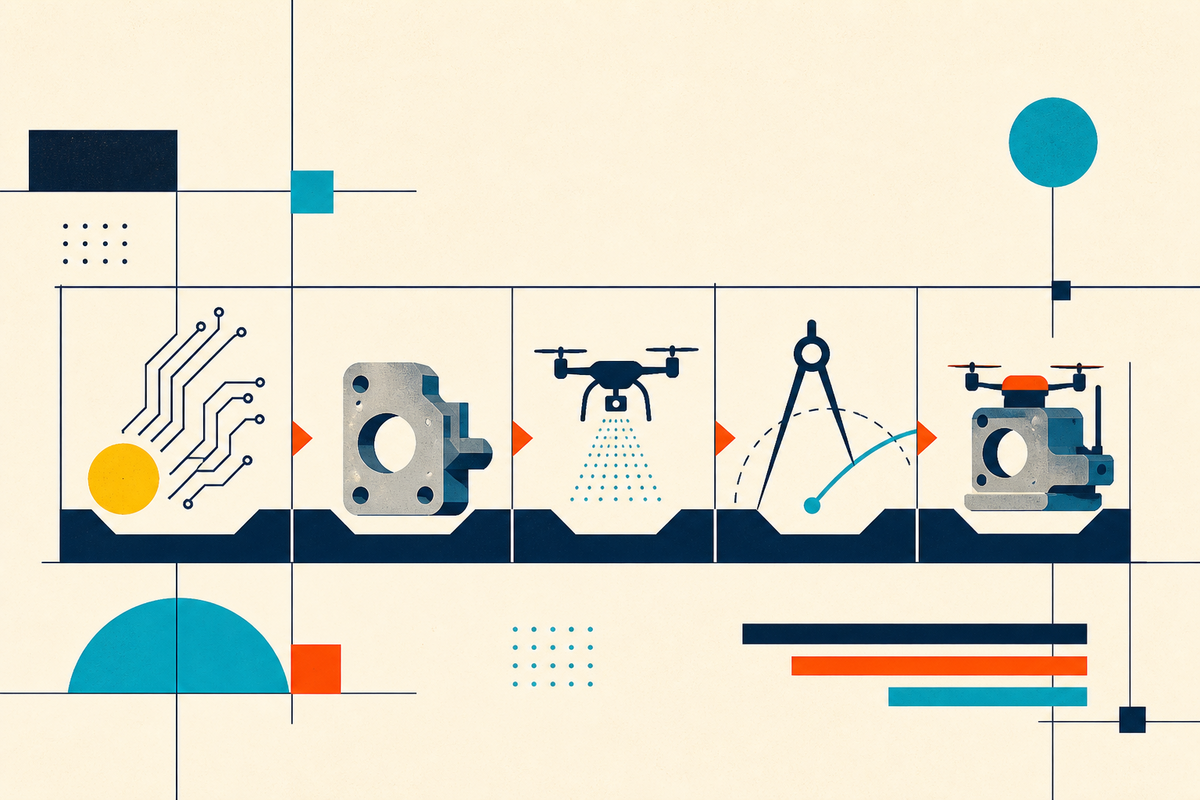
A workshop with a front desk
The public offer starts with familiar coworking ingredients: dedicated offices, hot desks, conference rooms, high-speed internet, printing, 24-hour access and a virtual business address. Those services can help a solo founder look established and give a scattered team somewhere dependable to meet. Coffee appears on the amenities list, as it must. The more consequential line items arrive farther down: prototype equipment, software development, manufacturing, marketing, mentoring and funding connections.
That combination makes TechFarms most relevant to founders building things that must eventually leave a laptop. A conventional coworking operator sells quiet, convenience and community. A makerspace sells access to tools. A consultancy sells expertise by the hour. An incubator sells a program and a network. TechFarms overlaps all four. Its position in the market is not perfectly neat, but neither is building an early-stage company.
The range also widens the front door. A founder can begin with a hot desk or a mailing address before committing to a larger program. An established business can book a room or seek technical capacity without pretending to be a startup. The arrangement gives TechFarms several ways to form a relationship early, then add more specialized help when the work becomes harder.
The incubator accepts applications on a rolling basis. Its customers include aspiring founders, early product teams, remote professionals and small businesses that need an office, meeting room or credible local address. Publicly named tenants have included software developer Teknika, drone specialist ArroTech, electronics maker Chaos Audio, network-security company Branch Networks, the affiliated investment organization formerly known as TechFarms Capital, and the University of West Florida's Small Business Development Center.
“The initial great idea is just one one-thousandth of what you do in starting a business.”Steve Millaway, founder and CEO
What the founders are really buying
The surface transaction may be a membership or office lease. The deeper purchase is reduced friction. A founder can waste weeks locating a contractor, negotiating access to equipment or learning that a product was designed in a way that cannot be manufactured economically. Proximity does not eliminate those mistakes, but it makes questions cheaper to ask and answers faster to test.
Chaos Audio offers the clearest case study. Founder Landon McCoy developed Stratus, a guitar pedal that can load multiple effects controlled through a mobile app. The team used 3D modeling and a CNC machine at TechFarms to cut an aluminum prototype. Teknika, another business born in the incubator, built mobile and web systems around the product. An early investment from the affiliated capital operation helped the company get moving. By 2024, Chaos had distribution relationships in Germany and South Korea; in 2025, its newer Nimbus amp and speaker system reached the semifinal round of Alibaba.com's CoCreate Pitch competition.
The point is not that every tenant follows the same route. It is that the route can bend. A cybersecurity company needs different tools from a drone developer. An industrial-sensor venture may need careful technical diligence; a one-person electronics company may need developers it can speak with across the hallway. The incubator's broad service mix lets support follow the product rather than force the product through a standard curriculum.
Capital was the missing rung
Workspace and advice can carry a company only so far. Millaway and his collaborators repeatedly saw startups exhaust friends-and-family money, then face a funding gap measured in hundreds of thousands of dollars. Bank financing is a poor fit for a young company without collateral or predictable revenue. In a region without a thick angel network, leaving town could seem like the only rational next move.
TechFarms Capital was created as a separate early-stage investment effort to address that problem. In 2025 it rebranded as GAIN Venture Capital. The name change is important because it clarifies a boundary: the incubator's everyday business is space, equipment and company-building support; investment decisions belong to an affiliated fund with its own diligence and portfolio. TechFarms itself does not publish revenue, valuation or corporate fundraising figures.
The obvious alternative
A desk at a coworking brand, tools at a makerspace, consultants hired separately and fundraising handled through distant networks.
The TechFarms wager
Bundle those relationships locally so a founder spends less time assembling infrastructure and more time validating a company.
This is also where the business model becomes easier to understand. TechFarms can earn from memberships, offices, meeting space, business-address services and technical work, while creating a stream of founders for its network. Software and engineering capacity arrive partly through Teknika. Capital sits alongside the incubator rather than inside a simple rent check. The model is closer to a small startup campus than to a single-purpose office landlord.
A regional strategy disguised as a building
Millaway came to the project with unusual credibility for this kind of institution. An electrical engineer by training, he worked in semiconductor design and founded Gain Technology Corporation, whose work included an early USB 2.0 chip later licensed to Intel. He returned to his hometown after years in Arizona and became involved in local higher education, entrepreneurship and workforce development. The origin story gives TechFarms a practical bias: its founder has designed products, started companies and watched technical talent leave a place that lacked private-sector opportunity.
That background also explains the proximity to defense and advanced engineering. Northwest Florida's military installations and research activity generate specialized knowledge in sensing, diving, unmanned systems and communications. The first company to enter TechFarms, Mine Survival, worked on self-escape breathing equipment for mines and confined environments. ArroTech has developed unmanned aerial technology, including systems intended to locate hazards. These are not the usual consumer-app demos associated with startup culture.
TechFarms' mission is explicitly economic. It wants to diversify a region heavily associated with tourism and the military by growing private technology employers from within. That is a slower proposition than recruiting a mature factory with tax incentives. It begins before the company has payroll, property or even a finished product. The incubator is making a patient argument that retention starts at the workbench.
The culture described by the company follows that argument: relaxed, collaborative and resource-rich, with flexible schedules, casual dress, shared lunches and an appetite for STEAM learning. Its current team spans operations, prototyping and manufacturing, special projects and communications. A member may come for privacy and fiber internet, but the intended advantage is the conversation that happens when an engineer, software architect, business adviser and investor inhabit the same orbit.
The clever feature is adjacency: the prototype lab, the software conversation and the funding introduction are all part of the same map.
The limits are part of the lesson
No incubator can manufacture demand. Tools cannot rescue a product nobody wants, and mentorship cannot substitute for a founder willing to sell, recruit and revise. TechFarms competes with larger ecosystems that offer more investors, deeper labor markets and a wider selection of specialist vendors. Its advantage is intimacy and access; its constraint is scale.
Still, that makes the experiment worth watching. Many smaller American regions talk about building innovation economies as if they could order one from a catalog. TechFarms starts with the less glamorous inventory: a place to sit, machines to make a first version, experienced people to challenge assumptions and a path to the next check. The formula is stealable precisely because it is concrete.
On Holley Circle, the distance between an idea and an object can be the length of a hallway. The greater test is whether enough of those objects become companies, and whether enough of those companies become durable Northwest Florida employers. Ten years after opening, TechFarms is still working on that conversion - one founder, one introduction and one machined part at a time.