The most intriguing product at La French Tech Lille is a meeting. Its website offers members an appointment with a regional business partner in a place called the Secret Room. The name supplies a little theatre. The transaction is refreshingly ordinary: choose an organization, reserve a slot, meet someone who might help your company move forward.
That is a useful entry point into an organization whose name can otherwise disappear into the fog of startup branding. French Tech Lille connects entrepreneurs with public agencies, established businesses and the people who support young companies. Its territory is Lille and the wider Hauts-de-France region. Its working material is access.
For founders, access is rarely an abstract concern. A company can have a promising product and still struggle to identify the person who understands its administrative question, the buyer willing to hear its proposal or the network that reaches beyond its existing acquaintances. Lille’s association tries to make those encounters easier to arrange.
A calendar beats a contact list
The clearest expression is French Tech Central’s booking platform. The public-service program is free and open to innovative businesses at any stage. Users select the kind of actor they need, choose an organization and reserve an available appointment. A confirmation email follows. Workshops and masterclasses provide another route into the same pool of expertise.
Business introductions follow a different rule: meetings with large companies and intermediate-sized regional businesses are reserved for members. Membership also brings priority access to event places. That distinction gives a prospective participant something concrete to assess. An administrative question and a corporate sales conversation enter through different doors.
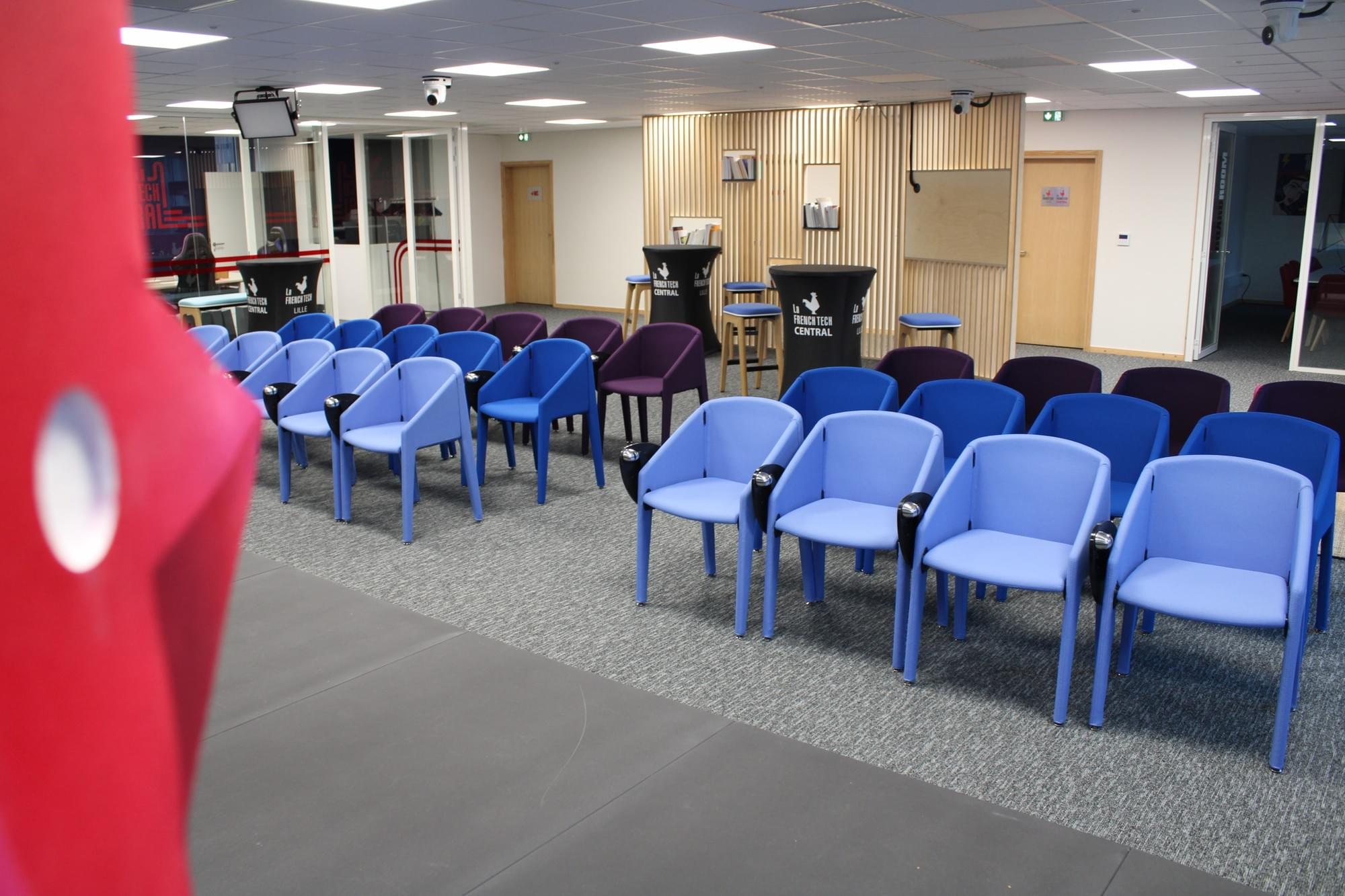
The published setting is a 300-square-metre space in Bois Blancs, near organizations including EuraTechnologies and Inria. For 2025, Central reports more than 35 public and private partners and more than 150 appointments. These are activity measures. They tell a reader that meetings happened; assessing the resulting contracts or business progress requires a different measure.
“Faire gagner du temps aux entrepreneurs”Save entrepreneurs time. The association’s stated mission.
The rooster has several owners
La French Tech is a national movement supported by government. Lille’s organization is a nonprofit association, legally created on July 2, 2018. It serves as a local operator and convener within that wider network. Understanding the distinction helps explain why the same French Tech identity appears on several different kinds of support.
A presentation distributed through Roubaix describes the national mission, regional capitals and French Tech communities as distinct parts of the system. It also separates those bodies from other public tools using the French Tech name. A founder therefore needs to ask who administers a particular program, which organization makes the decision and where the application belongs.
Lille’s published team names Hélène Clary as president and Sam Dahmani as general manager. Its board includes entrepreneurs associated with ClicData, Lattice Medical, Allistic and EKOO, alongside corporate representation. The operational work spans communications, projects and French Tech programs. This is a community organization with business people involved in its governance.
Its members and users range across sectors and stages. A regional presentation reports more than 300 active members, although the deck mixes reporting periods. The more durable point is the breadth: startups sit alongside incubators, investors, schools and advisers. Some organizations a founder might approach separately also participate in the wider network.
What the introductions cost
The 2026 operating plan puts a price on this connecting work: €682,500. It sets out €482,500 in public funding and €200,000 in private resources. The public side comprises €300,000 from the metropolitan authority, €32,500 from the region and €150,000 from the state.
70.7% public
€482,500
29.3% private
€200,000
The previous year’s plan totalled €685,000, including €555,000 in public funds and €130,000 in private resources. The comparison shows a nearly flat overall budget with a larger planned private contribution in 2026. It does not establish why any individual funder changed its allocation.
For a user, the immediate cost distinction remains simpler: public-service appointments are free; selected benefits depend on membership. For the association, the figures describe the resources supporting its activities. Dividing the whole budget by Central’s appointment count would mislead, because the organization also runs events and other programs.
In Lille, the guest list includes factories
The industrial emphasis gives the association a particular local character. Tech & Fab Summit brings together industrial startups, companies supplying digital solutions to industry, established manufacturers, smaller industrial businesses and students. The event’s offer includes one-to-one encounters and roundtables. Its website advertises a gathering with more than 40 exhibitors.
The metropolitan council recorded a second edition in 2024. The format puts a specific kind of potential customer into view. A supplier building something for a factory needs conversations with people who operate, equip or manage factories. An event organized around that demand offers a more focused starting point than a general startup reception.
The procurement work extends this buyer-facing approach. Through Je choisis la French Tech, Lille promotes a national initiative encouraging public and private organizations to buy startup solutions. Its published tools include targeted meetings, purchaser education and preparation for startups approaching public contracts.
That preparation matters because enthusiasm and purchasing authority are different things. The practical lesson for a founder is to arrive with a defined use case and a clear request. A useful first conversation can establish who owns the problem, who can authorize the next step and what the supplier must demonstrate. An introduction opens that inquiry; the commercial work continues afterward. For the buyer, the same meeting can clarify whether a young supplier understands the operational setting. Both sides benefit from deciding early whether there is a plausible next step, even when the answer is to end the conversation there.
The spotlight comes with entry requirements
For more established companies, Scale-Up Excellence tackles visibility. The 2026 program page describes cooperation among 11 French Tech capitals, with support in public affairs, press relations, communication and media training. Participants can meet decision-makers and other selected companies, with gatherings in Paris and masterclasses involving experienced business leaders.
The eligibility rules place it beyond the idea stage. Applicants need a commercialized product or service generating revenue, at least ten employees or collaborators, membership of a participating capital and a solution addressing societal challenges. Financial criteria include at least €2 million raised, or €1 million in annual revenue with the specified growth record.
Those gates reveal the program’s intended job. It is designed for companies with evidence of business activity that want greater recognition. A founder still testing an idea should choose a preparation route. A scale-up seeking press and public-affairs support can examine this offer against the time its leadership team is ready to commit.
Who gets into the room?
Networking has an awkward habit: it can be easiest for people who already have a network. Lille’s inclusion programs address that problem directly. La Prépa, offered with Kevaap, provides free collective and individual support to help eligible tech and innovation project holders develop an idea and test its potential.
Its published eligibility list includes recipients of social benefits, scholarship students or recent former scholarship holders, people unemployed for at least six months, residents of designated priority or rural areas and people aged 50 or above. Participants can subsequently have an opportunity to join Impulsion, a phase involving video production and integration into the regional community.
Amazing Ladies approaches access through recognition. The 2025 awards named Anaïs Maâchi of Aces O+ in Launch, Julie Dulot of Hektore in Boost and EKOO co-founder Emilie Brossier in Grow. The three categories give the spotlight a sense of business stage. Orange and French Tech Lille are identified as carriers of the initiative.

The association’s public culture also makes room for social and environmental engagement. Its Tocaté podcast, presented by Katia Dahmani and produced with Natif, interviews people from regional businesses about those subjects. Guests include figures from Vekia, Le Fourgon and OVHcloud. The name refers to the Italian “tocca a te”: your turn.
Come with a question worth answering
The useful way to approach French Tech Lille is to begin with a specific obstacle. For public-service questions, inspect Central’s available appointments. For an industrial customer search, examine the summit’s audience. For national visibility, check Scale-Up Excellence’s criteria. For an early idea and limited access to established circles, read La Prépa’s conditions.
Each route depends on fit. A regional network needs relevant partners with time to participate. A selective program needs applicants who meet its conditions. A business meeting needs a proposition the other side can evaluate. These constraints help a founder decide where to spend effort before committing an afternoon to an event.
Other communities can copy the practical design: make expertise discoverable, publish the access rules and let people reserve a conversation. The harder part is maintaining a roster that answers real business questions. Lille’s contribution becomes clearest at that scale: one founder, one defined problem and someone useful on the other side of the table.