A waiting list is usually good news. For Community Energy Labs, it revealed a problem that enthusiasm could not fix. Founder Tanya Barham reported more than 133 prospective customers within a year of launching a prototype. People wanted help managing building energy. Making the technology work reliably with existing equipment, at a price those customers could afford, would take longer.
- VertueLab backs early climate companies with money, mentoring, and help finding grants.
- Its nonprofit structure brings philanthropy into a business usually associated with venture capital.
- The focus is Oregon and Washington, with communities involved in shaping the solutions.
VertueLab helped Barham find suitable federal funding opportunities and prepare applications. Later, it joined other pre-seed investors. The sequence matters: technical work first needed breathing room; commercial investment followed. Her experience offers a useful entrance into an organization whose most interesting product is the chance to finish proving something.
01 / A different clock for climate
Founded in 2007 as Oregon BEST, VertueLab began with an economic-development brief: help Oregon turn clean technology into businesses. It supported nine university laboratories, connecting research with industry. In 2018, the organization adopted its current name and broadened its regional ambitions. The Cascadia Cleantech Accelerator, developed with CleanTech Alliance, had already helped extend its work beyond Oregon.
The underlying problem was stubbornly physical. Hardware needs testing, manufacturing expertise, and demonstrations. An attractive laboratory result can still be a long way from something a customer will buy. The Lemelson Foundation described precisely these difficulties when it backed VertueLab in 2021. Entrepreneurs needed help with production, potential buyers, corporate partners, and money suited to the stage of development.
This is VertueLab's place in the market: between research and commercial scale, where a conventional investor may want more evidence than an inventor can yet afford to produce. Its expertise combines funding navigation, commercialization support, and relationships across the region. The beneficiaries include scientists, hardware founders, and software entrepreneurs. Foundations and public agencies supply resources; startups receive support.
02 / Money with room to wait
In 2019, the U.S. Economic Development Administration awarded $300,000 toward launching VertueLab's impact fund, accompanied by a $300,000 local match. The federal description identified the intended fuel: patient capital from individuals, foundations, and corporations willing to accept below-market financial returns in pursuit of environmental impact.
Two years later, the Lemelson Foundation announced a $500,000 investment in Climate Fund I, which was seeking to deploy $5 million. That was the foundation's first domestic program-related investment. For a philanthropy accustomed to supporting invention, the move put charitable purpose directly into startup finance.
The business model combines charitable support, public grants, investment activity, and entrepreneurial assistance. It differs from a standard venture fund because philanthropy can support companies and communities that fall outside conventional investment appetites. Venture firms, university incubators, and other climate accelerators are alternative routes for a founder. Several are also collaborators. VertueLab operates among them, trying to make the handoffs work.
Subsequent funding is money raised by portfolio companies. It is neither VertueLab's revenue nor a measure of emissions already avoided.
03 / The bridge needed support, too
Then came a reminder that intermediaries have their own precarious economics. In September 2023, Business Oregon ended funding for VertueLab's core Oregon programming and operations after 16 years of continuous support, according to an organizational message reproduced by Silicon Florist. VertueLab reduced staff. Eleven people remained to deliver funded work, pursue replacement support, and rethink the organization's future.
The immediate damage landed on operating capacity. The message distinguished that from the Climate Impact Fund, whose reserved resources would continue supporting portfolio stewardship. It is an instructive separation: money committed to investments does not automatically pay the people running an entrepreneur-support organization.
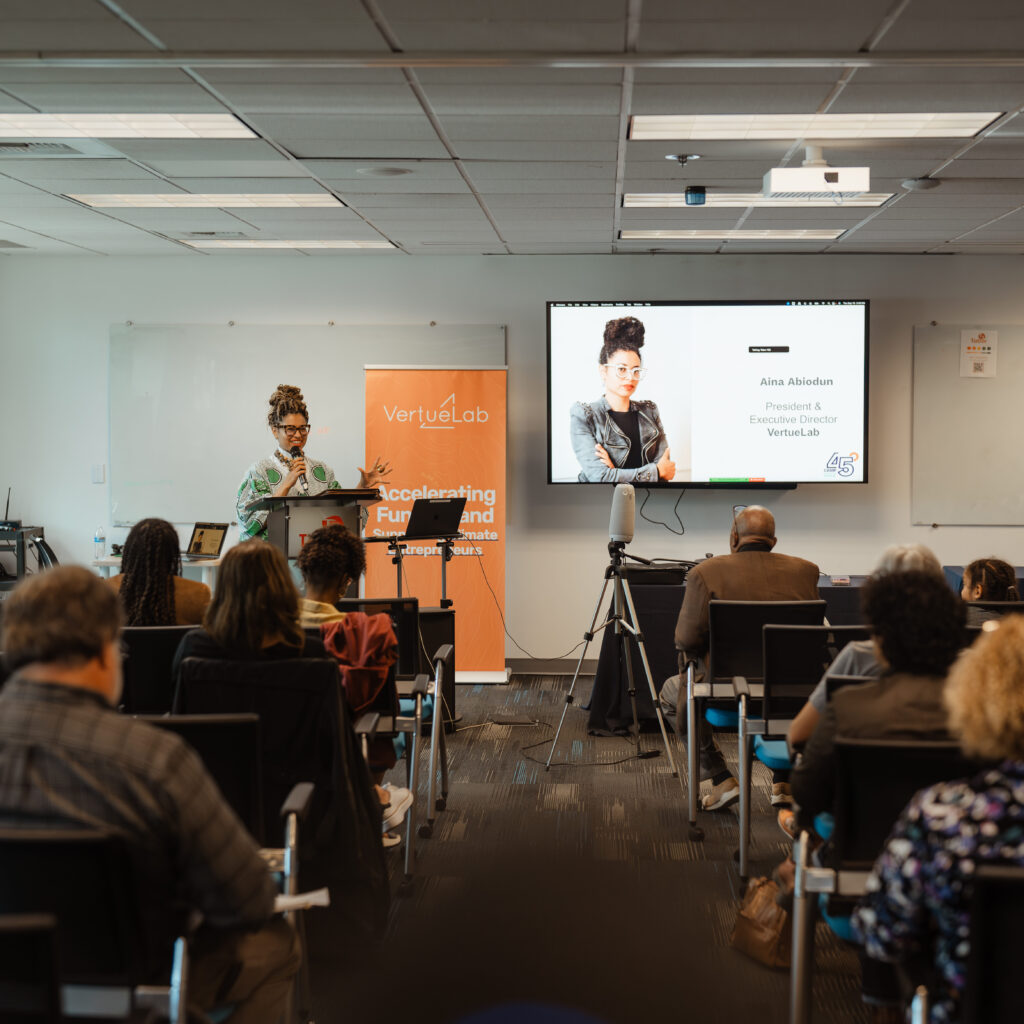
VertueLab's 2024 impact report describes another evolution. Research with entrepreneurs, investors, partners, and communities pushed its strategy toward climate resilience and stronger coalitions. The report connects those lessons to a broader view of whose needs technology should address. Under Aina Abiodun, its president and executive director, community participation became central to the organization's stated approach.
04 / Put the people in the room
The Seattle Climate Innovation Hub gives that coalition a physical address. Launched in January 2025 with the city's economic-development office, University of Washington's CoMotion Labs, and 9Zero, it combines incubation, gathering space, and coworking. The launch announcement identified $200,000 from the city and $85,000 from Washington's Department of Commerce. These were contributions to the shared hub.
In October 2026, VertueLab reported that its Opalene Climate Challenge selected six Washington startups from nearly 40 applicants. Together they received $375,000 in catalytic investments, with a separate $5,000 audience award for Airbuild. The list ranged from Emerald Battery Labs to ZILA BioWorks. The mechanism pairs philanthropic capital with investment selection; partner Realize Impact appears on recipients' capitalization tables.
“VertueLab empowers founders to grow not just our ventures, but ourselves.”Elba Ocasio, entrepreneur, in VertueLab's giving materials
05 / Start with the next obstacle
A founder can begin with BizLite, a free, self-paced course covering business models, customers, and commercialization. Bedrock offers individual mentoring around customer discovery, grants, and venture readiness. TerraForge, announced for 2027, targets Oregon's mass-timber micro supply chain and BIPOC leadership. Each starts from a particular gap.
The approach is useful when a credible technology needs time, technical proof, and the right connections. It has limits: these are regional programs, selection matters, and funding cannot manufacture customer demand. What another organization can copy is the sequence. Identify the next obstacle. Match the support to it. Keep enough operating money to remain there when the founder comes back.
Keep going
Watch / BizLite lessons
▶ Hear from mentor Bill Stevens▶ Building your cash budgets