A founder can have a working product, a plausible market and a calendar full of networking events, yet still lack the one introduction that matters. On Réunion, La French Tech La Réunion has built its work around that awkward gap. Its proposition is straightforward: help entrepreneurs find the public official, commercial partner or investor appropriate to the problem in front of them.
The association carries the French Tech name on an Indian Ocean island, but its daily usefulness is often less glamorous than the branding. An appointment about recruitment. A conversation about research support. A workshop where a large company meets a startup it might actually buy from. These small encounters are the raw material of its larger ambition: giving local innovation a better chance of becoming a business.
That makes the organization an unusual entry in a company directory. It is a nonprofit association, bringing together startups, established businesses, research organizations, support structures and public services. Its expertise lies in knowing this network and organizing access to it. For an entrepreneur, the useful question is therefore specific: who can help with the next obstacle?
The wrong meeting, then the right label
One early participant found her way in through an unusually literal networking accident. In January 2016, Élodie Royer walked into the wrong meeting and heard Digital Réunion president Philippe Arnaud presenting the local French Tech project. Recalling the episode in 2017, she told EWAG: “J’étais au mauvais endroit au bon moment” - the wrong place at the right time. She subsequently helped steer the initiative.
Digital Réunion carried the original project with public and private partners. The local network emerged in 2016 around e-health; Community recognition followed in 2019. The independent association was legally created on March 9, 2022. Those dates describe different stages of the same effort, which explains why a quick company lookup can make its history look contradictory.
In 2023, Réunion became the first French Tech Capital in France’s overseas territories. The title placed a local organizing effort inside a national framework for supporting innovative businesses. Réunion appears again in the official 2026-2028 Capital network. The progression is revealing: a thematic initiative became a community, acquired its own legal structure, then took on a wider coordinating role.
The first appointment costs €0
French Tech Central is the clearest way to understand the service. Its Réunion booking platform organizes access around recognizable business needs, including financing, research and development, taxation, regulation, recruitment and export. Entrepreneurs choose an organization and reserve an available appointment. Meetings take place by video or at Village by CA Réunion in Saint-Denis.
The program is free and open to innovative businesses at different stages, from startups to larger companies. Association membership is not required. That choice matters: a founder can ask for help before deciding whether to join the network. Access to a conversation should not be confused with approval for a grant, a tax treatment or an investment; the relevant institution still makes its own decisions.
There is a useful division of labor here. Village by CA and Technopole La Réunion occupy the local incubation and business-support landscape. French Tech helps people navigate that landscape and connects it to national programs. Entrepreneurs can also approach those organizations directly. The association earns its place when knowing which door to try, and when, saves a founder time.
French Tech Central expert appointments.
Membership is not required.
The buyer belongs in the room
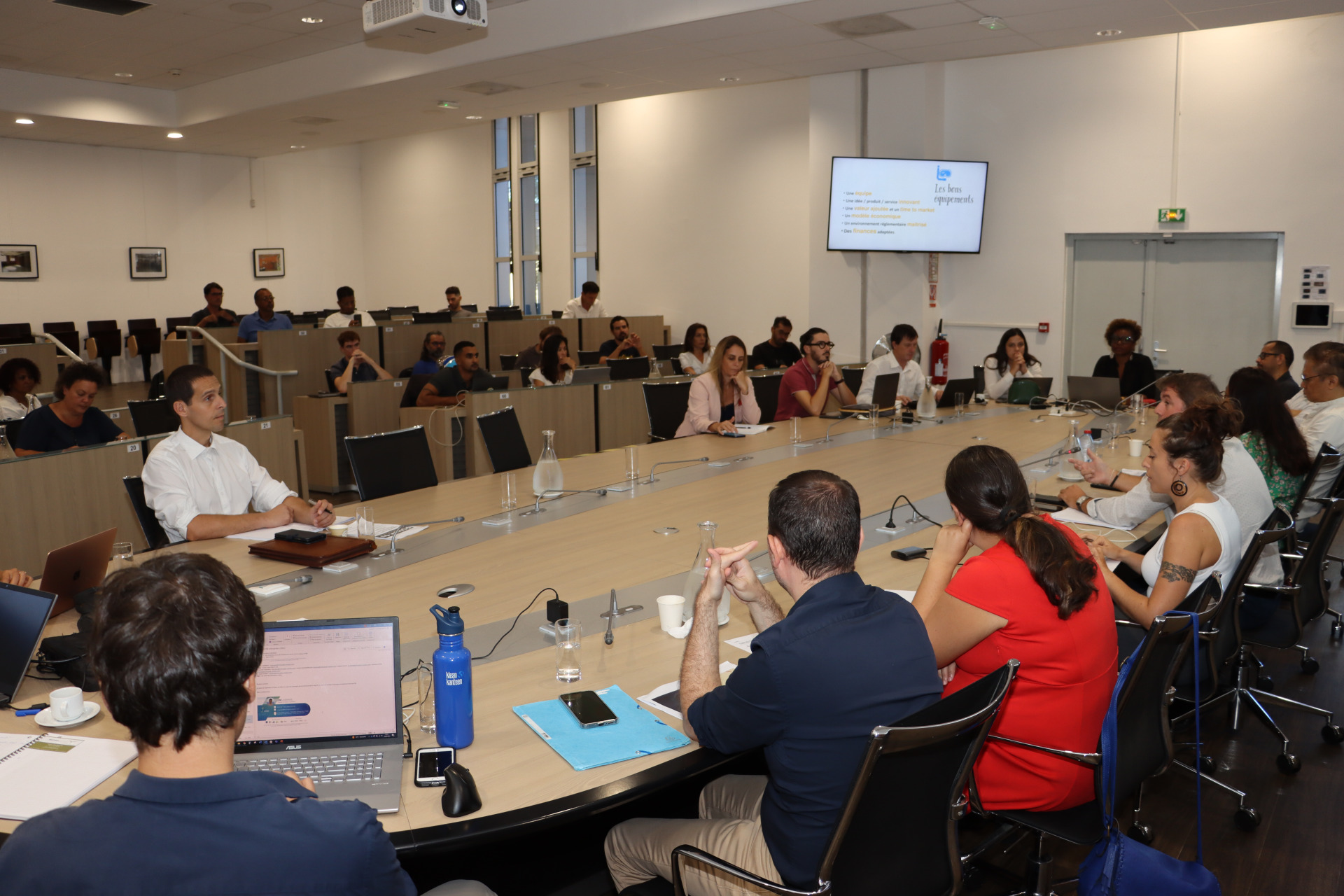
The first French Tech Connect, held from October 9 to 12, 2023, made the commercial problem explicit. It brought startups together with major companies and public-sector organizations through half-day workshops. Topics ranged from industry and agri-food to health, energy, mobility, cultural industries and public procurement. The workshops were free, with registration and capacity limits.
That agenda stretched well beyond a gathering of software founders. A health service, a manufacturer or a public buyer could arrive with an operational problem; a young business could arrive with something to test. The format put potential users in the conversation. Its value depends on what happens afterward: a scoped experiment, a purchasing discussion, a contract or a useful rejection.
Florent Montrouge, president when interviewed by L’Éco austral in February 2024, described a sequence built around commercial credibility. Working with established companies and institutions could give startups experience and revenue, improving their position with investors. He presented 2023 as a period of building connections, with implementation and more experiments to follow. That was a stated program, rather than proof of later fundraising results.
The distinction is essential to reading the association’s record. A label recognizes an ecosystem; an event creates access. Neither measures sales. The strongest version of this model asks buyers to participate seriously and founders to arrive with a defined problem they can solve. A roomful of friendly people is a pleasant afternoon. A buyer with a budget changes the discussion.

An airline ticket can be startup support
Distance gives the work a physical dimension. In a 2024 Zinfos974 interview, then-director Julie Van Snick described negotiating with French bee so that 14 startups could travel free to VivaTech. The region organized the exhibition opportunity; the association addressed the journey. It is a concrete example of support designed around the cost of reaching a market.
Van Snick also described a tougher first encounter with the exhibition floor: unfamiliar audiences, competition for attention and founders who had to work to be heard. Her account makes pitch preparation and advance meetings look less like optional polish. The practical lesson for a founder is to settle the audience, the ask and the follow-up before the flight.
National investor access is another route. The government’s 2023 French Tech Rise record lists data and AI company Duke under French Tech La Réunion and French Tech Mayotte. Across the national final, 20 selected startups received 90 individual meetings with 66 investors. Those are national figures, not Réunion’s totals, and meetings should not be read as money raised.
The regional work is equally tangible. At the twentieth Forum CITI in April 2024, French Tech La Réunion joined the Territoire de l’Ouest, Bpifrance, the Banque des Territoires, AFD, ADEME, the region and Technopole in discussions about financing innovative projects. The cast explains much of the association’s role: bringing otherwise separate parts of the support system into the same conversation.
Membership buys participation
The business model has the shape of an association: membership and institutional support help sustain shared services and community activity. A published 2023 membership offer allowed startups to join free for directory inclusion, while a €99 option covered more involved startups and established businesses. These are historical prices, not a current tariff.
Institutional participation operated at a different scale. On October 6, 2023, the regional council approved a €7,500 commitment for membership in the association. That figure is a specific public membership expenditure. It is neither the association’s total operating budget nor a venture-capital round, and it says nothing by itself about the cost of running an individual program.
The association’s 2025 membership announcement described a one-year term with preferential offers, member visibility, priority access to key events and voting rights in board decisions. It asked organizations to create a directory profile and pay annual dues. Participation thus carries both practical benefits and a governance component: members help support and shape the organization doing the convening.
That structure also reveals its working culture. Entrepreneurs contribute to a collective organization alongside institutions with different priorities and timetables. The directory supplies a public map of participants; events give them reasons to meet. The arrangement works best when people contribute useful expertise and follow through on introductions, rather than treating membership as a badge to put on a website.
“J’étais au mauvais endroit au bon moment.”Élodie Royer, on finding the project by accident.
EWAG, May 2017. “The wrong place at the right time.”
The network goes back into the diary
The tools now include a free French Tech Reunion mobile app, listed on Apple’s App Store under developer Crowdaa. Its advertised features cover news, event information, registration, startup discovery and appointments with mentors and experts. It packages community activity into a more convenient interface. The service underneath still depends on the availability and quality of the people involved.
There are also identifiable founder stories. In a 2026 post, the association featured Alice Robert and Apiz, a project connecting people who need a product with people already in a shop. It described her participation in French Tech Tremplin as helping refine the proposition and structure the project. The video series, supported by the region and prefecture through PAREF, highlights women entrepreneurs.
At VivaTech in June 2026, the association advertised a business meeting for startups from Réunion and New Caledonia with public and private groups. The Réunion list included Billie, Duke, Eyako and MoSITouch. Restricting visitor registration to those groups made the intended audience clear: organizations with which the startups could discuss business, rather than an undifferentiated crowd.
The next French Tech Connect is scheduled for September 22-24, 2026, across Saint-Denis, Saint-Paul and Saint-André. The published program emphasizes women entrepreneurs and financing in overseas territories, with reverse pitches, coaching, a fundraising serious game and investor encounters. As of September 10, those activities are still ahead. Their outcomes will depend on the work that follows the sessions.
For a founder considering the network, the approach is easy to copy: name the obstacle, identify the relevant counterpart and use the available route to request a focused conversation. Bring a short explanation of the product and a concrete next step. For a regional organizer, the lesson is equally practical: arrange useful access, account for the cost of reaching people, and keep asking whether introductions become business.
Make the next introduction
Explore the official website, find organizations in the community directory, or book a French Tech Central appointment.
Follow the association on LinkedIn, Instagram and Facebook. Read the September Connect announcement.
WATCH & LISTEN