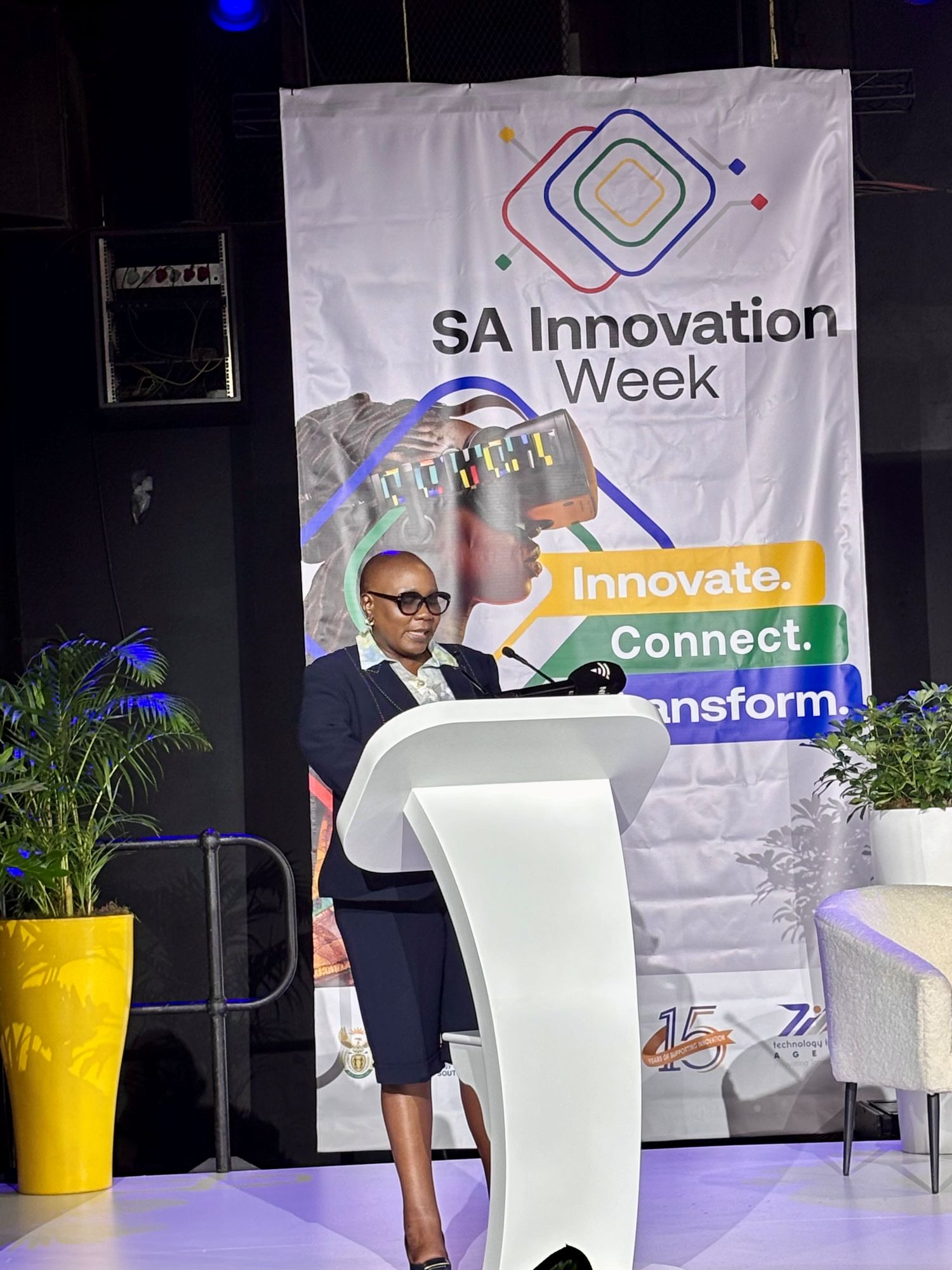
A funding rejection can at least be useful. Tell a founder why the application failed, and the next version might improve. Say nothing, and the entrepreneur is left guessing. At the opening of SA Innovation Week in Johannesburg, Deputy Minister Nomalungelo Gina made that small, maddening administrative problem a national innovation issue.
“Many start-ups rely on funders’ comments to refine and resubmit,” she said. Her complaint about silent rejections gave the gathering a sharper purpose than the usual invitation to be inspired. Getting an invention into use depends on decisions, explanations and follow-up. A stage and a lanyard can only do so much.
SA Innovation Week, or SAIW, arrived in March 2026 with a proposition built around that gap. Bring researchers, entrepreneurs, investors, corporate buyers and government into a coordinated programme. Give them places to exhibit, pitch, learn and negotiate. Make the next commercial step easier to identify. The ambition is straightforward; the institutional choreography is considerable.
The room is the product
The Technology Innovation Agency, an entity of the Department of Science, Technology and Innovation, hosts SAIW. The South African Innovation Summit supplies the operating partnership, contributing its network and delivery experience. This matters when reading the name: the inaugural Week is a 2026 initiative built on an older Summit foundation.
SAIW’s offer is a set of organised encounters. A founder can demonstrate a technology to potential adopters, seek an investor introduction or work through a business problem in a masterclass. An investor can meet ventures assembled through research and entrepreneurship networks. A corporate participant can look for a solution to an operational problem and discuss what a pilot would require.
Its public-facing business model follows that convening role. The inaugural edition offered free attendance, with registrations reviewed to shape the mix of participants. TIA’s hosting role and the supporting partner network underpin the platform. For the attendee, the transaction starts with access to people and practical sessions. Investment in a participating venture remains a separate decision.
The organisers’ description of a working environment makes an implicit demand on everyone in it: arrive with something specific to contribute. A room full of people seeking capital needs people who can evaluate and deploy it. A showcase seeking buyers needs participants who understand purchasing. The usefulness of the gathering depends on that balance.
Five days, several front doors
The programme ran from March 16 to 20, with provincial activities on the first two days and the flagship gathering at Johannesburg’s NASREC from March 18 to 20. That structure gave the national event more than one point of entry. Local organisations could present their own capabilities before the central convening.
In Cape Town, the OneBio Innovation Centre and Biosafety SA advertised a March 16 showcase combining questions about biosafety and sustainability with guided laboratory tours. There was networking over lunch, too. The practical attraction was the chance to see the facilities behind a biotech business, including the infrastructure that a slide presentation can make look deceptively simple.
In the Eastern Cape, T3 Living Lab hosted a youth technology competition and hackathon in Gqeberha. ITWeb reported ten finalists across subjects including agriculture, healthcare and climate resilience. The top-ranked entry, Asaka Wear, was a reusable sanitary solution made from biodegradable materials. Innovation here included a familiar household need, alongside the technology sectors that usually dominate conference posters.
Winning participants were eligible for prototype grants of up to R500,000, together with mentorship and incubation support. That figure describes an opportunity for the innovators, subject to the programme’s conditions. It should be read as prototype-development support, rather than a cheque awarded to the event or proof that every finalist received funding.
Provincial showcases
Local capabilities, lab visits and competitions
NASREC programme
Exhibitions, pitching and working sessions
Founders focus
Scheduled half-day masterclasses
A buyer has different questions
The NASREC programme put commercialisation beside the subjects that often steal the spotlight. There were sessions on technological sovereignty, artificial intelligence and digital trust, but also research-to-industry pilots, capital readiness and supply chains. The architecture was revealing: a main plenary, co-creation area, Entrepreneurship Central, an outdoor Boma Stage and a podcast booth.
A special founders’ half-day was scheduled for March 20. The broader learning offer covered business and technical concerns, including intellectual property and financial modelling. For an entrepreneur, the appeal is the chance to connect the product demonstration to the business decisions around it. Who owns the work? What evidence supports the price? What will the next stage cost?
The distinction between invention and adoption also appeared in a less glamorous corner of the programme: public procurement. The African Procurement Law Unit participated in the Small Business Research Initiative Colloquium, sponsored by the British High Commission. Professor Geo Quinot joined a discussion about how law and South Africa’s unfolding procurement reforms could help public purchasing encourage innovation.
That is a useful subject for a technology festival. A government department can recognise a promising solution and still face a long route to buying it. Putting procurement expertise into the conversation brings the discussion closer to the customer’s actual process. The analytical lesson is simple: a startup selling to institutions needs to understand how a purchase gets authorised.
The invention is only half the argument
For a taste of the exhibition mix, consider two participants’ own accounts. Coba Biomedical thanked the South African Medical Research Council for hosting it at the event. MycoSure said its co-founder and chief executive, Charles Reed, represented the company at an industrial biotechnology stand with TIA and the Council for Scientific and Industrial Research.
These examples help locate SAIW in the market. Its audience extends beyond software founders and venture investors. Medical technology, biotechnology and university research bring different development cycles, technical questions and commercial partners. A national convening can introduce those communities to one another, provided the meetings are specific enough to be useful.
The platform can also serve as a launch venue. In a company-issued March announcement, A-Game Business said KK Diaz had launched its AI-powered Business Operating System at the inaugural Week. That is a concrete use of the gathering: place a product in front of prospective users and partners. A launch announcement establishes that the product was presented; adoption is a later chapter.
The strategic background predates the festival. TIA’s 2025/26 annual performance plan envisaged a recurring national showcase for startups, university and science-council research, and innovation infrastructure. It also emphasised participation by historically disadvantaged communities. SAIW translates that institutional ambition into an event programme that participants can physically enter.
The price of the ticket, and the work around it
Free admission was a meaningful design choice for the first edition. The organisers also said space was limited and registrations would be reviewed. Access therefore depended on more than clicking a payment button: the intention was to assemble founders, investors, operators and policy participants in a useful mix.
For anyone planning a similar gathering, this suggests a practical trade-off. Removing a ticket price can widen the pool of applicants, while curation can improve the chances of relevant introductions. The approach needs clear selection criteria and enough of each participant type. Otherwise, a supposedly useful meeting can become another queue of founders waiting for the same handful of investors.
Attendance also consumes preparation and time. A founder should decide which question the event is meant to answer before booking the trip. Is the next obstacle laboratory validation, an industry pilot, a procurement introduction or capital? Each requires different evidence. Treating every conversation as a funding pitch risks missing someone who could become the first customer.
“The real measure of success will be what follows”Buntu Majaja, SA Innovation Summit CEO, after the inaugural edition
The first break was between the institutions
SAIW’s origin story is a response to fragmentation. Its hosts describe research, capital, industry demand and public priorities operating with insufficient coordination. Gina’s opening-day intervention put a human consequence on that diagnosis: a founder can leave a funding process without the guidance needed to try again.
There are different interpretations of the blockage. In a post-event Mail & Guardian essay, Michael Brian Lee reported Summit founder Audrey Verhaeghe’s concern about inadequate pre-seed and seed resources. He also described commercialisation expert Adrienne Leussa’s counterpoint that some public funding struggles to find suitable early-stage projects. Both observations can coexist when promising work needs development before it meets an investor’s requirements.
That tension makes SAIW’s matching ambition interesting. More introductions can help when the problem is that the right people have never met. They are less effective when a technology still needs expensive validation or an institution cannot commit to buying. A productive meeting should identify that distinction, even when the answer is an unexciting list of work still to do.
Leave with a next step someone owns
The post-event account described more than 85 exhibitors and named supporting partners including Absa, PetroSA, FNB, Exxaro Resources and Anglo American. Buntu Majaja, the Summit’s chief executive, spoke about deals initiated and partnerships formed. His emphasis on subsequent results supplies the appropriate yardstick: introductions should eventually be assessed through what participants do with them.
Founders can borrow the method without waiting for another national event. Define the bottleneck, identify the person who can help resolve it, and bring evidence suited to that decision. After a meeting, agree on a next action, an owner and a date. This is a suggested way to use the platform’s design, not a claim that every SAIW participant followed it.
For organisers, the equivalent discipline is to follow the relationship beyond the venue. A pilot started, a buyer’s evaluation completed or an application improved after feedback would each reveal something that a packed auditorium cannot. SAIW has created a place for those relationships to begin. Its most interesting stories will belong to the people who can show what happened next.
Keep the conversation going
Explore the programme, meet the network and read more about the first edition.