The biscuit tin belonged to his grandmother. So did the alarm clock. Xavier Verdaguer and a schoolmate used the household objects for a machine that could record rainfall, entered a television science competition and won a Commodore 64. There was a small administrative complication: they had lied about their ages to enter. The apparatus, however, did what they said it would. A graph came out. A computer came home.
Verdaguer was about twelve. The prize helped point him toward computing, but the episode also offers a useful introduction to his way of working. Find a question worth answering. Assemble whatever is available. Bring somebody else along. Produce something another person can actually see. The grandmother's contribution to this early research department deserves at least an acknowledgement.
Decades later, the founder and CEO of Imagine Creativity Center is still arranging unlikely combinations. Young people and company executives. Catalan design and Californian technology. Strangers and train journeys. His participants are called dreamers, a word that sounds as though attendance might require little more than a comfortable chair. His programs give them challenges, teammates, prototypes and deadlines. The dream comes with homework.
The attraction of having room to decide
Born in Vic in 1972, Verdaguer moved to Barcelona to study. His education crossed technical architecture and computer engineering at the Universitat Politècnica de Catalunya. He worked while studying, including in an architecture practice and serving drinks at weekends. Drawing plans gave him a close view of what computers could change in an established profession.
At Taller de Ingenierías, he moved into technology leadership. Work with three-dimensional models attracted interest from clients, but he wanted more room to develop the opportunity than his employers were ready to give him. In 1997, aged twenty-five, he founded TMT Factory. The immediate attraction of entrepreneurship was practical: he could decide where his effort went.
His early business worked in software and multimedia. It also encountered the unpleasant distinction between a promising technology market and a customer who can still pay. The dot-com collapse hit TMT. Verdaguer has described the disappearance of major clients and the debt left behind. His mother was a shareholder. Explaining entrepreneurship at the family table was evidently a continuing assignment.
The company survived by changing its business. It moved toward its own software products and licensing, rather than depending solely on commissioned work. It eventually employed fifty people and served customers including Gas Natural, Deutsche Bank and JCDecaux. In April 2009, Verdaguer handed executive responsibility to his partner Daniel Urruchua. Building a company had also meant learning when somebody else should run it.
TMT Factory. Innovalley. Imagine.
Three ventures, from software to smart textiles to shared experiments.
California, in ordinary clothes
A Stanford executive program brought another adjustment in expectations. Verdaguer had imagined Silicon Valley as a visibly futuristic place. He found modest towns and fog instead. The physical setting reminded him more of home than he had expected. The useful difference, in his telling, lay in people's willingness to make connections and consider unfamiliar ideas.
In 2010 he founded Innovalley in Palo Alto. The proposition joined Spanish fashion design with American technology. Its products included bags made with flexible solar fabric that could charge the electronics inside. A bag normally carries your charger; this one was being asked to perform the job. It was a characteristically tangible meeting of his technical and artistic interests.
His relationship with Barcelona continued. He became involved in the San Francisco-Barcelona Sister City Committee and Barcelona Global, and was a founding partner of the Conector startup accelerator. These connections help explain the geography of his career. California supplied experience and relationships he wanted to carry back across the Atlantic, along with opportunities to help other founders begin.
That preference for beginnings is explicit. Asked about creating companies, he has described his pleasure in assembling the initial idea, business plan and team, then stepping back as the business becomes more independent. The fascinating moment, for him, arrives before the organization has settled into its furniture. There are people to meet and a first version to make.
Strangers on a train, with a deadline
Imagine began in 2011. Its original Silicon Valley programs brought participants into an entrepreneurial environment and asked them to develop ideas together. The center later took that approach to other settings, including Latin America, Africa and Europe. Travel became part of the working method: people were expected to make something during the journey.
Imagine Express made the arrangement unusually literal. In the format Verdaguer described in 2023, thirty-six participants boarded a train from Barcelona toward Paris. They formed teams of three and developed an idea on the way. The journey continued to London, where teams pitched inside the London Eye. Selected projects were presented back in Barcelona at Mobile World Congress.
There is a certain comic efficiency to putting a pitch inside a moving observation wheel. Even the scenery has somewhere else to be. But the itinerary also imposes a sequence: meet, choose, make, explain. People who begin as strangers have a reason to listen to one another quickly. The trip provides a shared task before anyone has had much time to establish a comfortable hierarchy.
Underneath the travel is the Lombard Method. It moves through four stages: reconsider the problem, generate ideas, build a prototype and communicate it. The prototype matters because it gives a team something concrete to discuss. It also makes unfinished thinking visible, allowing people with different skills to see where they can contribute. A disagreement over an attractive phrase can last all afternoon. An object or demonstration invites a more specific question about what it actually does.
Verdaguer has repeatedly argued for teams whose members share values while bringing different abilities. In a room full of agreement, the missing skill can remain missing for a remarkably long time. Imagine's mixture of participants is meant to make different kinds of knowledge available at the same table. Executives bring organizational resources; younger participants bring their own experience and questions.
- 01ReframeQuestion the problem.
- 02ImagineGenerate possibilities.
- 03PrototypeMake a first version.
- 04CommunicateExplain what works.
A small daily production of happiness
His interest in connecting people extends beyond programs with sponsors and schedules. Supertramps invited people to share photographs of themselves with arms spread wide, marking a happy moment. The name referred to Into the Wild. Here was a social project with an uncomplicated submission requirement: find a place, open your arms, send the photograph.
In a 2014 account of his working day, Verdaguer described choosing a Supertramp photograph before leaving home in San Francisco. Around it sat the ordinary logistics of a transatlantic career: early calls to Catalonia, the Muni, coffee, meetings and a drive down to Palo Alto. He moved between conversations about future products and the rather less futuristic business of getting through traffic.
The details make him easier to picture than the label serial entrepreneur does. A person with another coffee, answering another message, trying to coordinate people whose working days overlap awkwardly. His creative life depends on this maintenance work. Somebody has to arrange the meeting, return the call and keep a relationship alive after the exciting first conversation.
He also gives happiness a practical place in his thinking about work. In a 2023 conversation he used the phrase “vivir cada día como si fuera el primero” - live each day as if it were the first. The appeal is the possibility of another attempt. Yesterday's mistake need not determine today's experiment. For somebody who enjoys starting things, that is a particularly suitable calendar.
“vivir cada día como si fuera el primero”
Live each day as if it were the first.
Xavier Verdaguer · 2023
The next person to begin
His work has increasingly given other people a first encounter with entrepreneurship. Dream BIG compresses an experience of team formation and problem-solving into a three-hour competition. Imagine's current programs also include sustainability challenges, work with teenagers through Audicrea, and innovation programs inside established companies. Different settings change the participants and the problem in front of them. A teenager choosing a first project and an employee reconsidering an established business have different resources. Both can be asked to notice something that could work better and try making a response.
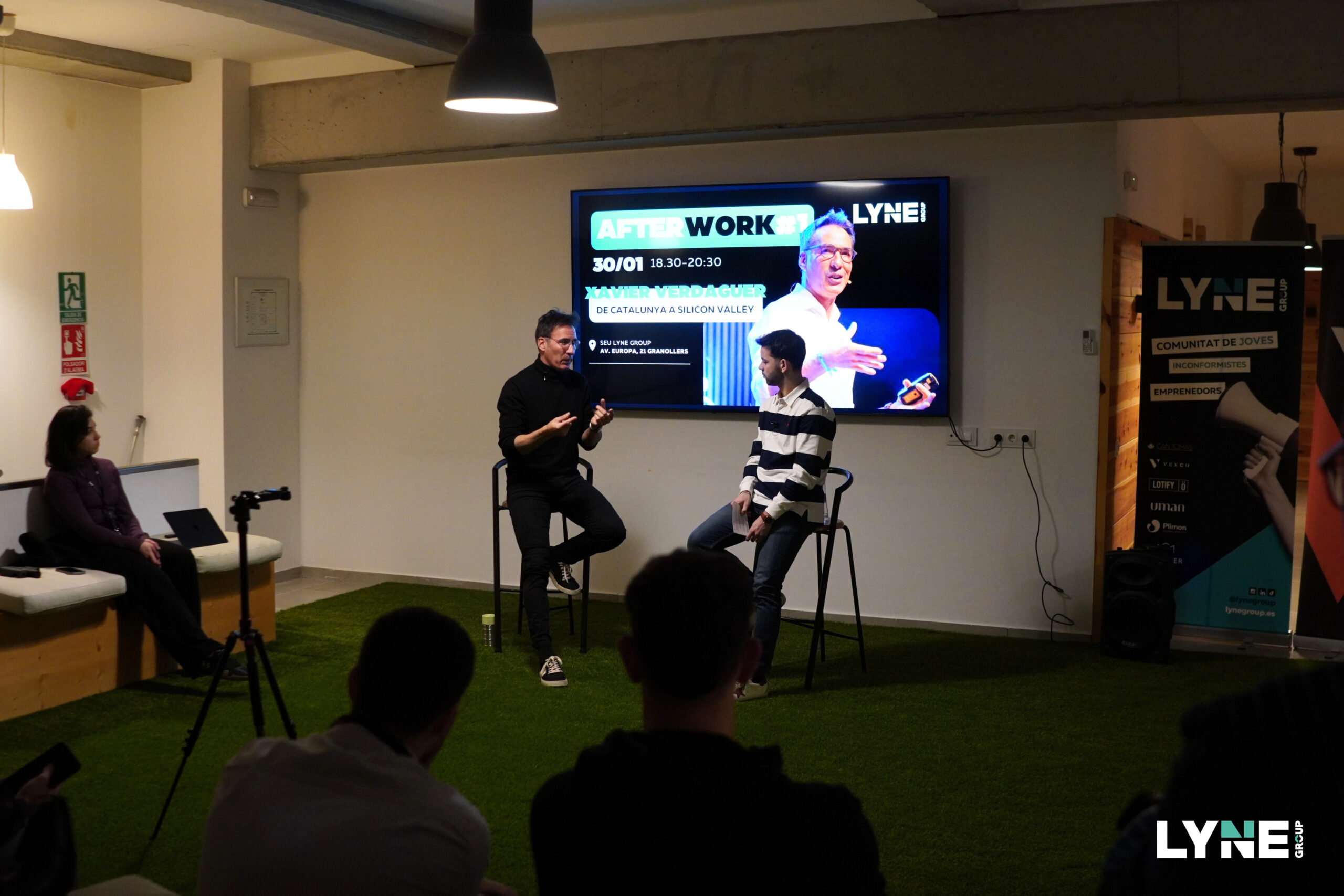
In January 2026, about thirty young people attended a LYNE Group event where Verdaguer discussed his route from Catalonia to Silicon Valley. His advice contained an unusually useful qualification for a founder's talk: a first project is likely to fail. He still considered the attempt valuable because of what participants can learn, and emphasized the need for people who will support them.
By June, Biotopia had won the sixth imaginPlanet Challenge. Its team proposed using marine waste to make structures that support underwater biodiversity. Verdaguer publicly congratulated the team and the other participants. The subject was a long way from multimedia screens or solar bags, but it fitted his growing interest in ventures with a social or environmental purpose.
In 2014, asked to imagine his own future, he had already said that social entrepreneurship attracted him increasingly. He wanted to improve people's happiness through technology. That ambition puts an extra question beside the prototype: who will find their life improved if this works? It is a question a group of students can ask as readily as an experienced founder.
The rain recorder makes a good place to return. Two children had a contraption, a measurable result and the pleasure of discovering that an idea could survive contact with the world. Verdaguer now spends much of his time arranging conditions in which somebody else can have that experience. The parts have changed. The next participant still needs a chance to put them together.
Keep the conversation going
Talks, interviews and places to follow his work.