A startup can rehearse its pitch a hundred times and still learn more from a shopper who walks past. In Las Rozas, northwest of Madrid, the municipal innovation company has taken that observation seriously. It helps young businesses put products in front of people: at sports centers, inside workplaces and among visitors to a shopping outlet. The city supplies something a presentation cannot - somewhere to find out whether an idea is useful.
Las Rozas Innova occupies an unusual position in the business world. It is a municipal company that supports entrepreneurs, connects businesses and investors, manages energy projects and helps the city pursue public funding. Its audience includes founders, established employers, public departments and residents. A successful project might produce a customer introduction. It might also produce a smaller electricity bill.
That breadth can sound suspiciously like a committee's wish list. The interesting part is what happens when it becomes physical: a roof covered in solar panels, a pool assessed for water efficiency, or a founder finding a first group of willing testers. Here, the smart city has an address and opening hours.
A city with room for a prototype
Launched in April 2020, during the pandemic, Las Rozas Innova grew from a municipal effort to support the local economy and develop the city's technological capacity. Mayor José de la Uz is its president; Isabel Pita has led it as director general. This is an institution created by the city, with public responsibilities and a strategy extending to 2030.
“It was born to serve residents and build the city we wanted.”
José de la Uz, president, reflecting on the April 2020 launch. Translated from Spanish.
The Hub opened in February 2022. Its role is to help technology ventures consolidate and grow, with workspace, advice, training and introductions. The company's 2023-24 action plan identified a specific local gap: startups needed somewhere to develop with support and a community, rather than having to take that next stage elsewhere.
For a founder, the offer combines mundane necessities with harder-to-buy access. The Hub advertises fixed desks, hot desks and private offices, with prices starting at €60 a month per workstation. Meeting rooms, event space, reception and shared facilities sit alongside mentoring and investor forums. Workspace is the entry point; the intended value lies in the people and opportunities attached to it.
The community counted 53 startups and service businesses in October 2025. The same month, the Hub widened eligibility to scientific projects coming from universities and technology centers, and introduced more flexible arrangements for rotating employees through desks. Those changes reveal an organization adapting its admission rules and working arrangements as its remit grows.
Different routes have different entry rules. A place in the Hub is not a public contract.
The customer gets a vote
Early Adopters is one of the clearest expressions of the company's approach. Its published offer addresses Hub members with a minimum viable product who need people to try it. Aitaca, which develops technology for body measurements and three-dimensional models, was given space in local sports centers to meet testers and gather metrics. WerGym tested a workplace wellbeing proposition with people from the Hub's business community.
A shopping center provides a different kind of laboratory. Las Rozas Innova and Las Rozas The Style Outlets have collaborated on startup fairs, letting visitors encounter unfamiliar products during an ordinary shopping trip. The 2024 selection included circular fashion from Ecodicta, Solar Lab's solar kits and Aitaca's photo-based ring-sizing tool. There is an appealing lack of ceremony to the experiment: explain the thing before your potential customer loses interest.
The distinction between programs matters. Early Adopters' current published rules explicitly exclude businesses directed at public administrations, smart-city services or municipal services. Those founders should investigate the company's separate innovation and public-sector routes. Corporate introductions are another offering: the Hub describes a Venture Client service that connects companies with startups addressing their problems and accompanies integration.
The practical lesson is to define the buyer before choosing the program. A resident trying an app, a corporate manager considering a supplier and a municipality testing infrastructure represent three different decisions. Access to one does not establish demand from the others.
The roofs are doing some of the work
Las Rozas Innova also operates where the customer is the municipality itself. The council's July 15, 2026 update reported completion of the solar rollout across 30 public buildings, with more than 3,000 photovoltaic panels. Schools, sports facilities and other municipal properties became generating sites, with production and consumption data feeding into the city's technology platform.
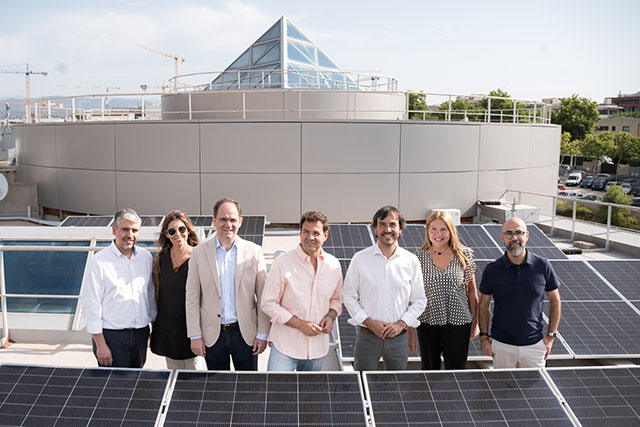
The council reported annual generation of 2.4 gigawatt-hours and an average 30 percent reduction in energy expenditure at the buildings. Those are municipal figures, and the annual generation number should be read as the reported annual production rate, not as a full year of measured output from a system only just completed.
In September 2025, the company put the total planned solar investment at nearly €2 million. Separately, its wider energy-efficiency plan was expected to save close to €2 million in municipal expenditure during 2026. That wider plan includes monitoring and modernization as well as solar. Pairing those numbers to announce a one-year solar payback would muddle two different scopes.
Total planned investment reported in September 2025.
Projected municipal savings for 2026, including measures beyond solar.
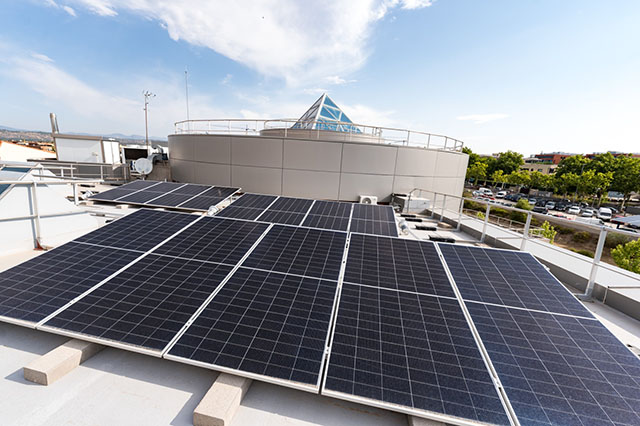
The operating model depends on municipal coordination. The council granted the company access to public roofs, while the work involves infrastructure officials and the city's data systems. That is a meaningful advantage over a standalone business adviser: Las Rozas Innova can help connect local economic development to assets and operational problems already under public management.
A pool report with something left to fix
Not every useful result looks like a finished installation. In 2024, The Fun Lab and Bioscore's Blue Leaf standard was tested at the San José de Las Matas municipal swimming pool. The exercise examined more than 100 environmental, social and governance parameters over roughly six weeks.
The result was a B rating and a 69 percent overall score. Hydraulic performance scored 88 percent, while the general assessment of the facilities reached 51 percent. The published account identifies room for improvement in renewables, rainwater reuse and exterior control software. The municipality received proposals for improvements.
Assessment scores, not percentages of water saved.
That uneven score is worth keeping in the story. A pilot earns its keep when it exposes a weakness precisely enough to act on it. The useful takeaway is the method: specify the site, establish criteria, run the assessment and hand the operator a list of improvements. The certificate is easier to photograph; the list is what can change the building.
Five sessions to untangle official language
The city's experiments also extend to the relationship between residents and public administration. In early 2026, Las Rozas participated in iDEM, a European project developing AI tools to make complex public information easier to understand. Local implementation was led by Fundación Cibervoluntarios and Plena Inclusión Madrid, working with the council and Las Rozas Innova.
Older people, migrants and people with intellectual disabilities took part in five sessions during January and February. They examined municipal documents, tested tools and discussed barriers to understanding. On February 17, participants presented 11 agreed recommendations to the town council.
The recommendations included clearer language, information in multiple languages and human support when completing administrative procedures. That last point is a useful corrective to the temptation to solve every access problem with another interface. Participants were asking for understandable services and help using them. The project says their experience will help refine the technology.
Who pays for the introductions?
Las Rozas Innova's approved 2026 budget was €3.9 million, broadly level with 2025. The announcement described higher spending on activities and projects, lower operating expenses and a reduction of more than 12 percent in the municipal transfer. Its business model combines public support with paid services such as workspace, while particular initiatives involve external programs and partners.
Training illustrates the public-service side. The Hub recorded more than 600 registrations across 14 free sessions in 2025, covering subjects such as financing, international expansion and business administration. Registrations are a measure of participation, not a count of businesses made profitable. The benefit offered is more immediate: access to practical expertise without a course fee.
Specialist partners add depth. In 2025, the Hub hosted Startup Boost with INCIBE and Sherpa Tribe. The final account described nine startups receiving six months of business support and cybersecurity-related development; Vapasec won the Investor Day competition. The free program also provided continuity for several projects that had previously joined the city's Startup Inspire incubation initiative.
The next investor event is already on the calendar. The sixth Las Rozas Innova investment forum is scheduled for October 1, 2026, with applications closing September 13. Its partners include Banco Sabadell's BStartup, BIGBAN Investors Spain and Senda Partners. Selection gets a company in front of investors; investment remains a separate decision.
Bring a testable problem
Las Rozas Innova fits between a startup workspace, an economic-development service and a municipal innovation operator. Founders can compare its offer with independent coworking spaces, university incubators or specialist accelerators. Its distinctive proposition is the possibility of combining support with access to the local business community and real places to test.
That proposition works best when the startup's stage, intended customer and need for local access match an available program. A desk cannot settle whether customers will pay. A successful municipal demonstration cannot establish that another city will buy the same solution. Founders still need a credible product, a suitable test and evidence they can carry into the next sales conversation.
For other cities, the copyable idea is equally concrete: make an inventory of useful sites and willing participants, then connect each experiment to someone who can act on its findings. Las Rozas has put roofs, sports facilities, shopping traffic and public documents to work. The next good idea may need a willing building manager as much as an investor.
Find your way into Las Rozas
Explore the company website, Hub workspace options, Early Adopters and investment forums. Follow developments through its news and blog.