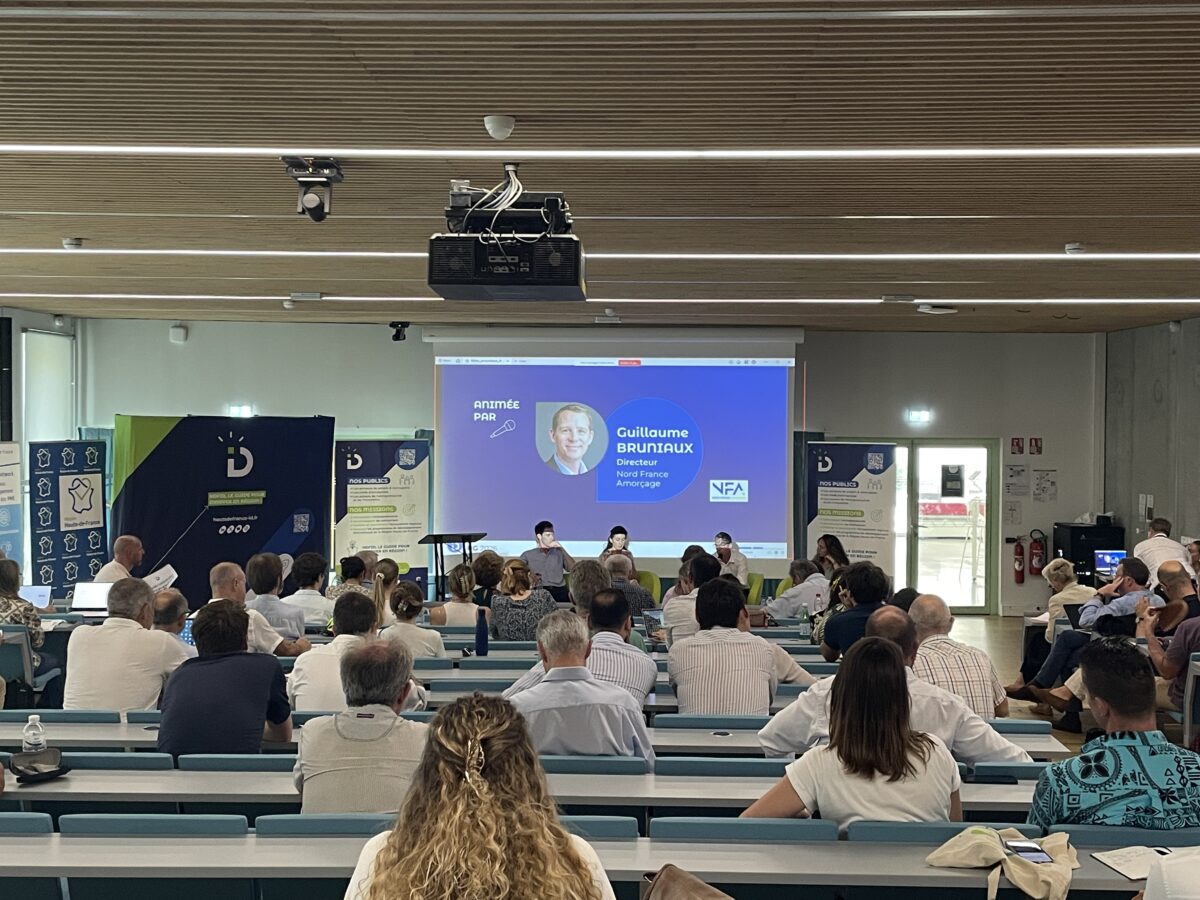
On 24 June 2026, more than a hundred people gathered in Lille for an event about innovation. The discussion quickly reached a less glamorous subject: becoming ready for money. Before investors, the panel argued, came evidence of a market, early results and a team capable of delivering. A funding rejection could mean the timing was wrong. The idea might still have work to do.
- HDFID helps regional businesses turn an innovation problem into a practical project.
- Its tools connect companies with laboratories, finance expertise and international partners.
- Several services are publicly funded, including a financial-support offer valued at €5,000.
The gathering, co-organised with Eurasanté, captures what Hauts-de-France Innovation Développement is trying to become: a place where companies can work out their next move. HDFID reported 138 businesses followed and 217 Enterprise Europe Network support engagements in 2025. Those count different activities. Together, they suggest an agency whose everyday work is the patient business of getting projects into shape.
A region full of doors
Imagine running a small manufacturer with an unfamiliar materials problem. You need laboratory equipment, someone who understands production, and perhaps money to test a new process. Which door comes first? That hypothetical dilemma explains HDFID’s place in the market. Northern France has specialist organisations. A generalist can help a business decide which specialist it actually needs.
Created in 2018 through the merger of the innovation agencies of the former Nord-Pas-de-Calais and Picardie regions, HDFID is a nonprofit association. Its five branches cover Saint-Omer, Lille, Valenciennes, Amiens and Senlis. Prospective founders, established businesses and organisations supporting entrepreneurship can all use it. Confidentiality is part of its published service commitment, including signed undertakings when needed.
Its partners include INPI, the French intellectual-property office, SATT Nord for research transfer, and Nord France Invest. Their roles explain the agency’s generalist brief. A patent question needs different expertise from an investment-location question. HDFID’s value lies partly in recognising the difference before a business spends months pursuing an unsuitable answer.
The search engine with laboratory keys
Plug-In-Labs makes that approach tangible. The free search tool lets a company look for regional scientific capabilities, research equipment and laboratory expertise using keywords and thematic filters. Materials, chemistry and bioeconomy are among the examples. Users can examine a laboratory’s work and contact it directly. It turns the abstract instruction to “collaborate with research” into a searchable task.
HDFID runs the platform with regional research institutions. For a business, the useful trick is to describe the missing capability precisely: a measurement, a test, a piece of equipment. That recommendation follows from how the search works. A company need not arrive knowing a university department’s name; it can start with the problem it needs help investigating.
Ten days, spread over months
The industrial diagnostic gets closer to the factory floor. HDFID describes up to ten days of support across three to five months. Advisers begin with the manager, set the scope, then examine operations with production staff. They look at flows, machine availability and effectiveness, maintenance practices and the way performance is managed. The intended output is a costed improvement plan.
It is a useful antidote to the shopping-list approach to innovation. Buying a machine is easy to describe; understanding why existing equipment is underperforming requires observation. HDFID explicitly calls this diagnostic free and without commercial bias. Its method asks employees to help identify the constraints and build the response, giving the exercise a practical owner inside the business.
Free advice has a funding model
The agency is financed by the Hauts-de-France regional authority and the European Regional Development Fund. Its financial-strategy offer gives the arrangement a price tag: a service valued at €5,000, lasting a maximum of ten days, with 100% public cofinancing. The work includes putting numbers against a project’s needs and improving financial management. The subsidy pays for support; securing project funding remains a separate task.
Association membership has a separate published schedule. An independent or company with fewer than 50 employees pays €150 including tax annually; the 50-to-249 bracket pays €300. Membership brings participation in the network and its exchanges. These fees describe membership, while the service pages explain which advisory activities are publicly covered. A business should read the offer it intends to use.
Beyond the regional address book
For companies looking abroad, HDFID participates in Enterprise Europe Network alongside regional chamber-of-commerce expertise. Its services include partner matching, innovation guidance and advice on European rules and intellectual property. RERI, jointly led with the Region, focuses on research and innovation programmes such as Horizon Europe, helping the professionals who support European projects build their knowledge and connections.
GreenPowerIT adds a route into digital and environmental transition, including artificial intelligence, cybersecurity and connected industry. These relationships put HDFID between a business and a wider supply of expertise. A company can also go directly to a cluster, consultant or research-transfer organisation. HDFID is especially useful when the question crosses several of those boundaries.
The agency changed its own brief
The revealing moment appears in its 2024 annual report. Director general Antoine Macret described ending the management of business-aid schemes to concentrate on more personalised, longer-term support. The document states a strategic choice; it does not establish a failed experiment. The 2026 assembly account continues that direction, emphasising project structuring and referral to appropriate partners.
“un accompagnement de qualité, plus personnalisé et sur le long terme”
Antoine Macret · 2024 annual report
Quality support, more personalised and longer term.
There are limits to what introductions can accomplish. The June financing discussion identified immature projects, mismatched investor expectations and poor timing as obstacles. Useful advice cannot remove the need for customers or convincing evidence. The portable lesson is straightforward: define the uncertainty, find the expertise that can resolve it, then finance the next step. For a regional business facing a crowded support landscape, that sequence is something it can use tomorrow.
Take the next step
Explore HDFID · Search Plug-In-Labs · Read the agency’s news