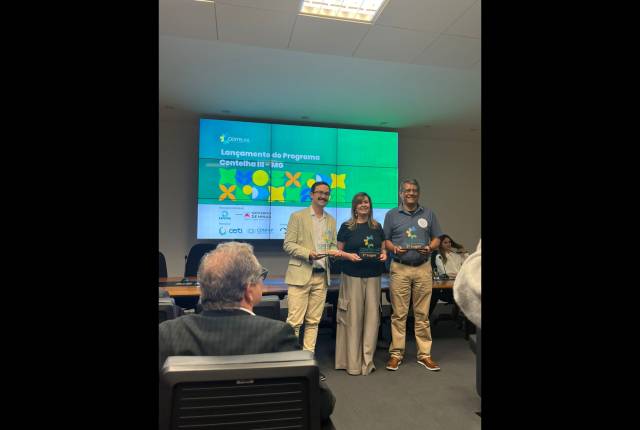
A child sees a needle. The appointment gets harder. In Uberaba, dentist and university professor Maria Angélica Hueb de Menezes Oliveira and fellow dentist Fernando Carlos Hueb de Menezes noticed that familiar problem. Their response was a polymer cover shaped like an alligator. The instrument could look a little less frightening. Eventually, the business behind it, INOPREV, took second place at a Centelha Demoday.
It is an unusually concrete introduction to innovation policy. No flying cars. A small animal, a nervous patient and a clinical problem somebody had bothered to observe. Programa Centelha occupies the space between that observation and the work of building a business around it.
- Individuals can enter with an innovative idea before forming a company.
- State calls combine grants, technical scholarships and business training.
- Edition three plans R$155 million and targets more than 1,100 initiatives.
The door opens before incorporation
The timing is the point. A researcher may understand a technology without knowing who would buy it. An inventor may recognize a problem without having the money to develop a prototype. Centelha lets an individual start the application before obtaining a CNPJ, Brazil’s business registration number. Approved applicants must establish an eligible business before receiving the money.
That sequence lowers an entry barrier while preserving a demanding next step. Existing businesses can qualify too, within the age and size limits of the relevant call. The intended users include students, researchers, independent inventors and young enterprises. The programme’s place in the market is the beginning of the journey, when evidence and resources are both thin.
Created in 2018, Centelha is a public programme. Its institutional origins matter more than a founder legend: the Ministry of Science, Technology and Innovation coordinates it nationally, with Finep, CNPq, CONFAP and Fundação CERTI playing distinct roles. CERTI’s methodology drew on its earlier Sinapse da Inovação experience. The operating expertise includes organizing selection and supporting the institutions that deliver it.
National money, local doors
Consider the machinery. Finep selects state partners and channels economic subsidies. CNPq supports technical talent through scholarships. CERTI supplies methodology, tools and implementation support. CONFAP connects the state research foundations. Those state institutions turn the national design into calls, timetables, selection and contracting. Cooperation is built into the operating structure.
For an applicant, the practical consequence is wonderfully unglamorous: choose your state and read its edital, the official call. Amounts and schedules differ. A national announcement does not create one national deadline. This distributed design gives regional institutions room to work with local conditions, while retaining a common programme framework.
What the spark costs
The first edition, covering 2019-2021, reported R$40.1 million invested and 498 businesses supported across 19 federative units. The second reported R$97 million and 1,142 supported businesses across 26. Edition three, launched in 2025, brings participation from all 26 states and the Federal District, with R$155 million planned. A budget commitment and money already spent are different measures.
The participant’s arithmetic lives in the state call. Paraná’s 2026 edital offers up to R$96,000 in economic subsidy and up to R$50,000 in CNPq scholarships per project. It requires a financial counterpart of at least 5% of the contracted subsidy. At the maximum subsidy, that is R$4,800. Scholarships are a separate instrument, rather than an interchangeable pot of company cash.
Centelha’s model is public development finance. The subsidy is non-repayable, subject to its rules. Unlike a conventional equity investment, this instrument does not price a stake in a startup. Incubators, private accelerators, university support and other grants may offer alternatives or complementary help. Centelha’s particular combination is very early entry, public funding and state delivery.
The homework comes with the money
Money addresses the development bill. Training addresses a different difficulty: explaining why the development should happen. Centelha’s first-phase curriculum covers the problem, market opportunity, target customer, innovative difference and team. The second moves toward revenue models, a minimum viable product, technological maturity, execution schedules and budgets. Those subjects make a useful checklist even for someone who never wins a grant.
“O Centelha foi muito mais do que apoio financeiro.”INOPREV, in a testimonial published by Centelha
“Centelha was much more than financial support.”
The selection is real. On 19 October 2026, Fundação Araucária announced 200 first-phase selections in Paraná, from 1,221 ideas submitted by 2,920 entrepreneurs across 110 municipalities. Roughly one idea in six advanced. That is a first-stage selection ratio, not a business survival rate or the proportion ultimately funded. The distinction keeps an encouraging number honest.
Nor does non-repayable mean effortless. Applicants need time to prepare, comply with the call and execute the project. A mature company outside the eligibility window needs another route. An eligible team unable to meet counterpart requirements faces a different obstacle. And a successful application cannot establish that customers will pay. That still requires evidence from the market.
The question now includes consequences
Edition three also adds a more explicit impact lens. Centelha de Impacto brings social and environmental effects into idea evaluation and training. ICE helped refine assessment criteria and prepare participants and delivery teams. Through that partnership, Instituto Sabin licensed its TransformAção training pathway. This is an addition within Centelha, rather than a separate accelerator.
The practical lesson is a sequence readers can borrow: observe a specific problem, identify the people who experience it, explain the proposed difference, plan a test and cost the work. Then examine the consequences of the solution. The alligator-shaped cover makes that sequence easy to picture. Before there was a business pitch, there was a child looking at a needle.
Follow the spark
Explore the official website and state calls, the training library and Centelha de Impacto. Read Uniube’s INOPREV story or watch the Centelha 3 introduction. Follow updates on LinkedIn, Instagram and YouTube.