At InovAtiva, there is a rehearsal before the investor pitch. Its name, Demolation, sounds like something that happens to an unlucky building. In practice, mentors take the investors’ seats and entrepreneurs test their arguments before the meeting that counts. A weak answer can be repaired. A customer assumption can be challenged. The business gets a chance to improve before the applause begins.
That small detail explains a good deal about this Brazilian startup support network. InovAtiva offers training, business mentoring and introductions to people who might invest, buy or collaborate. Participation in its national acceleration programs is free and requires no equity. The entrepreneur keeps ownership; the program supplies a structured opportunity to become more convincing.
The distinction matters because an introduction is only the beginning of a sale. InovAtiva can put a founder in front of an experienced listener. The founder must still explain why a buyer should change a working routine, trust a young supplier or spend money now. Its most useful output may be a sharper question.
2025 national acceleration terms.
Travel and personal expenses are extra.
01A public project with a private-sector address book
InovAtiva began in 2013 through Brazil’s development ministry and Endeavor. McKinsey helped design the project pro bono. The initial problem was a mismatch: investors were interested in young companies, but entrepreneurs needed more business preparation to have useful conversations with them.
The first physical pilot exposed the next constraint. Reaching an entire country required a different delivery system. In 2014, the team worked with Everwise on remote mentoring, combining online learning and individual sessions with in-person events. CERTI took on execution in 2015; Sebrae became a co-organizer in 2016. That same year brought the pilot for social and environmental impact businesses.
Today, the institutional arrangement explains the economics. MDIC, Brazil’s Ministry of Development, Industry, Commerce and Services, and Sebrae organize the initiative; Fundação CERTI supplies execution, with Impact Hub involved in delivery. This is publicly supported entrepreneurship infrastructure, financed and organized through partners, rather than a conventional accelerator built around buying stakes in its graduates.
Its beneficiaries are founders. Its other essential audience consists of mentors, investors, established businesses and regional organizations that want to meet them. The network creates value when those groups have something useful to exchange. A contact list alone would be a rather thin product.
02Free admission. Bring your own time.
The fee is unusually easy to explain: zero. The 2025 rules explicitly prohibited organizers, mentors and volunteers from demanding financial or other compensation for program services. They also drew a clear line around expenses. Travel, accommodation, internet access, data plans and outside advisers remained the participant’s responsibility.
That is a meaningful distinction for a founder watching cash. A free program with a required physical event still needs a travel budget. InovAtiva Experience was mandatory for the 2025 cohort. Entrepreneurs also had to make room for preparation, mentoring and their business alongside it. Nobody can attend the meetings on behalf of an unattended customer pipeline.
The offering sits between business education and market access. Unlike a standalone online course, it includes personal feedback and encounters with potential commercial partners. Unlike an investment offer, acceptance does not itself establish a financing deal. For founders comparing programs, the sensible question is what they need next: expert scrutiny, a sector-specific buyer, sustained operational support or actual cash.
Those needs can lead to different doors. Sebrae and Bossa Invest’s separate INOVA Startups program combines investment with acceleration. Tecnopuc Garage offers business-model development and practical validation. Their names and vocabulary overlap with InovAtiva’s, but the underlying transactions differ. Applicants should compare the specific call, the services and the commitments, rather than collect accelerator badges.
03The pitch is the exam, not the syllabus
The 2025 InovAtiva Brasil journey began with assessment and planning involving a lead mentor. It included a maturity diagnosis, individual and specialist mentoring, Academy training, valuation work and revised pitches. Demolation and the final Demoday gave that work a deadline and an audience.
There is useful discipline in that sequence. A founder must make an argument, hear objections, revisit the evidence and try again. The practical benefit depends on the quality of the question brought into a session. “Help us grow” offers little to examine. A specific uncertainty about pricing, a sales conversation or a customer’s purchasing process gives a mentor something to work with.
An August 2025 industrial transformation workshop made the commercial lesson explicit. Specialists Tatiana Pieper, Marinaldo Gomes and Luciana Dotta discussed approaching industrial customers. Their advice included translating technical language into operational benefits, understanding the people who influence procurement and building a reputation through smaller industrial clients. They also pointed to established suppliers and integrators as possible routes into larger companies.
This is where the coaching becomes more interesting than a motivational talk. A factory may care more about implementation risk than technical novelty. An engineer who likes a demonstration may not control the budget. A product can be impressive and still create too much disruption for the buyer. Learning those differences can change the sales approach before another month disappears into unanswered proposals.
- 01DiagnoseFind the business gap.
- 02ChallengeWork with a mentor.
- 03RehearseTest the pitch.
- 04ConnectMeet potential partners.
04What would the customer have to give up?
In an October 2025 reflection, InovAtiva mentor Lawton Benatti recalled a question from fellow mentor André Ferreira during a Demolation session. Translated from Portuguese: “For the market to buy your startup’s solution, what does it have to get rid of?”
Benatti wrote that it made him rethink a great deal. An incumbent supplier, a familiar process or an established habit might stand between a startup and a sale. That is a more demanding test than asking whether somebody likes the product. It forces the entrepreneur to consider the customer’s cost of switching.
His broader advice was similarly practical: talk to potential customers, validate demand early and turn occasional contacts into continuing relationships. The transferable exercise is straightforward. Before the next pitch, write down what a buyer must replace, who must approve the replacement and what evidence would make the change worthwhile. Take the unanswered parts into the next customer conversation.
There is also a condition attached. If a team treats mentoring as a substitute for those conversations, it can improve its presentation without improving its business. The program’s tools are most useful when feedback changes an experiment, an offer or a decision. A beautifully rehearsed claim remains a claim.
A product can be impressive and still create too much disruption for the buyer.
05A room full of businesses, not one kind of startup
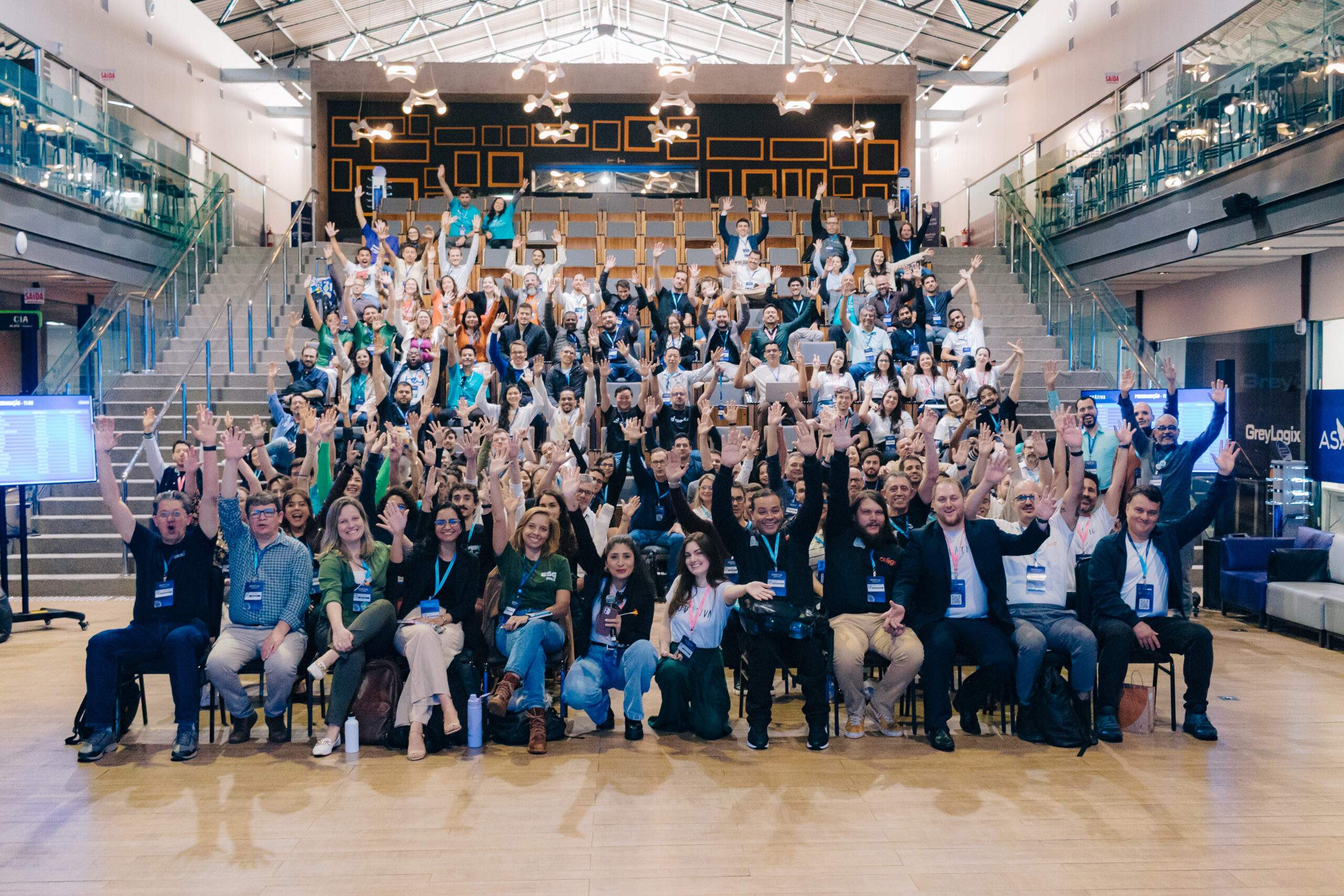
At the 2025 Experience in Florianópolis, the range of businesses was visible in the Demoday distinctions. ESGpec worked on digital sustainability tools for livestock production. Preço da Obra addressed construction estimates. Libra.se translated audiovisual content into Brazilian Sign Language. The common need was commercial development, even when the products and buyers looked very different.
More than 200 people attended the August 30-31 event, according to the program’s account. InovAtiva also reported having supported more than 4,500 startups across 18 editions, with a network of more than 1,000 volunteer mentors and evaluators. Those figures describe accumulated activity and reach. They should not be read as a count of profitable companies or completed investment rounds.
One participant offers a narrower, useful confirmation. Acelera Dados publicly announced its certification as an accelerated startup in the 2025 cycle, describing its business as turning data into commercial intelligence. That establishes participation. The more demanding questions about customer retention, profitability and how much the program contributed belong to subsequent business performance.
CERTI’s 2024 annual report described support reaching more than 620 startups and 236 municipalities through acceleration, training, events and regional connections. It also recorded recognition from Top Open Startups and Startup Awards. The breadth is part of InovAtiva’s appeal, but the mixed activities matter: attending an event and completing acceleration are different experiences.
06The national network is getting more specific
The broad invitation in older descriptions needs a date attached. In 2025, InovAtiva Brasil advertised up to 90 places and an emphasis on industrial digital transformation under the Nova Indústria Brasil policy. The social and environmental impact program offered up to 30. These were the stated capacities for that cycle, not a permanent intake promise.
In 2026, the impact program took a territorial approach. Its announced selection covered 72 ventures in six states: Alagoas, Ceará, Espírito Santo, Pará, Pernambuco and Rio Grande do Norte. Priorities reflected local productive sectors, from the açaí chain in Pará to recycling and circular economy in Espírito Santo. The stated aim was closer integration with regional industry and institutions.
Local delivery also has an established route through Powered by InovAtiva. Goiás’s government reported 67 applicants and 25 selected businesses in the 2024 second edition of AceleraGO. This gives regional organizations a way to apply acceleration support close to their own entrepreneurs. The national brand supplies a shared framework; the local partner supplies context and relationships.
For an applicant, geography and sector therefore belong near the top of the checklist. A national mission does not mean every call accepts every Brazilian startup. The website itself announced a temporary suspension from July 4 to October 25, 2026, during the election period. Someone planning a future application should use the dated program announcement, rather than assume an older cycle is still open.
across six states
Territorial eligibility for this intake, within a national support network.
07A network is only as available as its people
Volunteer expertise helps explain how InovAtiva can offer personal assistance without charging founders. It also creates dependencies. A government monitoring report recorded that a planned intellectual-property course for the Academy was canceled after a volunteer specialist withdrew and future cycles remained uncertain. Two related awareness workshops nevertheless took place through Powered by InovAtiva.
That is a concrete operational limit, rather than a grand verdict on acceleration. A promised resource needs somebody to deliver it. Regional partners need time and coordination. Founders need enough capacity to use what is offered. The model works through those commitments, and their availability shapes the experience.
The lesson worth copying is the sequence: find the business question, bring in somebody qualified to challenge it, rehearse the explanation and return to the market with a better test. InovAtiva has built a public-private structure around that process. The attractive price gets a founder’s attention. What happens after the difficult question determines whether the time was well spent.
Keep the conversation going
Explore the programs, meet the community or watch a longer conversation about innovation networks.