The desks come without an equity bill. At Andalucía Open Future, technology founders can get workspace, specialist advice and introductions while keeping their shares. It is an appealing opening offer. The harder part starts when someone asks who will buy the product, what they will pay and whether the team can actually deliver it.
That is the business of this Andalusian initiative: helping young technology companies become businesses with customers. Established by the Junta de Andalucía and Telefónica in 2014, it operates El Cubo in Seville, La Farola in Málaga, El Cable in Almería and El Patio in Córdoba. The names have personality. The work is familiar to anyone who has tried to turn a promising prototype into a reliable income.
Its May 2026 announcements make the mission tangible. Four hubs selected 25 ventures between them. Some are working on cybersecurity and artificial intelligence; others address industrial energy, hospitality or professional services. The common thread is a technology business that needs help reaching a market.
Founders retain ownership. Participation requires commitment.
A regional answer to the relocation question
Open Future began in Andalucía with a public-private agreement announced in January 2014. Telefónica described the region as the first Spanish territory where it was launching the model. El Cubo followed that year. The ambition extended beyond an office: connect entrepreneurship, research and corporate experience closely enough that a young company could develop locally.
By December 2014, ten Andalusian public universities had joined. Their promised contributions included laboratories, research equipment, expert advice and access to patents. That matters because a technical discovery and a marketable company are separated by practical questions. Who owns the invention? Which customer has the problem? What can the team demonstrate?
In an early interview, El Cubo codirector Juan Jesús Velasco described the pressure on ambitious founders to leave for Madrid, Valencia or Barcelona. His case for the program was geographic as well as commercial: make it possible to establish the company and its working base in Andalucía. The present four-city network gives that argument physical addresses.
The free desk comes with company
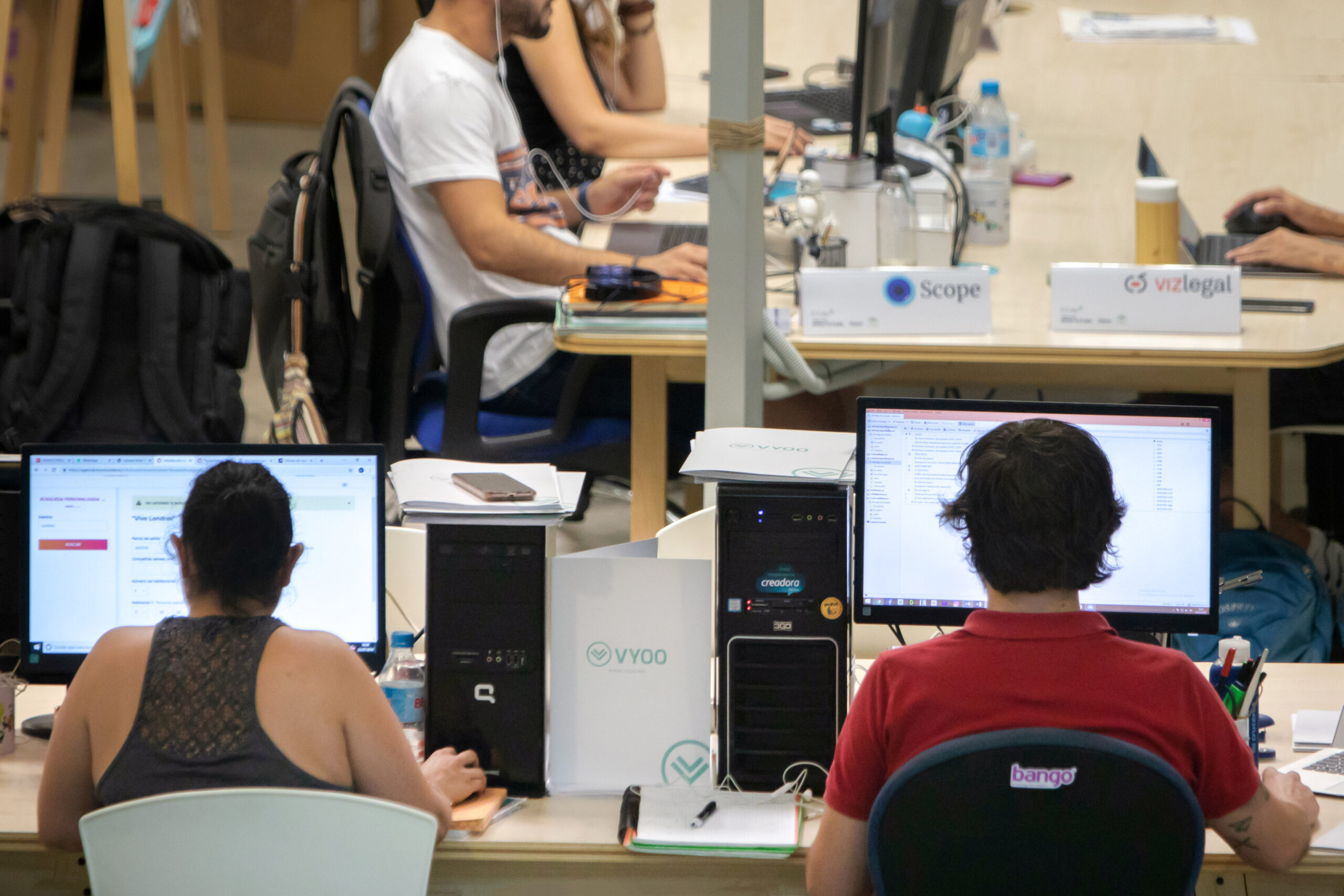
AOF’s published program offers more than 80 mentors, a tailored work plan, continuing training and support with visibility. Founders can work alongside other teams and draw on specialists as their priorities change. Early on, the problem might be defining a customer. Later, it might be pricing, cash management or the mechanics of selling abroad.
The regional and corporate partnership gives the offer its particular shape. The Junta brings connections to public support; Telefónica brings technical and commercial relationships. Promálaga, Almería’s city council and Córdoba’s IMDEEC participate locally, while PCT Cartuja appears among the initiative’s supporting partners. It is a network assembled around operating companies and public institutions.
For a participant, the useful distinction from renting a coworking desk is the organized business development around it. The program describes access to investors and public financing tools, as well as media and networking opportunities. An introduction opens a conversation; the startup still needs a proposition worth buying or financing.
The wider market includes private accelerators and more specialized public programs. Andalucía’s MISIÓN initiative, for example, organizes support around fields including agrotech, games, port logistics and mobility. AOF’s four hubs offer a broader technology route. A founder choosing between them should start with the help the business needs next and the people qualified to provide it.
Free to join is a price, not a budget
The program’s economics are unusually straightforward from the founder’s side: free acceleration, with no ownership stake taken. Telefónica’s February 2025 announcement also states that the entrepreneur retains the product’s intellectual property. The participating business remains the founder’s responsibility, including the job of finding enough money to keep operating.
The institutions have their own bill. In December 2014, Telefónica described an €8.9 million commitment for the broader Andalucía Open Future agreement covering 2014-2016. That agreement included several activities, such as entrepreneurship centers, internationalization and university initiatives. The number belongs to that historical package; it should not be read as today’s annual accelerator budget.
Founders also pay in time and presence. The 2025 participation terms call for a team of at least three, with two full-time decision-makers, and ordinarily make the chosen hub the team’s workplace. A semi-presential arrangement can be requested. Participants cover their own travel and accommodation. Those conditions make location and team readiness practical questions before applying.
Four months to put the business to work
The May 2026 intake notices describe an initial four-month process, extendable by another four. Their promise is personalized support: mentors from different business disciplines, a place to work with peers and help approaching finance. The calendar gives the work a boundary. A team has to decide what meaningful progress should look like inside it.
The 2025 rules also describe three stages: Ready, Steady and Go. Ready addresses an unfinished minimum viable product; Steady concentrates on commercial launch and customer fit. Go supports consolidation, potentially through a longer residence. Advancement is evaluated. The broader rules and the shorter intake announcements make it sensible to confirm the actual pathway with the chosen hub.
Test assumptions and complete the first usable product.
Work on launch, pricing and commercial validation.
Strengthen sales, the organization and its financing.
The commercial emphasis runs through the mentoring. In a published essay, HostAndBoat founder and AOF mentor Silvina Reyes sets out three areas she works on: product and value proposition, business model and monetization, and sales execution. Her experience comes from travel technology, where connecting boat holidays to travel agencies means dealing with fragmented inventory and entrenched manual processes.
That is a useful reminder of who acceleration serves. A technically capable founder may know how to build a tool while needing help deciding how to package and sell it. Reyes’s account puts margins, repeat business and commercial discipline alongside product development. A polished demonstration is only one piece of a functioning company.
The graduate who came back to advise
José Antonio Jiménez Lama offers a specific example of the program’s longer relationships. He founded Eurasmus, a student accommodation, mobility and employment platform, in 2014. It entered AOF’s first cohort at El Cubo. In the program’s later account, he described learning from fellow founders and mentors and becoming more willing to compete internationally.
He also reported a business-model pivot that produced two related companies, together employing more than 30 people in Andalucía and operating in several European countries at the time of the interview. This is a historical founder account, rather than a present-day headcount. It shows a company’s direction changing after entry, without pretending that joining an accelerator makes every original plan work.

Jiménez Lama became a marketing and growth mentor in 2017. His route illustrates how experience can stay in the building after a cohort leaves it. Velasco’s interview describes the everyday settings that make those relationships possible: shared meals, peer reviews and conversations between neighboring teams. It also describes exit meetings and follow-up plans intended to keep graduates connected.
“Uno de los pilares clave de AOF son las personas.”
Juan Jesús Velasco, historical El Cubo interview
“One of AOF’s key pillars is its people.” Translation.
The next cohort has very specific problems
The May 19, 2026 announcements are a useful antidote to vague talk about innovation. At El Cable, HoreKit is developing software for hospitality management; AutomaProX works on business automation. Dental Brain focuses on clinical AI for dentistry, while ServiR Migrantes addresses immigration administration. These are recognizable workflows with identifiable users.
El Cubo’s six selections include SANILOGICS, working on urgent healthcare deliveries, and MASS, a software platform for photovoltaic maintenance. FoodGuard addresses manipulated delivery-claim images. SOLEAHEAT works on industrial thermal energy. Their presence illustrates how widely the program interprets technology entrepreneurship, across software and physical industrial applications.
One intake. Four front doors.
25 selections announced on May 19. Counts describe this intake, not hub capacity or investment outcomes.
La Farola selected ten ventures, including FRUTT.AI for the fruit-and-vegetable import chain and OnionSentry for cybersecurity. Bioentotech proposes using black soldier flies to turn agroindustrial byproducts into valuable products. An accelerator cohort can contain both dark-web monitoring and insects. That breadth is a better description of the place than a single fashionable industry label.
El Patio added five businesses, including industrial-process platform NEXT-USTRIAL and Aterriza en Córdoba, which helps international professionals settle in the city. The latter’s services include housing searches and essential administrative tasks. Read together, the four lists show founders addressing the everyday complications of running companies, moving people and maintaining infrastructure.
Copy the discipline, then do the work
There is a method here that a founder can borrow before gaining admission. AOF mentor Miguel Macías describes innovation as disciplined experimentation: understand the opportunity, define the idea and validate the model. His point is to expose imperfections early, while changes remain possible. The first thing tested should be an assumption about the business, before a team spends heavily defending it.
For a founder, that suggests a concrete routine: state the customer problem, build a test that could disprove the proposed answer, and set a date to review the result. This is an interpretation of the mentoring approach, not a claim that every AOF company follows an identical checklist. The point is to make evidence capable of changing the plan.
The program fits teams prepared to work on a technology business in Andalucía and participate actively. Someone seeking a passive office arrangement, an automatic investment or a fully remote experience should look closely at the terms. For a committed team, the offer is practical: a place to work, experienced people to consult and a commercial problem to solve before the next review.