A founder can walk into National Incubation Center Karachi with an idea and, if selected, spend a year developing it without handing the incubator a slice of the company. That is an unusually concrete opening offer in a business full of promises. The harder part comes later: finding customers who care enough to pay.
At NED University, NIC Karachi puts workspace, mentoring and introductions within reach of young businesses. Public money pays for the incubation initiative; private partners help run it. The arrangement removes some early expenses and gives founders people to ask before a small mistake becomes an expensive habit. It cannot make a customer want the product.
Its evolution now turns on that distinction. A structured accelerator, introduced with Orbit in 2025, adds a shorter, more selective route for businesses ready to grow. The proposition moves from helping someone start to helping a working business make its next commercial step.
Thirty-seven places. More than 400 hopefuls.
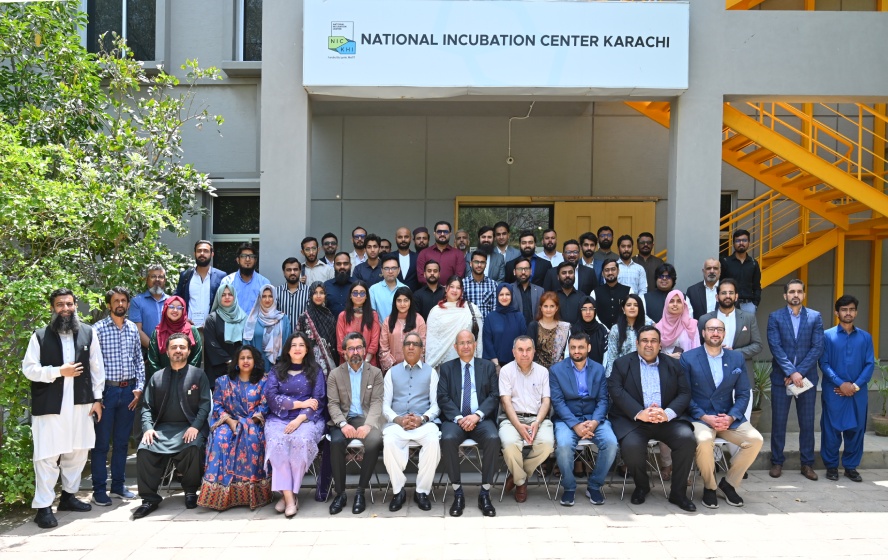
The admissions figures bring the offer down to earth. In October 2024, NIC Karachi welcomed 37 startups into Cohort 12 after receiving more than 400 applications and hearing 112 pitches. Fewer than one in ten applicants made it through. Free does not mean a walk-in desk with a complimentary investor attached. The center’s announcement records the funnel.
The funnel before the first workshop
Bars use 400 as the application baseline. Actual admission share was below 9.25%.
That selection stage is part of the service. Founders have to explain the problem, the proposed business and why their team belongs in the room. The resulting cohort gives participants peers facing comparable decisions. A useful conversation can happen between scheduled sessions, when another founder has just encountered the same pricing problem or baffling customer response.
Government reporting later counted 30 graduates from that cohort in September 2025. Admission and graduation measure different things. Those two numbers alone do not establish how many companies failed, or why anyone did not graduate. Treating the gap as a startup mortality rate would turn a program record into a claim it cannot support.
The bill goes somewhere else
NIC Karachi opened in May 2018. LMKT’s launch record describes a collaboration involving NED University, HBL, PTCL, PPAF, Founder Institute and i2i. The origin is institutional: a public initiative assembled with operating and ecosystem partners, rather than the familiar tale of two founders and a garage. LMKT’s archive dates the formal launch to May 11.
In August 2024, Ignite awarded a new five-year Karachi operating project to a consortium led by Lucky Landmark, part of Yunus Brothers Group, with LMKT and Orbit Startups. The composition matters. A technology operator, an industrial group and an international acceleration partner bring different kinds of experience to the same building. Their usefulness depends on how much of that experience reaches an individual startup.
The economic bargain is straightforward. Ignite funds the initiative under the Ministry of IT and Telecom; founders receive incubation without tuition or an equity charge. September 2025 government reporting describes free incubation alongside mentoring, investor access and legal and financial advice. The subsidy buys support before a business can comfortably purchase it itself.
It also creates a distinction worth keeping: NIC Karachi’s finances and its startups’ finances are separate. When a portfolio company raises money or sells a service, that sum is not automatically revenue for the incubator. Publicly supported entrepreneurship needs careful accounting precisely because the headline numbers can become so inviting.
First a year. Then a different three months.
The main incubation program runs for 12 months. Its published sequence moves through orientation, business-model validation, product development, training, market entry and investor preparation. The practical question changes along the way: what problem is worth solving, how should the product work, and what would persuade someone to buy it? NIC Karachi’s FAQ sets out those stages.
For a founder, the useful habit to copy is sequencing. Test the business assumption before polishing the presentation. Bring a specific customer objection to a mentor. Return with the result of the experiment. These are editorial lessons suggested by the program’s design, not a promise that every participant follows the same path or reaches the same destination.
The separate accelerator compresses its work into three months. Its published design targets ten technology startups a year, five per batch. Applicants need a working minimum viable product and early traction. The support includes market validation, company structuring, strategy and preparation for investors. This is a program for something already moving.
Up to this amount per startup.
Disbursed against milestones.
The grant wording deserves its own pause. NIC Karachi’s acceleration page offers up to PKR 5 million, released against key milestones. It is not a universal payment to every incubated founder. Nor should the maximum award be mistaken for cash already disbursed. For an applicant, the milestone agreement is where the attractive headline becomes an operating plan.
That design gives the 2024 partnership change a visible consequence. Orbit brings international mentoring and investor connections into a structured growth program. The documented shift supports a modest interpretation: NIC Karachi expanded its offer for companies beyond the earliest stage. It does not require a dramatic story about the old model collapsing.
Invoices, classrooms and a pile of compost
The businesses on the investor stage are a better guide to NIC Karachi’s range than a long list of fashionable sectors. At the September 2025 Orbit Demo Day in Karachi, participants included Blinq, working on invoicing and reconciliation; Chaajao, offering online learning; and Mergn, providing customer-retention software. TrashIt brought organic-waste composting into the mix.
The lineup also included STEMverse’s robotics and AI learning activities, and Apaale’s shipper-and-trucker marketplace. Business Recorder’s account described an event bringing startups before investors and industry leaders, including participants from both Karachi and Peshawar. A place on that stage records an opportunity to pitch, not proof of a completed investment.
More recent cohort material adds specificity. NIC Karachi’s November 2025 newsletter describes Stellisys building software that brings sales, finance, HR, inventory and procurement together for smaller businesses. It also features SOCByte’s security-operations platform. Those examples connect the center’s enterprise and cybersecurity interests to recognizable work: keeping business records together and making security teams’ jobs manageable.
The incubator’s users are the founders. Their eventual customers may be schools, finance teams, retailers, farms or logistics businesses. That two-step relationship explains why commercial access matters so much. A mentor can improve the proposition; somebody outside the program still has to choose it.
The sofa is useful. So is the lawyer.
The physical setup is pleasantly literal. NIC Karachi lists meeting rooms, training spaces, an auditorium and a soundproof pod for one person. Shared infrastructure lets a small team hold a serious meeting without building an office around it. The campus also advertises backup electricity and specialist spaces for fintech, industrial automation and media work.
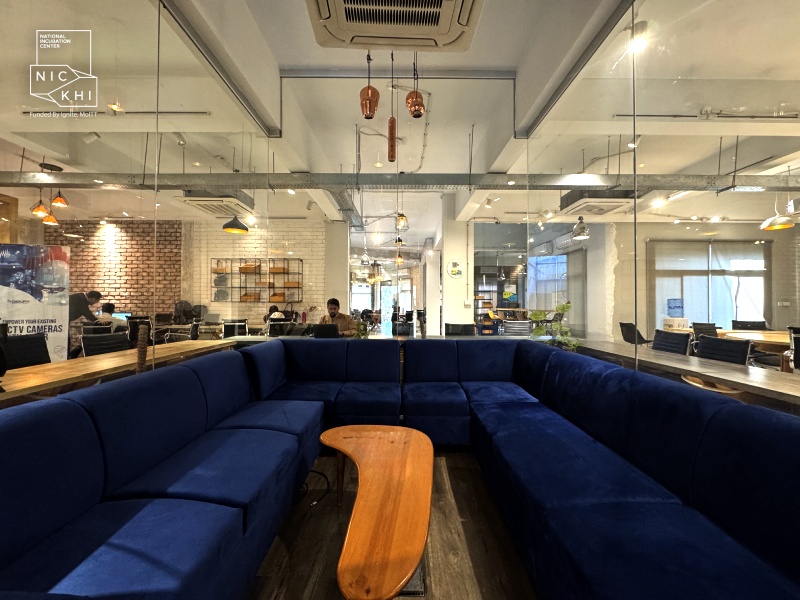
There are less photogenic resources, too. The management roster includes an investment consultant and a legal specialist, alongside operations, outreach and growth roles. This is relevant expertise for founders confronting company finances, contracts and the practicalities of building an organization. Good advice can be valuable long before a startup produces a photogenic demo.
“NIC has proved to be a very open environment”
Muzafar Manghi, Farmdar / testimonial published by NIC Karachi
The setting has a few eccentricities worth enjoying. Its urban forest page catalogs trees including neem, banyan, moringa and guava. A one-person pod and a tree list will not determine a startup’s fate, but they make the place easier to picture than the customary language about innovation. Founders need somewhere to spend the unglamorous hours between announcements.
What the big numbers actually count
At the 2024 contract renewal, Ignite reported 299 startups supported, PKR 9.1 billion in investment raised and PKR 8.7 billion in revenue generated by startups. These are reported portfolio totals. They indicate accumulated activity, while leaving open the separate question of how much any particular company benefited from incubation. Ignite’s dated newsletter anchors the figures.
For someone considering an application, aggregate money is less actionable than a relevant introduction. A founder should be able to connect the program’s resources to a current business task: testing an industrial product, organizing financial information or meeting a potential buyer. That is a more useful decision rule than choosing an incubator because its cumulative funding figure looks impressive.
There are alternatives. Karachi’s Katalyst Labs also offers acceleration, mentoring and founder networks, with an emphasis on businesses seeking growth. NIC Karachi’s distinctive combination is public funding, a university location, operating partners and a route spanning incubation and selective acceleration. The choice should follow the business’s stage and the support it can actually use. Katalyst’s program overview offers a comparison point.
The founder still has to leave the building
The limits follow from the offer. A team without a working product or early traction is poorly matched to the accelerator’s stated criteria. A business seeking an automatic cash payment would misunderstand the grant. A founder who needs only a quiet desk may place less value on a year of structured participation than one actively testing a new business.
NIC Karachi has continued recruiting. April 2026 reporting recorded 36 arrivals in Cohort 15, following more than 500 applications. Its official LinkedIn feed subsequently advertised Acceleration Cohort 4, with an extended September 15, 2026 deadline. The different intakes underline the need to choose the right program rather than treating every announcement as the same opportunity.
For an interested founder, the next move is practical: read the current application terms, identify the business problem that needs help and prepare evidence of progress. An incubator can provide rooms, expertise and introductions. The most useful thing to carry out of those rooms is a clearer answer to why a customer should pay.
Step inside the network
Visit NIC Karachi · Explore the programs · Newsroom · Application FAQs
LinkedIn · X · Instagram · Facebook · YouTube sessions