J. A. Barbhuiya’s problem was stubbornly physical. In a public account of building a startup in Silchar, Assam, he recalled having “not a single FabLab” locally for manufacturing custom parts. He described support from KIIT-Technology Business Incubator, beginning with NIDHI-PRAYAS and continuing through other programs. Eventually, his team set up a small fabrication lab of its own. Here was an entrepreneurial obstacle that better slides could hardly fix: somebody needed to make the parts.
- Shared labs and fabrication tools help founders build before buying their own infrastructure.
- Different programs address prototypes, early capital and customer pilots.
- Funding is selective. Facilities and equity terms depend on the agreement.
That account offers a useful way into KIIT-TBI. The nonprofit company, established at KIIT University in 2009 with government support, occupies a particular place in India’s startup economy. It helps people whose ideas require equipment, specialist advice and time to become something another person can use. Its regional focus is eastern and northeastern India. Its raw material includes research that still has a considerable distance to travel.
The expensive part comes before the pitch
Consider the difference between describing a diagnostic device and developing one. A description fits in a paragraph. Development might require cell culture, analytical testing, a fabricated enclosure and advice about intellectual property. KIIT-TBI lists those sorts of resources across its laboratories and incubation services. Sharing them changes the size of the commitment a young company must make before it learns whether an approach is useful.
The scientific background matters. Mrutyunjay Suar, the incubator’s establishing leader and CEO, trained in molecular microbiology and undertook postdoctoral research at ETH Zurich. He returned to India and established KIIT’s School of Biotechnology in 2007. His institutional biography connects that academic work with the subsequent creation of KIIT-TBI. The route from research to enterprise is embedded in the organization’s origin.
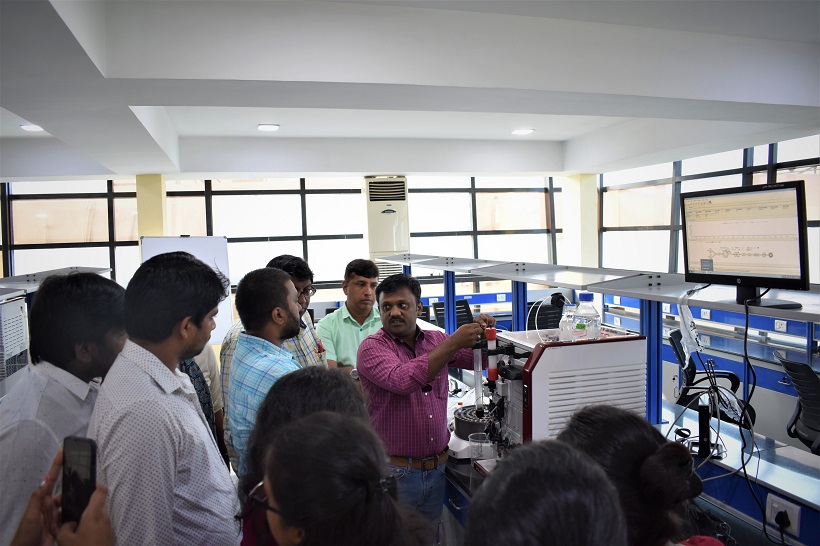
BioNEST, operating since 2017 with BIRAC support, makes the logic explicit: biotechnology founders need somewhere to test ideas and access specialized instruments. The wider facilities include bioprocessing and common instrumentation. A founder can therefore ask a more useful question than “How do I finance a laboratory?”: which experiment should I run next?
A runway measured in experiments
The funding offer follows stages. KIIT-TBI advertises NIDHI-PRAYAS support of up to ₹10 lakh over 12 months to move an idea toward a prototype. Its seed-funding page describes separate routes for proof-of-concept validation, market entry and biotechnology commercialization. These are distinct schemes, with distinct conditions. Treating them as one large pot of available money would miss the point.
An editorial map of the development journey, not a guaranteed sequence of awards.
The companies make the offer tangible. KIIT-TBI’s INVENT portfolio includes EzeRx, a medical-device startup, and Sascan Medtech, which develops cancer-care technologies using biophotonics. Its SAMRIDH cohorts include Avay Bioscience’s advanced 3D bioprinter and Aurassure’s environmental-awareness platform. These ventures have different buyers and technical challenges. What connects them is the need to turn an engineering or scientific proposition into a usable product.
“We want good teams.”
KIIT-TBI’s seed-funding page
The same page asks applicants to identify technical risks and potential economic and market benefits. That is a revealing combination. Technical ambition gets a hearing, but the team still needs an explanation of who benefits if the work succeeds. A machine can answer one question. It cannot answer every question.
The invoice behind the invitation
The business model combines institutional and program backing with consideration for services. KIIT-TBI’s published incubation policy describes discounted monthly rent or facilities charges and possible equity or revenue sharing. It gives an indicative equity range of 2-5%, subject to case-specific decisions and change. Founders should establish the current terms in their own agreement.
Programs can operate differently. The BUILD 2026 information says applications and coursework are free, while participants may bear everyday expenses. Competitive grants are an opportunity rather than an entitlement. The useful budgeting exercise is to separate access costs, living expenses, development spending and any ownership commitment.
KIIT-TBI’s reported portfolio figure. It is not the incubator’s own funding round or revenue.
From a lab result to a purchase order
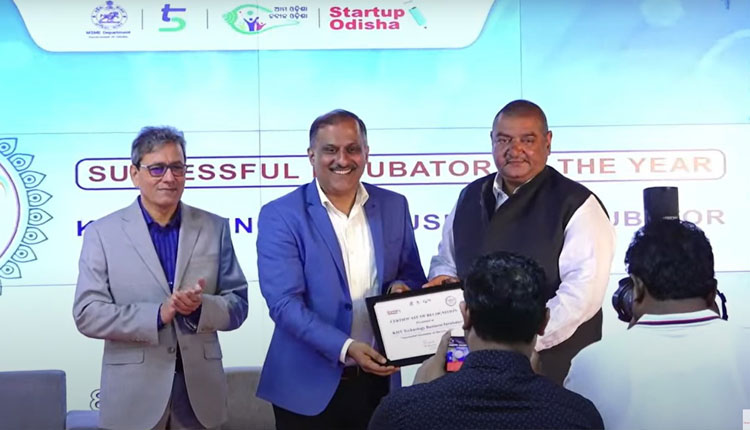
Getting something to work introduces another problem: getting it adopted. KIIT-TBI’s Technology Transfer Office began operations in 2021 under National Biopharma Mission support. Its job is to connect innovators and industry around commercialization. Boeing supplies another connection. In February 2026, it confirmed KIIT-TBI among seven incubator partners for BUILD, bringing structured learning and industry expertise to early-stage teams.
The next step is especially clear in KIIT-TBI’s October 2026 promotion for GENESIS Pilot 2.0. It advertises support up to ₹40 lakh and asks for a working prototype plus a pilot purchase or work order. The stated application deadline is October 30. An expression of interest has become something more demanding: evidence that there is a place to deploy the technology.
The part another city can copy
Regional replication is already part of the story. A 2022 agreement with Manipur’s government proposed a technology innovation hub, with furnished space and part of the operating cost supplied by the state. KIIT-TBI’s work also reaches rural enterprise: its March 2024 newsletter describes pickle and sweet-potato model units in Kandhamal. The range is unusually concrete, from specialist laboratory work to local food production.
Our reading of the model: start with a bottleneck, share the expensive resource, and fund a test with a clear next milestone. It depends on capable technical staff, relevant facilities and founders willing to validate demand. A business with little technical uncertainty may need a different kind of help. Equipment cannot supply customers by itself. In Silchar, the useful outcome was a team gaining the means to make its own parts. That is a sensible ambition for an incubator: help founders acquire capabilities they can carry away.